Luna 16: The First Robotic Return of Moon Samples
On 24 September 1970, Luna 16 delivered lunar material to Earth without a crew. Its journey linked a robotic drilling operation with laboratory science.
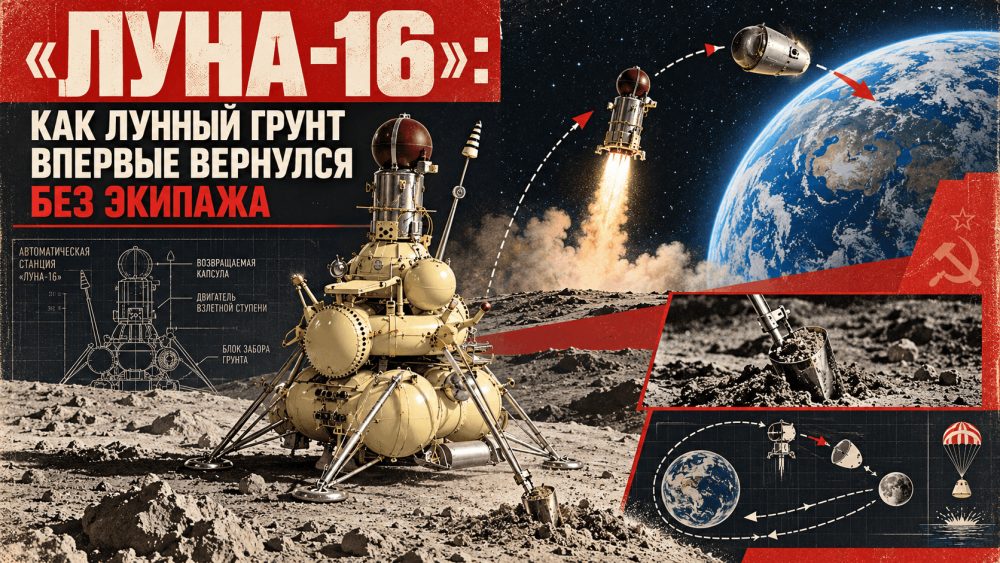
On 24 September 1970, a small capsule landed in Kazakhstan carrying material from the Moon. There was no crew aboard. Luna 16 had completed the first robotic return of samples from the lunar surface. Apollo 11 and Apollo 12 had already brought lunar rocks to Earth, so the Soviet achievement concerned the fully automated method of collecting and returning them.
The mission took twelve days from launch at Baikonur to the arrival of its return capsule. It entered lunar orbit, landed, collected a sample, launched from the surface and delivered its cargo through Earth's atmosphere. Each stage introduced a different problem. Failure at any of them could have left the material beyond the reach of a terrestrial laboratory.
Why return a sample instead of sending instruments?
An instrument on a spacecraft can investigate a distant world without bringing any of it home. Cameras reveal landscapes, while other instruments measure properties of the surface or its environment. But the equipment must be chosen before launch, and its capabilities are constrained by the spacecraft's mass, power supply and design.
A returned sample can be examined with different microscopes, divided into fractions and investigated by several laboratories. Researchers can compare chemical measurements, study individual grains and retain material for techniques that do not yet exist. The ability to ask new questions about an old sample makes sample return a distinct form of exploration.
NASA's Apollo Next Generation Sample Analysis program provides a later example of this principle. It studies Apollo material deliberately preserved for future investigation. That program concerns the American collection, not Luna 16, but it demonstrates why a sample's scientific life need not end with the original mission or its first published results.
From landing to returning
In 1966, Luna 9 demonstrated that a working instrument package could survive touchdown and transmit pictures from the ground. Luna 16 had to add further operations: extract material, put it into a protected container and launch again.
The spacecraft therefore had components with different destinations. The descent stage supported work on the Moon and remained there. An upper section sent the return capsule toward Earth. There was no need to bring home landing legs and equipment that had already completed their purpose.
This distinction helps explain the phrase the spacecraft returned. Often, only a small component designed specifically for reentry comes back. The larger system exists to deliver that component to the research site, support the collection operation and launch the sample on its homeward journey.
Twelve days in September 1970
Luna 16 launched on a Proton rocket on 12 September. It entered lunar orbit on 17 September and subsequently prepared for descent. On 20 September, the spacecraft landed in Mare Fecunditatis, the Sea of Fertility, on the Moon's near side.
The lunar sea is a dark plain rather than a body of water. The landing site lay on basaltic terrain. NASA's description of the site notes that the Sun had already set when Luna 16 arrived, so sample collection took place in darkness.
- 12 September: launch from Baikonur.
- 17 September: arrival in lunar orbit.
- 20 September: landing and the start of sampling operations.
- 21 September: departure of the return vehicle from the Moon.
- 24 September: the capsule lands in Kazakhstan.
This sequence required more than transmitting a measurement. A radio message can be received on Earth while the instrument remains on the Moon. A physical sample must survive the return journey and atmospheric entry before it can be placed under a laboratory microscope.
Collecting the lunar material
After landing, a drill extracted material from the upper regolith and transferred it to the return capsule. The Lunar Sample Compendium describes the recovered core as approximately 35 centimetres long and lists its mass as 101 grams.
Historical summaries do not all give precisely the same mass. The figure used here comes from the specialist sample catalogue and agrees with NASA Photojournal's mission description. For a general account, the payload was roughly one hundred grams of lunar material. For a particular laboratory investigation, the identification, mass and position of the subsample become more important than the rounded mission total.
A core can preserve information about material at different depths, not simply provide a bag of loose particles. However, drilling, packing and later subdivision are also part of its history. Documentation of those processes is essential when researchers try to relate a laboratory observation to conditions at the original site.
Small samples are not necessarily scientifically trivial. Instruments can investigate individual grains and fragments. The practical limitation lies partly in how well the collected material represents its surroundings. A stationary sampling device cannot walk or drive to several distinct geological features and choose a different specimen at each one.
What scientists found
Charles Meyer's sample compendium describes abundant basalt fragments in the Luna 16 material. It gives ages of about 3.4 billion years for the studied basalts. That is a statement about particular rocks, not a date for the formation of the entire Moon or for every particle in the soil.
Comparison with Apollo samples helped scientists investigate differences between lunar regions. Mare Fecunditatis became another location represented by actual material in terrestrial collections. Bringing more geological settings into those collections helps prevent observations from one place being treated as a complete description of the Moon.
The value of a sample also depends on where it came from. A chemical analysis becomes more informative when researchers can connect it with the mapped terrain, the collection method and its position in a core. Photographs, mission records and the physical specimen support one another; none supplies every part of the interpretation alone.
A robotic mission after the first human landing
Luna 16 flew after people had already walked on the Moon. For the Soviet space program, it provided an independent scientific and engineering result after the contest to make the first crewed landing had been decided.
Robotic sample return did not reproduce every capability of a human expedition. A person can select material in response to what is visible, revise a plan and collect specimens across different locations. An automated mission, however, does not need the systems required to sustain and return a crew.
The comparison is therefore about different mission designs as much as national competition. As with Yuri Gagarin's flight, the achievement needs to be described in terms of the task completed. The first human in orbit, the first working lunar lander and the first robotic sample return are separate milestones.
What remained on the Moon?
The descent stage stayed in Mare Fecunditatis. Much later, the Lunar Reconnaissance Orbiter camera photographed the landing site. Such observations connect the records of an earlier mission with a modern map of the lunar surface.
In the same year, Venera 7 accomplished another kind of robotic investigation by transmitting information from the surface of Venus. It did not return a sample. Together, the two missions show the range of tasks covered by automated exploration: bringing material to a laboratory in one case, and making a brief measurement in an extreme environment in another.
Frequently asked questions
Was Luna 16 the first mission to bring Moon samples to Earth? It was the first robotic mission to do so. The crews of Apollo 11 and Apollo 12 had returned samples earlier.
How much material came back? The Lunar Sample Compendium lists 101 grams for the Luna 16 drill core.
Where did the capsule land? It returned to Kazakhstan on 24 September 1970.
Did the whole spacecraft come home? No. The descent stage remained on the Moon. The sample travelled back in a dedicated capsule.
Sources
- NASA Photojournal: Luna 16 landing site and mission dates.
- C. Meyer: Lunar Sample Compendium, Luna 16 Drill Core.
- NASA: Deep Space Chronicle, pp. 82-83.
- NASA: Apollo Next Generation Sample Analysis.
Cover: original USSRborn editorial infographic illustrating mission stages. It is not an archival photograph or an exact flight trajectory.