Vega 1 and Vega 2: Venus Balloons and Halley’s Comet
Vega 1 and Vega 2 delivered balloons to Venus before flying past Halley. Their journey linked atmospheric measurements with an international comet campaign.
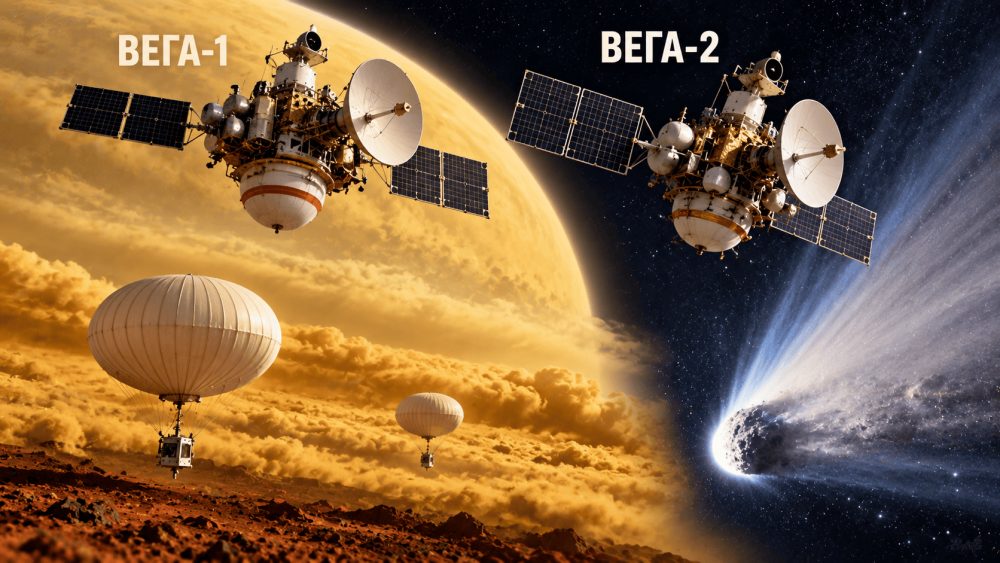
In June 1985, two small balloons drifted through the atmosphere of Venus and transmitted measurements to Earth. The Soviet spacecraft that delivered them, Vega 1 and Vega 2, continued traveling. In March 1986 they flew past Halley's Comet. One program combined surface landers, airborne laboratories and a comet investigation.
The separate components matter. The balloons stayed at Venus. The main flyby spacecraft continued toward the comet. Landing on the planet and encountering Halley were parts of the same expedition, but they were not performed by the same individual device.
Two spacecraft, two destinations
Vega 1 launched on 15 December 1984 and Vega 2 on 21 December. Both reached Venus the following June. Each carried a landing system and a balloon for atmospheric observations. After delivering those components, the main spacecraft continued their interplanetary journeys.
The mission extended the experience of the Soviet space program by combining different observing methods. Researchers could examine atmospheric descent, measurements near the ground and the movement of instruments within the cloud layer. The expedition would then address a very different object in another part of the Solar System.
The word “spacecraft” can hide this complexity in a short summary. Saying that Vega reached a comet does not mean that its Venus landing capsule did so. Quoting the duration of the balloon experiment does not give the lifetime of the complete mission. Separating the hardware makes the chronology much easier to understand.
Why use balloons at another planet?
A descent probe moves downward through an atmosphere. An orbiter looks at it from outside. A balloon provides a third method: travel with the surrounding air and measure conditions along the route. Its motion becomes part of the experiment.
Vega delivered the first balloons into another planet's atmosphere. They drifted at roughly 53 to 54 kilometers altitude and operated for about 46 hours each. Scientific papers by the experiment's participants, available in a NASA translation, place the first balloon's observations on 11 to 13 June and the second's on 15 to 17 June 1985.
The instruments measured quantities including temperature, pressure and aspects of air motion. Radio observations also helped reconstruct the movement of the platforms themselves. Their changing position was therefore not simply an inconvenience to eliminate. It supplied information about the atmosphere carrying them.
This is a different kind of exploration from taking a picture of a cloud top. A moving instrument can connect a sequence of local measurements with a path through the air. The resulting observations depend on both what the sensors record and how accurately the platform's motion can be determined.
Cloud altitude is not the surface
Conditions tens of kilometers above Venus differ substantially from those near the ground. A balloon operating for almost two days cannot be directly compared with a surface station's survival time. The machines occupied different environments and were designed for different tasks.
Venera 7 marked an earlier step in receiving measurements from the ground itself. Vega added an extended opportunity to observe within the atmosphere. One experiment did not replace the other. Together, different methods allowed investigators to examine the planet at different levels.
For that reason, the statement “a spacecraft worked at Venus” benefits from an explanation of where it worked. Orbit, clouds and surface are distinct observing locations. Without that distinction, a comparison in hours or minutes can become a misleading contest between machines facing very different conditions.
The same caution applies to comparisons with Earth. A familiar pressure or temperature at one altitude would not, by itself, make the surrounding environment equivalent to a place on our own planet. A measurement describes a particular property, not every condition relevant to a spacecraft or a living organism.
Receiving the balloons on Earth
The balloon stations transmitted their telemetry directly to Earth. An international network of radio telescopes received signals and supported measurements of their motion. France's CNES coordinated the international part of the network, alongside Soviet facilities and deep-space antennas in the United States, Spain and Australia.
This was cooperation through observing infrastructure and scientific teams. It differed from the crewed docking carried out during Apollo-Soyuz, while illustrating another essential form of collaboration: combining ground facilities to recover information across interplanetary distances.
The receiving system was not an optional addition to a complete experiment. Earth's rotation, the distribution of antennas and receiver sensitivity all affect what can be measured. A probe's instrument may be far away, but its ability to deliver useful evidence still depends on an extensive system at home.
This also helps explain why the mission is not adequately described by launch vehicles and flight hardware alone. The ground network and the people who interpreted its observations were part of the scientific operation.
Passing Halley's Comet
ESA's history of comet missions gives Vega 1's closest approach as 6 March 1986, at approximately 8,890 kilometers from the nucleus. Vega 2 passed closer on 9 March, at approximately 8,030 kilometers. These were flybys. The spacecraft neither landed on Halley nor remained in orbit around it.
A flyby brings instruments near a target for a limited interval. Observations, pointing and communications must be prepared for that encounter. Two spacecraft offer the possibility of comparing measurements taken at different times and along different paths, rather than relying on one brief passage.
The Vegas were not the first spacecraft to encounter any comet. ICE had passed through the tail of Comet Giacobini-Zinner in September 1985. Vega's importance lies in its observations of Halley and its role in the international campaign, without the need to assign it every possible cometary first.
The distinction between a comet's nucleus and its much more extensive surroundings matters, too. Passing through cometary material is not the same as touching the solid body. A mission description should state what region was investigated rather than allowing the word “visit” to imply a landing.
How Vega helped Giotto
The European Giotto spacecraft and Japanese probes also approached Halley. ESA describes the Vegas as pathfinders: their information about the nucleus helped Giotto refine its targeting for a closer encounter. An earlier flyby could therefore contribute to the preparation of a later one.
Within the wider setting of the Cold War, this is a useful reminder that space science was not exclusively a set of isolated national competitions. Missions could pursue their own objectives while improving the effectiveness of a shared observing campaign.
That does not make Vega and Giotto one spacecraft, or transfer the work of one project to another. Each contribution is clearer when their differences remain visible: Soviet flybys, a closer European encounter, Japanese observations and a common scientific target.
The mission's enduring interest comes partly from this combination of methods. A balloon drifting in a planetary atmosphere and a spacecraft passing a comet appear very different. Vega connected them through a carefully arranged sequence of deliveries, observations and continued flight.
Frequently asked questions
Did the balloons travel onward to Halley? No. They operated in Venus's atmosphere. The main flyby spacecraft continued to the comet.
How long did the balloons operate? About 46 hours each, at roughly 53 to 54 kilometers altitude.
Did Vega land on the comet? No. Vega 1 and Vega 2 flew past its nucleus in March 1986.
What did international cooperation involve? A multinational receiving network supported the balloons, and the comet encounter data helped prepare Giotto's approach to Halley.