Laika: the first living creature to orbit the Earth
A stray mongrel from the streets of Moscow who became the most famous animal of the 20th century. For half a century the world believed she lived a week in orbit. The truth was shorter and sadder — and it was told only in 2002.
Who Laika was
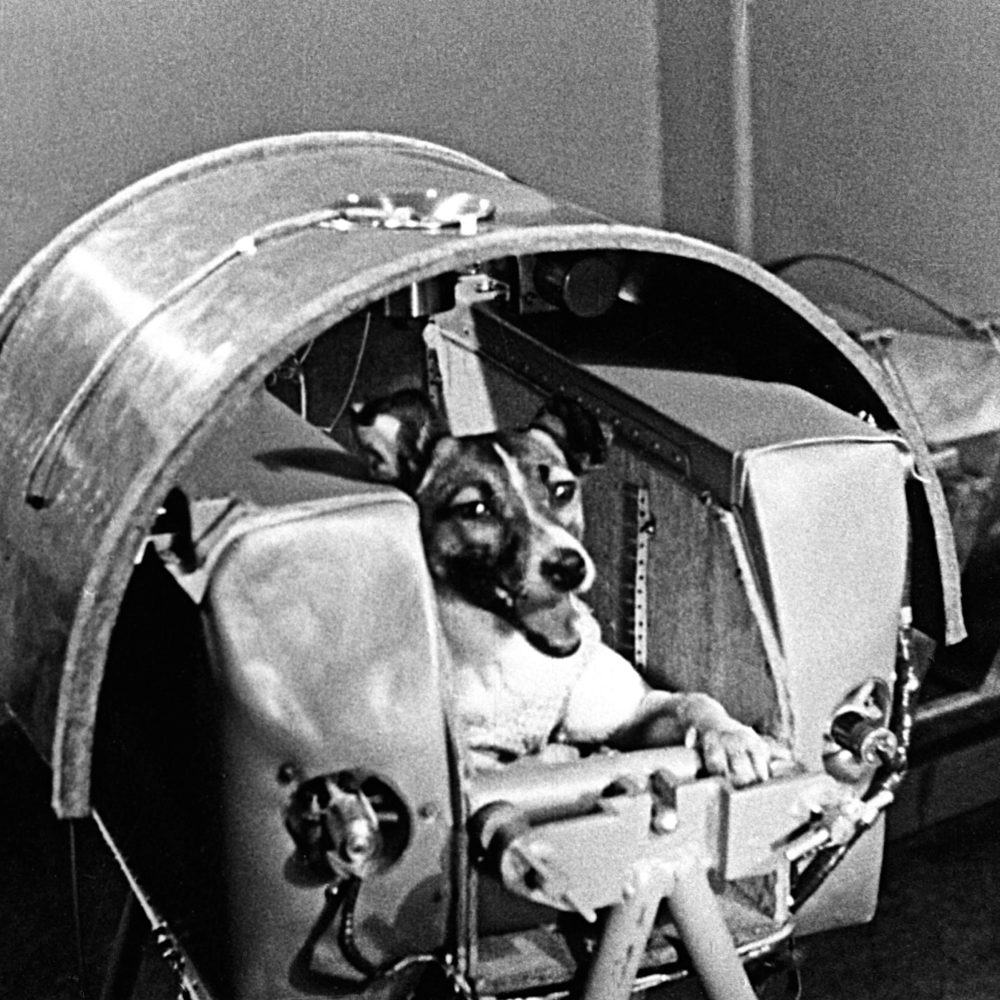
Laika — a small mongrel of about six kilograms, picked up on the streets of Moscow — became, on November 3, 1957, the first living creature to complete an orbit of the Earth. She flew aboard Sputnik 2, the second artificial satellite in history, launched just a month after the first Sputnik.
Humanity did not yet know how to bring spacecraft back from orbit: Sputnik 2 had no heat shield and no descent system. Laika's fate was therefore sealed before liftoff — and everyone who prepared the flight knew it. Her mission answered a single question: can a living organism survive launch and weightlessness? The answer, bought with her life, opened the road to Gagarin.
Why a stray
Dogs for the space program were recruited precisely from the streets — the logic was harsh and practical: an animal that had survived a Moscow winter would endure hardship better than a pampered pet. The requirements: weight up to six or seven kilograms, height up to 35 centimeters (the cabin was tiny), light-colored fur (easier to see on film), age two to three years. And females only — the sanitation device was simpler to design for them.
The selection was passed by a calm, affectionate two-year-old mongrel who was given the name Laika — "Barker." Training was brutal by today's standards: the dogs were accustomed to confinement in progressively smaller cages for weeks at a time, spun in centrifuges simulating launch g-forces, and subjected to the deafening sounds of liftoff. The staff who worked with Laika grew attached to her; shortly before the flight one of the scientists took her home to play with his children. He later explained that he wanted to do something nice for the dog — she had so little time left.
Haste for an anniversary
Why did Laika never have a chance? The answer is in the calendar. After the triumph of the first Sputnik in October 1957, Khrushchev demanded a new space spectacular by November 7 — the 40th anniversary of the October Revolution. A proper scientific satellite would not be ready until December, so Korolev's design bureau assembled a simplified craft with a pressurized dog cabin in four weeks. There was physically no time to build a reliable thermal control system — let alone a means of return. The launch date was political, and the price of that date is known.
On October 31, days before launch, Laika was placed in the capsule. The technician who sealed the hatch recalled that they kissed her nose and wished her a good journey — knowing she would not survive the flight.
The flight, and the truth about it
Sputnik 2 lifted off from Baikonur in the early hours of November 3, 1957. The sensors showed Laika's pulse tripling during ascent, then gradually settling in weightlessness — the dog moved and ate. That alone was a scientific result: a living creature had survived being placed in orbit.
For decades afterward, two stories existed. The official one: Laika lived in orbit for about a week and quietly fell asleep. The world followed "the shaggiest passenger of the planet," newspapers reported on her condition, and the only debate was whether her oxygen ran out on the sixth day or she was painlessly euthanized before that.
The truth emerged only in October 2002 — 45 years later. Dimitri Malashenkov, who had worked on the mission, reported at the World Space Congress in Houston that Laika died five to seven hours after launch, on the fourth orbit, of overheating and stress. The rocket's core stage had failed to separate cleanly, the thermal insulation was damaged, and the cabin temperature climbed past forty degrees Celsius — the hastily built thermal control system could not cope, which the participants linked directly to the impossibility of creating a reliable system under such deadlines. The dead satellite, with Laika's body aboard, circled the Earth for another five months — 2,570 orbits — and burned up in the atmosphere on April 14, 1958.
We tell both versions — the official one and the real one — because the distance between them is itself a historical fact: this is how a system worked in which a launch date and a ceremonial report weighed more than the truth.
What the flight achieved
The cynical arithmetic of the space race is this: Laika's flight proved that a mammal could survive launch and weightlessness — and without that knowledge, no human flight could be prepared. Her telemetry data fed directly into the life-support systems of the Vostok spacecraft.
The next step belonged to Belka and Strelka: in August 1960 they became the first living creatures to return from orbit alive — aboard a prototype of Gagarin's ship. Strelka's puppy Pushinka was later given by Khrushchev to the family of US President Kennedy — a rare warm gesture in the middle of the Cold War. And on April 12, 1961, Gagarin flew — and in his orbit there is the invisible trace of a small stray dog.
Memory and conscience
Laika's story long ago ceased to be a story of success alone — it became a conversation about price. As early as 1957, animal-welfare protests sounded in the West; in the USSR this side of the question was not discussed at all for decades. The confession of one of the program's leaders, physiologist Oleg Gazenko, is telling: decades later he said that the more time passed, the more he regretted that flight — the data obtained, in his words, did not justify the death of the dog.
In 2008 a monument to Laika was unveiled in Moscow, at the military medicine institute that prepared her flight: a small dog standing on a rocket that curves into an open human palm. She also appears on the Monument to the Conquerors of Space. Streets bear her name; her story lives in books, films and songs around the world. Laika became perhaps the most famous animal of the 20th century — and a permanent reminder that every great leap has a price, and an honest history is obliged to name it.
Frequently asked questions
Who was Laika? A Moscow stray, the first living creature to orbit the Earth. She launched on November 3, 1957, aboard the Soviet spacecraft Sputnik 2.
Did Laika return to Earth? No. The technology for returning from orbit did not yet exist, and her death was inevitable from the start — everyone in the program knew it.
How and when did Laika die? Five to seven hours after launch, on the fourth orbit, of overheating and stress: the hastily built thermal control system failed. The truth was revealed only in 2002 — until then the official account was that she lived about a week.
Why was a stray chosen for the flight? Street dogs were considered hardier than pets. The mission required small size, a calm temperament and light fur — Laika fit on every count.
Which dogs returned from space alive? Belka and Strelka, in August 1960, aboard a prototype of the Vostok spacecraft. Their successful flight opened the way for Gagarin.
Is there a monument to Laika? Yes — since 2008, in Moscow, at the institute that prepared her flight: a dog standing on a rocket shaped like an open palm. Laika also appears on the Monument to the Conquerors of Space.
Related
- Sputnik 1: the dawn of the space age — the triumph whose sequel was rushed.
- Sergei Korolev — the designer who built Sputnik 2 in four weeks.
- Yuri Gagarin — the man whose flight Laika made possible.
- Nikita Khrushchev — the politician who set space a deadline for an anniversary.
Sources
The facts in this article can be verified against authoritative sources:
- Encyclopaedia Britannica, "Laika": https://www.britannica.com/animal/Laika
- Wikipedia, "Laika": https://en.wikipedia.org/wiki/Laika
- Wikipedia, "Sputnik 2": https://en.wikipedia.org/wiki/Sputnik_2
- Smithsonian Magazine, "Laika Declassified": https://www.smithsonianmag.com/air-space-magazine/laika-declassified-180967077/
Where the versions diverge (the official Soviet account and the 2002 data), we give both and explain where each came from.