Dubna’s Synchrophasotron in 1957: Startup and the 10 GeV Milestone
Why Dubna’s Synchrophasotron started in March but reached 10 GeV in April 1957: Veksler, the magnet, particle acceleration and the machine’s purpose.
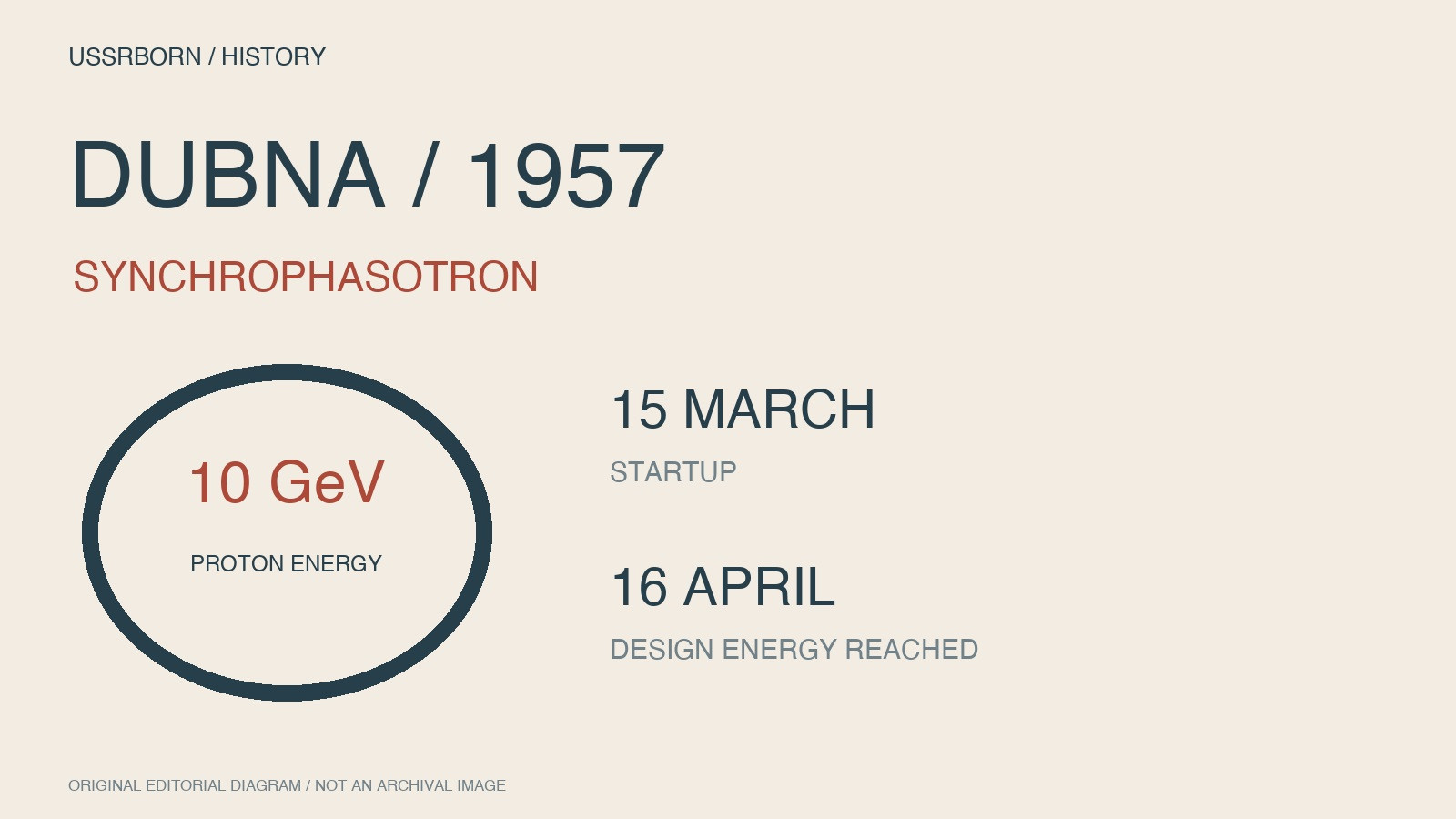
In 1957, Dubna’s Synchrophasotron began operating as a proton accelerator designed for an energy of 10 gigaelectronvolts. That was a world record for its time. The machine prepared particle beams for physics experiments, and its enormous ring became one of the most recognisable images of Soviet science.
March startup and April design energy
The Joint Institute for Nuclear Research dates the startup to 15 March 1957. That does not mean the machine immediately achieved every design parameter. Its energy was increased progressively. L. L. Zinovyeva’s historical account identifies the next milestone: 10 GeV was reached on 16 April.
Pravda reported the achievement on 11 April, between those events. JINR explains that the announcement followed the accelerator’s surpassing the energy of the American Bevatron at Berkeley; the newspaper reported 8.3 billion electronvolts. The March startup, April announcement and eventual attainment of 10 GeV therefore describe different stages.
That sequence is instructive. A complex experimental system’s first successful operation, improved performance and routine service need not begin on the same day. Naming the achievement precisely is more useful than choosing one anniversary and assigning every milestone to it.
What does 10 GeV mean?
GeV is a unit of energy. One gigaelectronvolt equals one billion electronvolts, so 10 GeV means ten billion electronvolts. It describes a particle’s energy in the beam, not the electrical power consumed by the building or the electricity supplied to customers.
The distinction between energy and power can be expressed without specialist mathematics. Energy is an amount; power is an amount transferred per unit of time. One cannot replace the other without specifying an additional timescale. An impressive electronvolt figure alone therefore says nothing about the electricity consumption of an entire research facility.
The Synchrophasotron also had a different purpose from the Obninsk nuclear power station. A power station and a research accelerator are different kinds of installation. The word “nuclear” in the surrounding scientific field does not make them interchangeable.
Accelerating particles and guiding the beam
CERN’s explanation separates two tasks: electric fields increase the energy of charged particles, while magnetic fields steer and focus the beam. In a circular machine, particles repeatedly pass accelerating regions. A vacuum reduces unwanted collisions with gas molecules.
This is a general account of accelerator principles, not a claim that Dubna’s 1957 installation had the same engineering as modern CERN equipment. Separating the systems’ functions is the useful first step. The giant magnet dominates photographs, but its size alone does not explain how energy reaches the particles.
A radiofrequency field changes direction, so particles must arrive at the accelerating region at an appropriate time. CERN’s account of RF cavities explains the importance of coordinating motion with the field’s oscillation. A simple analogy is pushing a swing: the same effort applied at different moments can help or oppose the motion. This illustrates the importance of timing without attempting to model the whole accelerator.
Veksler and the wider project
Vladimir Veksler was the project’s scientific leader. JINR connects the machine’s development with the phase-stability principle he formulated in 1944. Zinovyeva’s history also traces work at the Lebedev Physical Institute and the contribution of specialists transferred from the laboratory at Obninsk.
The history cannot therefore be reduced to one successful calculation. Turning a principle into a working machine required equipment production, power-supply adjustment, vacuum and acceleration systems, measurements and repeated troubleshooting. Scientific authorship and engineering implementation were connected, but were not the same activity.
The JINR museum gives the magnet’s dimensions as almost 60 metres in diameter and about 36,000 tonnes in mass. These figures help convey the scale of the construction. They refer to the magnet, not the exact diameter of the particle orbit or the mass of an individual beam.
A beam is a research tool, not yet a discovery
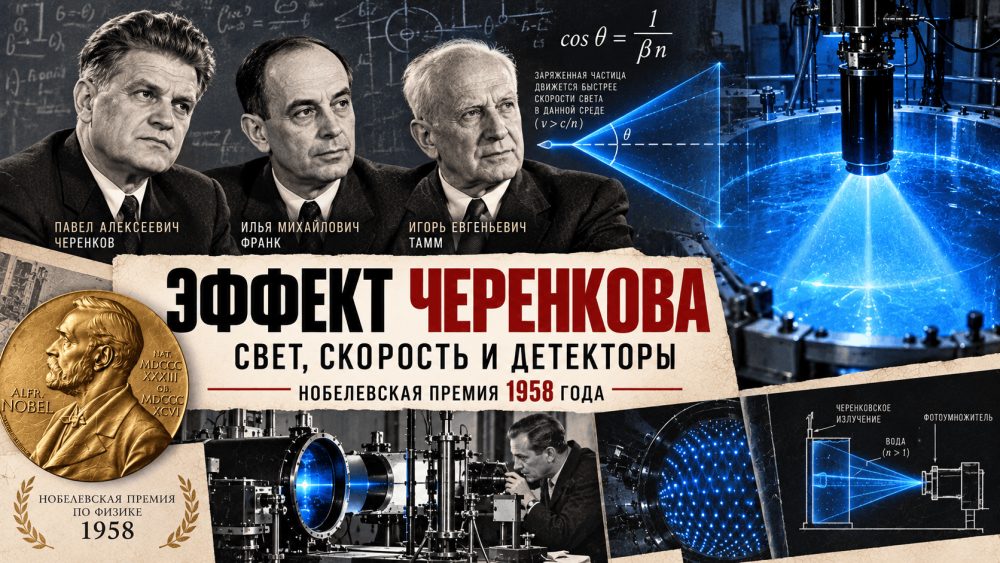
Producing a beam prepares the means for an experiment. Establishing what happened in a particle interaction requires measuring equipment and analysis. Our article on the Cherenkov effect introduces one physical principle used in particle detection; this is a conceptual connection, not a claim about the Synchrophasotron’s exact equipment on startup day.
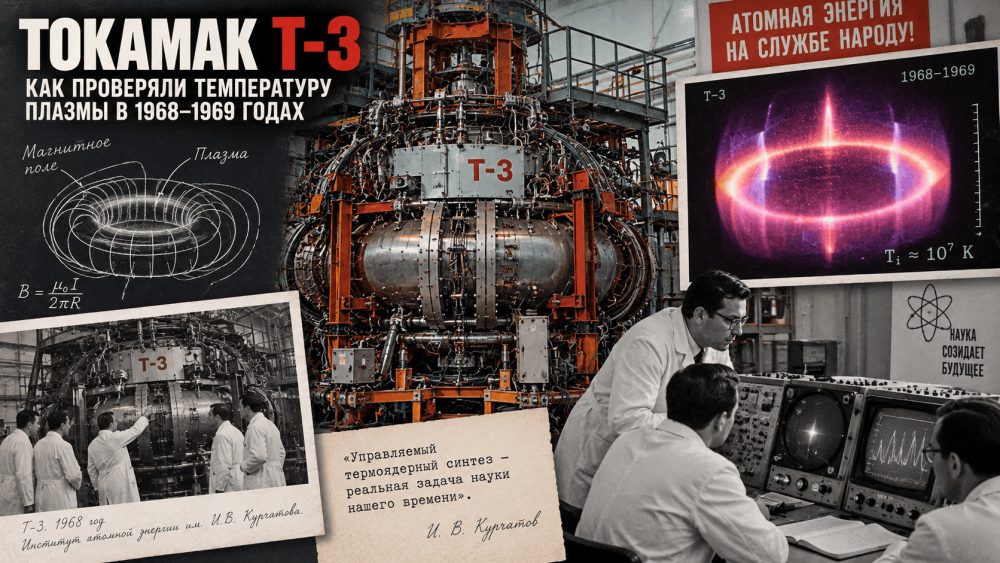
Accelerating a beam should also be distinguished from the confinement of hot plasma discussed in the history of Tokamak T-3. A ring shape does not establish that two installations have the same internal design or scientific purpose.
The Synchrophasotron later worked with nuclei as well. JINR records relativistic deuteron beams in 1970. The machine ceased operating in 2002. Its history thus extended far beyond its original energy record: a scientific instrument can remain useful after more powerful machines have appeared.
Alongside theoretical work such as that associated with Lev Landau, accelerator history reveals a different side of physics. Some work develops explanations; other work creates the experimental conditions in which explanations can be tested. Dubna’s Synchrophasotron belongs above all to that second history.