Basov, Prokhorov and the Laser: What the 1964 Nobel Prize Recognized
The Soviet contribution to quantum electronics: research at Lebedev, masers versus lasers, pumping and why Maiman built the first working laser.
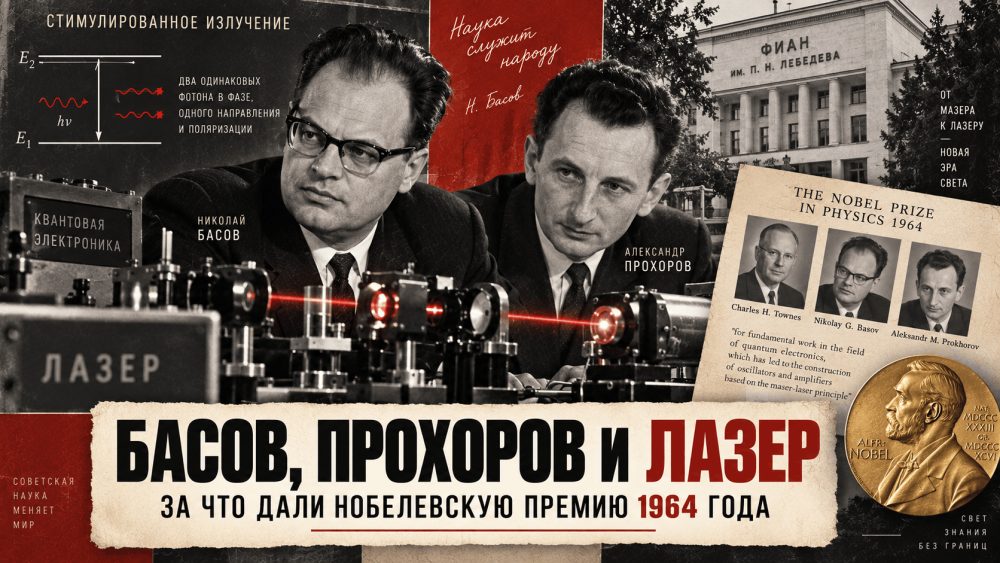
Nikolay Basov and Aleksandr Prokhorov shared the 1964 Nobel Prize in Physics with the American physicist Charles Townes. Their award recognized foundations of quantum electronics that made masers and lasers possible. Townes received half the prize; Basov and Prokhorov received one quarter each. The distinction concerned a new approach to generating and amplifying electromagnetic radiation, rather than a single finished machine.
Why the story begins with a maser
A maser operates with microwave radiation. A laser applies the same central principle in the optical range. The historical starting point is therefore radio physics, rather than the familiar image of a narrow red beam. Frequencies, materials and engineering arrangements differ, but stimulated emission connects the two devices.
An excited atom can release energy spontaneously. In stimulated emission, an appropriate incoming photon triggers a transition that produces another photon matched to the incoming radiation. This makes amplification possible. Turning that possibility into an instrument requires control of the material and its interaction with radiation.
An orchestra offers a limited analogy. Many unrelated sounds can be loud without forming a coordinated performance. What matters in a laser is likewise more than the amount of radiation produced. Atoms, of course, neither listen nor follow a conductor; the comparison only illustrates why coordination matters. It helps distinguish coherence from the everyday idea of brightness.
Basov and Prokhorov at the Lebedev Institute
Both Soviet laureates worked at the P. N. Lebedev Physical Institute in Moscow, commonly known by its Russian abbreviation FIAN. Basov's scientific biography dates his work in quantum radiophysics from 1952. His 1956 doctoral thesis addressed a molecular oscillator using an ammonia beam, connecting quantum transitions with the practical problem of producing a stable signal.
Prokhorov approached the subject through oscillations and microwave spectroscopy. His biography describes their joint development of a molecular oscillator and a pumping method proposed in 1955. His later work on open resonators was relevant to extending the approach to optical frequencies.
The research does not fit a simple division between theoretical discovery and instrument building. Measuring matter suggested a way to construct a new source; that source could then improve measurement. The Soviet contribution included both theory and experiment. Describing it merely as the copying of a foreign device would miss what was being investigated.
Pumping, amplification and oscillation
Amplification requires a suitable distribution of particles among energy states. Supplying energy to prepare the working medium is called pumping. The term does not necessarily mean pushing gas through a pipe: the method depends on the device. The essential question is whether energy stored in the medium can be transferred to the electromagnetic wave.
An amplifier strengthens an incoming signal. An oscillator must sustain oscillations, making feedback important. In the familiar laser diagram, mirrors return light through the active material. That is an explanation of a common operating arrangement, rather than a drawing applicable to every laser.
These distinctions also explain why the word laser does not automatically mean an extremely powerful, continuous beam. Pulse duration, power and spectral properties depend on the design. Coherence does not by itself specify how much energy the light carries. A useful instrument must have properties appropriate to its particular purpose, not simply a dramatic appearance.
The first working laser was Maiman's
Theodore Maiman built the first functioning laser in 1960. The American Physical Society dates the successful experiment to 16 May. A flash lamp excited a ruby working medium, and the device emitted pulses rather than an uninterrupted stream of light. Basov and Prokhorov therefore did not win their Nobel Prize for personally constructing that first laser.
The distinction is straightforward. Building the first working example of a device and establishing the foundations of a scientific field are related achievements, but they are not identical. A prize for the second need not go to the person responsible for the first. Chronology alone cannot resolve that difference: the award came four years after Maiman's experiment, but its subject was broader.
Understanding the Soviet contribution
The important sequence is a physical principle, the development of ways to make it useful, working instruments and wider scientific recognition. These stages overlap rather than forming a relay race in which one person simply hands a completed invention to the next.
Basov and Prokhorov belonged to the Moscow school of quantum electronics; Townes developed the field in the United States. Their shared award records that international character. Remembering the 1964 prize alongside Maiman's 1960 ruby laser preserves both the Soviet contribution and the history of the first working optical device.
Related reading
- Lev Landau and quantum liquids
- Pyotr Kapitsa and superfluidity
- Nikolay Semenov and chain reactions
- Testing the T-3 tokamak results