Pyotr Kapitsa: Liquid Helium, Superfluidity and the Nobel Prize
What earned Pyotr Kapitsa the 1978 Nobel Prize: liquid-helium techniques, superfluidity, Cambridge and Moscow, and how his experiments differed from Landau’s theory.
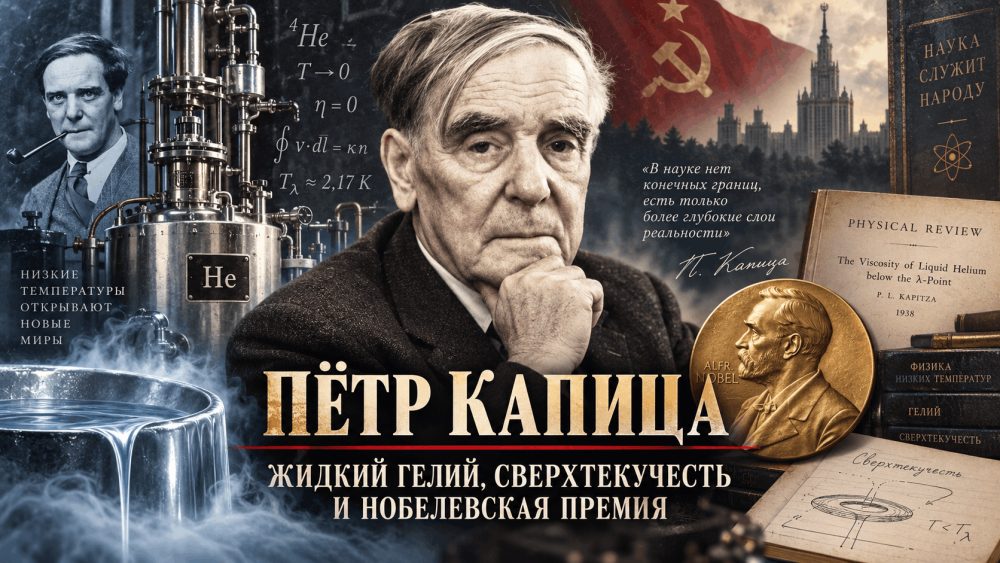
Pyotr Kapitsa received the 1978 Nobel Prize in Physics for inventions and discoveries in low-temperature physics. His career illustrates how closely an experimental result can depend on the apparatus that makes it possible. Before the unusual behaviour of liquid helium could be investigated, researchers needed a dependable way to obtain it and maintain the conditions required for an experiment.
The instrument was therefore part of the scientific achievement, rather than an incidental object standing behind it.
What the 1978 prize recognized
Kapitsa received one half of the physics prize. Arno Penzias and Robert Wilson shared the other half for discovering cosmic microwave background radiation. These were separate research achievements, not a single collaboration involving all three laureates.
The award to Kapitsa recognized both invention and discovery. That combination matters. Retellings of science sometimes treat equipment as preparation and the discovery as the only result worth remembering. In this case, improved access to very low temperatures expanded the range of experiments that could be attempted.
The prize also followed the crucial work by several decades. The year 1978 should not be presented as the date when superfluidity was discovered. The Nobel biographical facts page dates Kapitsa's discovery to 1937, while the committee's explanatory account discusses what had been demonstrated by 1938.
An award date identifies an act of recognition. It is not necessarily the date of the observation, publication or invention being recognized.
Cambridge, Moscow and an interrupted choice
Kapitsa was born in Kronstadt on 9 July 1894. An important part of his scientific career unfolded in Cambridge, where he worked in Ernest Rutherford's laboratory. His research included strong magnetic fields before he turned towards low-temperature physics.
The transition to work in the Soviet Union was not an ordinary voluntary move between institutions. After a visit in 1934, he was prevented from returning to Britain. Trinity College's memorial account explicitly describes his enforced stay and Rutherford's assistance in arranging equipment from Cambridge for the Institute for Physical Problems in Moscow.
This connects the history of the laboratory with political constraints and personal scientific relationships. Moving across a national boundary did not erase the importance of equipment, correspondence and professional support. At the same time, Kapitsa's freedom to choose where to work had been severely limited.
The distinction prevents an institutional chronology from concealing the circumstances of an individual's career.
Why liquid helium mattered
At very low temperatures, substances can display properties unlike those familiar under everyday conditions. Liquid helium is interesting both as a material to study and as a means of cooling other experiments. Equipment that supplies useful quantities of it can support an entire programme of research.
In 1934, Kapitsa developed a new apparatus for producing liquid helium. The Nobel committee emphasized that it operated without preliminary cooling by liquid hydrogen. This was not the first liquefaction of helium in history: Heike Kamerlingh Onnes's work had preceded Kapitsa's.
Producing a substance for the first time and developing a more useful method of producing it are distinct achievements. The latter can make research more repeatable and enable a larger range of measurements. Investigators can vary a condition, repeat an observation and ask whether a surprising result survives a different test.
A supply technique consequently influences which scientific questions can be investigated in practice. The method of obtaining the material belongs to the history of the discovery itself.
What superfluidity means
In experiments with very cold liquid helium, Kapitsa observed behaviour that did not fit the ordinary picture of viscous flow. The Institute for Physical Problems museum describes experiments in which helium passed through narrow slits with extraordinarily little resistance to that flow.
Superfluidity names a particular quantum state. It is not a general promise that any sufficiently cold liquid will behave in the same way. Nor is “a liquid that flows without any limits” an adequate replacement for the experimental description. Temperature, the kind of motion being measured and the arrangement of the apparatus remain important.
Superfluidity should also be distinguished from superconductivity. One concerns fluid flow; the other concerns electrical current. Both are important in low-temperature physics, but they are not interchangeable names for the same phenomenon.
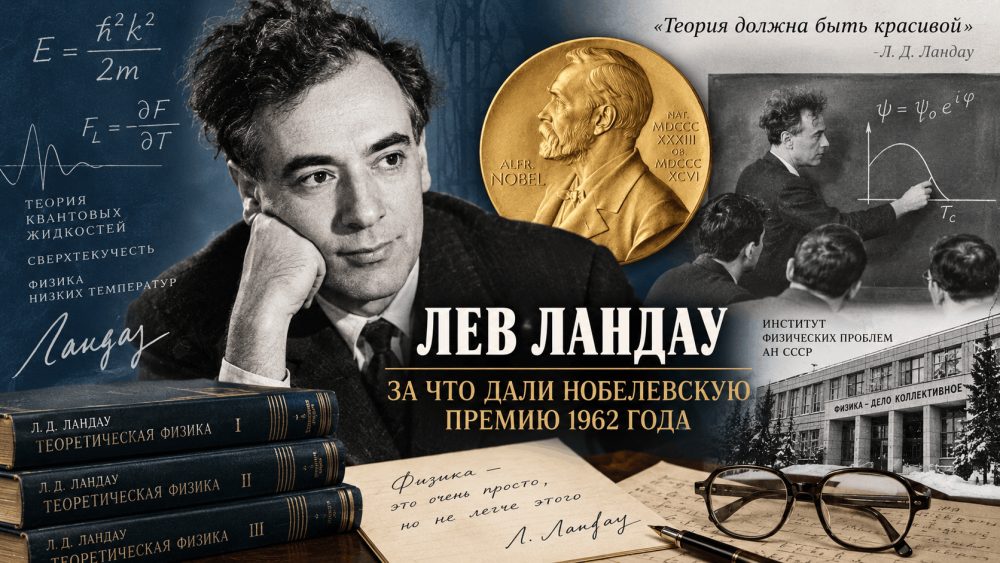
The theoretical explanation of quantum liquids is associated with Lev Landau, who received the Nobel Prize in 1962. Kapitsa and Landau addressed related physical questions, but their contributions and awards should not be collapsed into one date or one citation.
The relationship is more informative when kept precise: experiments reveal behaviour that demands explanation, while a theory must account for the observations and offer consequences that can be tested.
The people who made the experiment possible
The museum's account of the early Institute for Physical Problems names laboratory assistants, technicians, mechanics, glassblowers and other skilled workers alongside researchers. This is a reminder of the physical work behind an experimental programme. Apparatus must be designed, fabricated, assembled and maintained.
A measurement depends on vessels, connections and instruments, as well as on the question posed by the scientist. The quality of those objects and the skills of the people making them affect what can be observed reliably.
A comparison with Nikolai Vavilov's seed collection brings out a broader point. Vavilov's research programme relied on organizing biological material; Kapitsa's relied on experimental installations. The disciplines differ, but both show why creating the means of investigation is an intellectual task in its own right.
A Nobel lecture about plasma
On 8 December 1978, Kapitsa delivered a Nobel lecture on plasma and controlled thermonuclear reactions. Its topic differed from the field named in the award decision. The lecture title therefore cannot be used as a substitute for the official reason he received the prize.
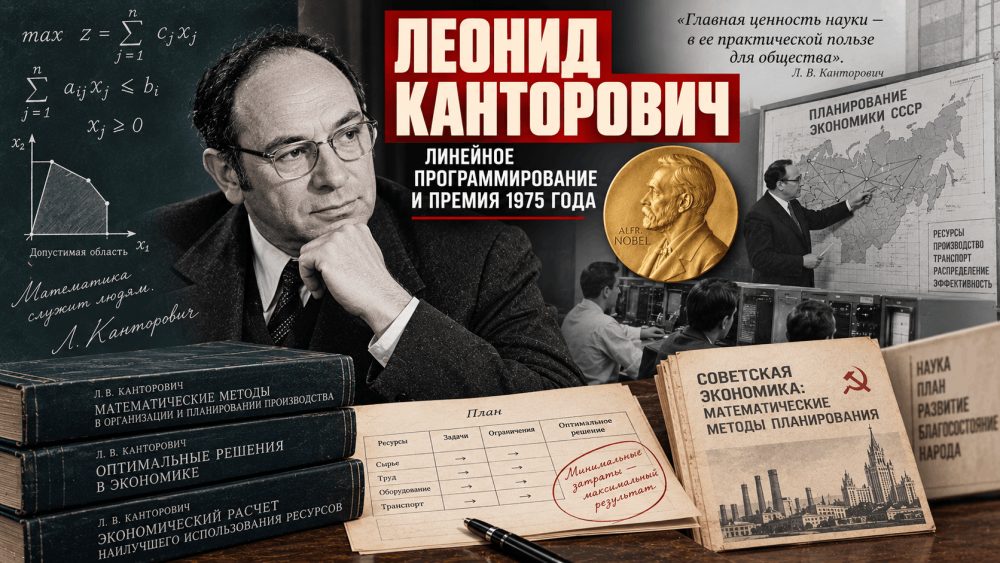
This is a compact reminder that a scientific career extends beyond its most famous result. A researcher may spend substantial later effort on new questions. The biography of Andrei Sakharov offers another Soviet physicist's trajectory and another relationship between science and public responsibility; the two lives should not be treated as interchangeable.
The work of Leonid Kantorovich provides a further comparison between kinds of scientific contribution. A mathematical method, a physical theory and an experimental apparatus require different forms of demonstration. Kapitsa's achievement rested on making unusual material behaviour accessible to investigation under deliberately established and controlled conditions.
Sources
- NobelPrize.org. Pyotr Kapitsa: facts and prize information.
- Nobel committee. The 1978 physics prize: explanatory press release.
- Trinity College Cambridge. Memorial account of Kapitza.
- Institute for Physical Problems museum. Kapitsa's instruments, installations and research.
- NobelPrize.org. Kapitsa's Nobel lecture, 8 December 1978.