Larisa Latynina: The Story Behind Eighteen Olympic Medals
Explore Larisa Latynina’s 18 medals at Melbourne, Rome and Tokyo: nine golds, all-around titles, floor victories and the meaning of her Olympic record.
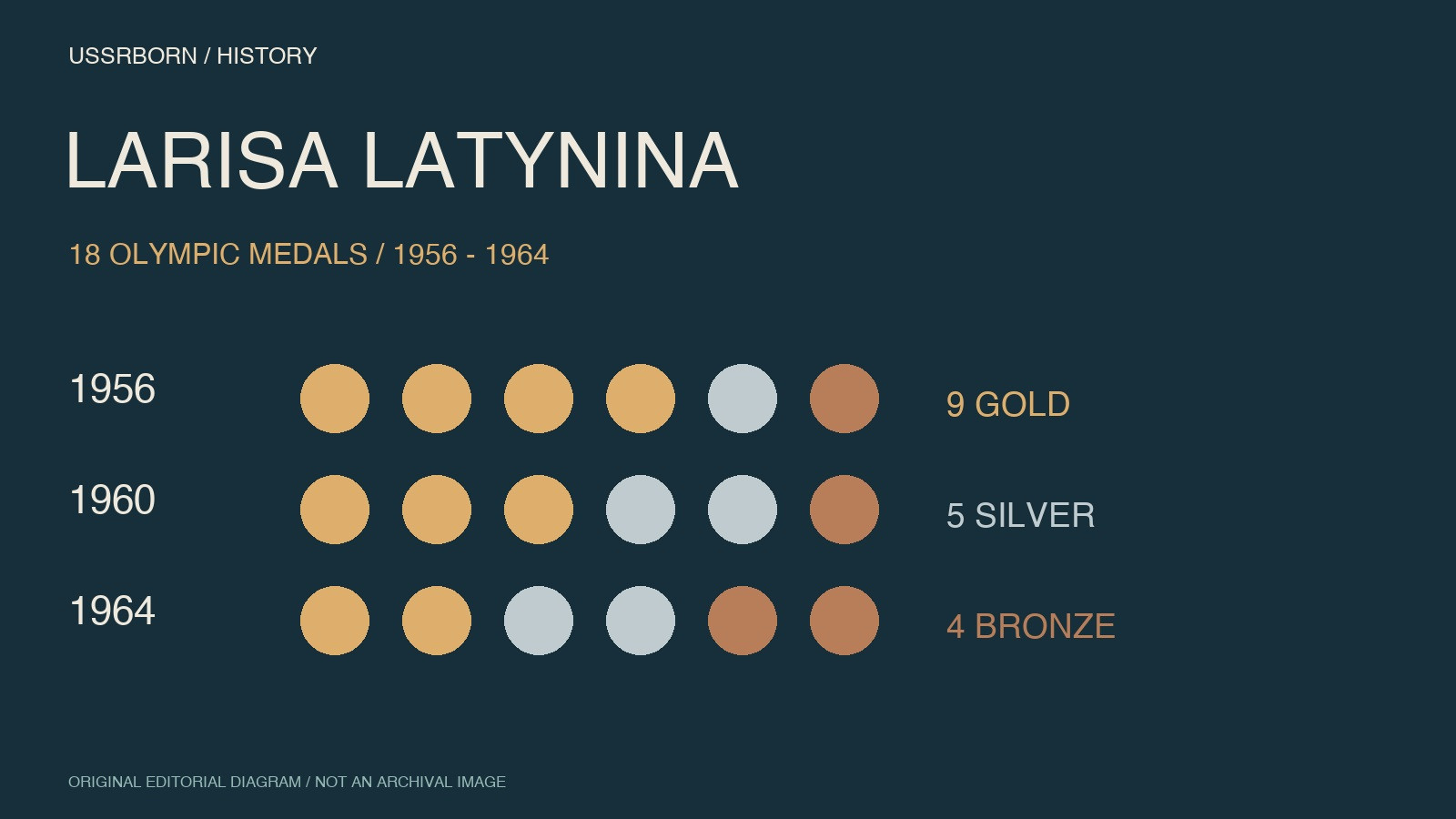
Larisa Latynina won 18 Olympic medals across three Games: Melbourne in 1956, Rome in 1960 and Tokyo in 1964. Nine were gold, five silver and four bronze. The familiar total describes more than one exceptional tournament. It reflects repeated success across different parts of the gymnastics program.
Understanding that career means asking what each medal represented. Team competition, the individual all-around and apparatus events test different aspects of performance. Combining them into one number is convenient for record lists, but it can conceal the nature of the achievement.
Kherson, Kyiv and the Soviet team
Latynina was born on 27 December 1934 in Kherson. Olympedia identifies her club affiliation as Burevestnik Kyiv and her Olympic team as the Soviet Union. Place of birth, club affiliation and the country represented at an international event are distinct pieces of biographical information.
That distinction is useful for readers approaching Soviet sport through present-day national categories. A birthplace should not simply be replaced by the name of the Olympic delegation. Our guide to the Soviet republics explains the structure of the country. Ukrainian places in Latynina's biography and her appearances for the Soviet team describe compatible parts of the same history.
The arithmetic behind eighteen
Latynina collected six medals at each of her three Olympics, but the distribution changed:
- Melbourne 1956: four gold, one silver and one bronze.
- Rome 1960: three gold, two silver and one bronze.
- Tokyo 1964: two gold, two silver and two bronze.
Adding the rows produces nine golds, five silvers and four bronzes. This simple check prevents a common misunderstanding: six medals at a Games do not mean six victories. Total podium appearances and first places are different measures.
Melbourne also included a team portable-apparatus event in which the Soviet team earned bronze. Not all eighteen medals were individual awards. Four were team medals, including that additional event, while fourteen were individual.
The distinction matters beyond bookkeeping. A team medal recognizes participation in a collective result. An individual medal records a placing in an individual competition. Both belong in an athlete's Olympic total, but neither should be silently relabeled as the other.
All-around consistency and apparatus excellence
Latynina won the individual Olympic all-around in 1956 and again in 1960, then took silver in 1964. At Rome, Sofya Muratova won silver and Polina Astakhova bronze, completing a Soviet sweep of the podium.
The all-around assesses performance across the program. An apparatus title identifies excellence in a particular discipline. Winning one does not automatically imply winning the other, and different gymnasts can lead the two competitions without any inconsistency.
A hypothetical example makes the distinction clearer without inventing historical scores. One gymnast might be exceptional in a single exercise while falling behind elsewhere. Another might maintain a consistently high level across the whole program. Their strongest claims to success would then concern different competitive measures.
Team competition adds a further layer. Several participants contribute to a collective result. It would be inaccurate to attribute team gold exclusively to one famous member, but equally misleading to dismiss it as an irrelevant addition to that member's career.
These distinctions help explain why a medal table needs interpretation. It tells us who placed where. Understanding the achievement also requires knowing whether the event measured a whole program, one exercise or a team's combined performance.
Three successive Olympic floor titles
Latynina won floor exercise at all three of her Olympics. The sequence stretched over eight years from the first victory to the third. It is a particularly clear thread of continuity within her broader medal record.
Floor exercise can be watched as an arrangement of acrobatics, connecting movements and changes of direction. Its visual appeal does not remove the athletic demands. The control of a landing, the continuity between movements and the organization of a routine can be considered separately from a general impression that it looks graceful.
When viewing archival footage, useful questions include how a movement begins and ends, where pauses occur, how direction changes and how individual elements form a whole. These are suggestions for observation, not an attempt to award a retrospective score using current rules.
A comparison with Soviet ballet can help viewers notice expressive movement. Yet gymnastics remains a competition with its own requirements. An aesthetic resemblance does not make the evaluation systems identical or turn a routine into a ballet performance.
Nor does a modern viewer need to choose between artistry and athleticism as if only one could matter. A controlled movement can be physically demanding and visually expressive at the same time. The useful historical task is to examine the performance within its own competitive setting.
Which record stood for forty-eight years?
The International Gymnastics Hall of Fame identifies Latynina's eighteen-medal total as the overall Olympic record that stood from 1964 until the London Games in 2012, when swimmer Michael Phelps surpassed it. This statement concerns total medals, not only gold medals.
Records for total awards, victories and the number of different events won are not interchangeable. An athlete can occupy different positions in those lists. Phrases such as most decorated are therefore clearest when accompanied by a criterion and a time frame.
Comparisons between sports also need care. Gymnastics offers opportunities in team competition, the all-around and separate apparatus events. A numerical ranking across sports reflects those opportunities as well as individual achievement. Recognizing this does not diminish Latynina's record; it explains what the number can and cannot demonstrate.
An overall table cannot, by itself, answer every question about sporting excellence. It does not tell us the difficulty of each competitive field or reduce a whole performance to a universal unit. It remains valuable evidence when its meaning is stated precisely.
Elite success and mass physical culture
An Olympic biography describes the top level of competitive sport, rather than the everyday experience of everyone who practiced gymnastics in the Soviet Union. The history of the GTO fitness program concerns a different scale of activity: physical standards and broad participation.
One person's medals cannot establish the condition of an entire country's physical culture. Assessing mass participation would require evidence about facilities, coaching, access and the people taking part. Assessing Latynina's competitive career begins with specific international performances and results.
Likewise, the competition program of the 1950s and 1960s should not be projected unchanged onto later Games. Our article on the 1980 Moscow Olympics concerns another period. These subjects belong to a connected history of Soviet sport without sharing every rule or circumstance.
This separation of scales makes the biography more informative. Latynina's achievements can be studied in their own right while broader institutional questions remain open to their own evidence.
Reading the record carefully
Even established reference sites can contain mistakes in medal lists. The distribution used here was checked against competition results rather than copied from one commemorative profile. In particular, Latynina did not win Olympic beam gold in 1956: she tied for fourth in that event.
That correction illustrates why an impressive career does not need additional invented victories. Its documented achievements are already substantial. A precise account is stronger than a celebratory narrative that expands the record through repetition of an error.
The number eighteen is a useful starting point, but not the whole story. Two all-around titles, three successive floor victories and team awards reveal different aspects of sustained performance. Reading the record this way restores the actual events, tournaments and fellow competitors behind a celebrated total.
Sources
- Olympedia: Larisa Latynina, biographical information and event-by-event Olympic results.
- Olympedia: the women's all-around at Rome 1960, results and podium places.
- Larousse: Larisa Latynina, Olympic victories.
- International Gymnastics Hall of Fame: Larissa Latynina, the three Games and duration of the overall medal record; individual medal-list entries were checked against Olympedia results.
The cover is an original diagram of her Olympic medal distribution, not a photograph of the athlete.