GTO in the USSR: What the Fitness Badge Meant
What did a Soviet GTO badge certify? Explore the programme, its five age stages, the 1972 reform and the records behind family memories of fitness tests.
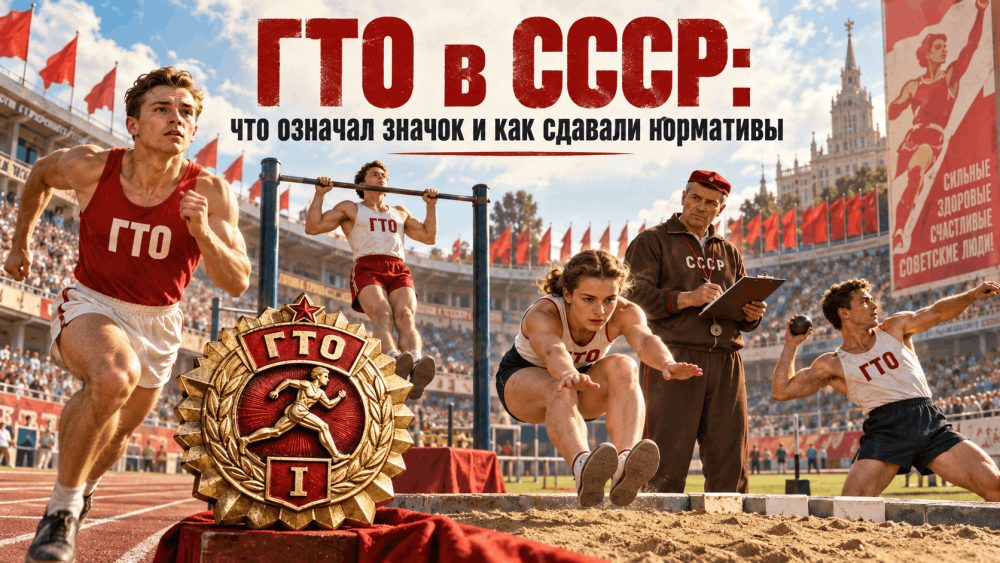
A GTO badge in a family collection can look like a small sporting medal. Yet it raises a surprisingly complicated question: what did its owner actually achieve? Was it a competition victory, membership of an organisation, or completion of a set of tests? The Soviet Ready for Labour and Defence programme connected individual physical performance with schools, workplaces and the state's expectations of its citizens.
What GTO meant
GTO is the transliteration of the Russian initials for Ready for Labour and Defence. The programme was approved on 11 March 1931. It established requirements and physical tests rather than creating a separate sports club. A children's programme, BGTO, or Be Ready for Labour and Defence, followed in 1934. Both dates appear in the programme's official historical account.
The requirements changed over time. There was no single set of Soviet GTO standards that remained valid throughout the country's history. A prewar participant and a schoolchild in the 1970s belonged to the same broad tradition, but they did not necessarily complete the same tests. Nor can the tables used by the later Russian programme be treated as evidence of Soviet requirements.
This distinction matters when reading family recollections. A remembered distance or exercise may be accurate for a particular period without describing the entire system. Before comparing two accounts, establish their dates and the participants' age groups.
The 1972 reform
An especially useful source for the later Soviet period is Resolution No. 61, adopted by the Communist Party Central Committee and the USSR Council of Ministers on 17 January 1972. It introduced a revised programme from 1 March and required educational authorities to adapt physical education curricula for the 1972/73 academic year.
The resolution did more than announce ambitious objectives. Its introduction acknowledged weaknesses in the organisation of physical education, slow development of sporting facilities and insufficient everyday attention to exercise at workplaces and in agriculture. An official commitment was therefore not the same thing as uniform implementation.
Responsibility extended across sports committees, trade unions, the Komsomol, educational bodies and other institutions. The intention was to place physical preparation inside existing school and workplace structures. Exercise was presented as a collective responsibility as well as an individual activity.
Why there were five stages
The accompanying regulations describe five age-based stages. Their names can be translated as Brave and Agile, The Sporting Generation, Strength and Courage, Physical Perfection, and Vigour and Health. The first three covered children and young people aged 10 to 18.
Adult groups had different boundaries for men and women. Stage four covered men aged 19 to 39 and women aged 19 to 34. Stage five covered men aged 40 to 60 and women aged 35 to 55. The regulations also included specific qualifications, such as the assignment of university students who had reached 18 to stage four.
Thus, the familiar description of a programme for people aged 10 to 60 summarises the overall system. It does not mean that everyone had identical age limits or faced identical requirements. A family badge can only be interpreted properly when its date, stage and age category are known.
These distinctions also explain why a modern comparison can mislead. Looking up a running time without identifying the correct edition of the rules is not enough to judge a historical result. The same name can survive while the underlying standard changes.
From exercise to a recorded qualification
The programme combined requirements concerning knowledge and practical skills with physical performance tests. Running, jumping, strength exercises, swimming and skiing examined different aspects of preparation. Excelling at one event did not stand in for completing the whole programme.
The regulations required prior preparation and medical permission to participate. Results were entered in school registers, statements or individual record cards. Competitions could provide qualifying results, but the rules also allowed other arrangements. GTO cannot therefore be reduced to a single annual sports day.
A badge and certificate followed completion of the relevant requirements. Schools, workplaces and sports organisations used prescribed procedures to confirm the records. This administrative element is easy to overlook when the surviving object is only the badge itself.
The award certified completion of the programme. It was not equivalent to winning a national championship, and it cannot by itself establish how often the recipient exercised afterwards. Those are separate questions requiring different evidence.
Health, labour and defence
Defence was part of the programme's purpose, not an incidental word in its title. Physical development appeared alongside preparation for work, military service and the formation of a Soviet citizen. Describing GTO solely as a health initiative would remove an important part of its historical meaning.
The opposite simplification is also unhelpful. An individual's sporting effort cannot be reconstructed from a government resolution alone. To understand practice, historians need local records: school registers, competition protocols, sports society reports and recollections that identify a place and date.
Those sources make it possible to separate the intended programme from recorded performance and personal experience. The distinction is particularly important when discussing participation statistics. A target is not an achievement, while the existence of an achievement in a report does not automatically tell us everything about how it was measured.
The 1972 resolution provided for awards to territories with the strongest results in preparing badge holders. Organisational performance therefore mattered as well as individual performance. That fact justifies examining how records were produced. It does not, on its own, prove either that every report was reliable or that every report was fabricated.
Reading a badge as family history
If a certificate survives with the badge, start there. Its date and issuing organisation are more useful than an unsupported guess based on the object's appearance. Then consult the appropriate edition of the programme. Ask relatives where the tests took place, who recorded the results and which activities they remember.
This approach turns a small possession into evidence about education, work and leisure. It does not make one person's experience representative of the entire USSR. It shows how that person encountered a system which linked physical preparation to wider social expectations.
Related reading
- Everyday life in the USSR
- The Pioneers and Soviet childhood
- The Komsomol and its social role
- The 1980 Moscow Olympics