Universal Secondary Education in the USSR: The 1972 Decisions
What the 1972 Soviet education decisions required: evening schools, teacher preparation, curricula and the limits of policy documents as evidence.
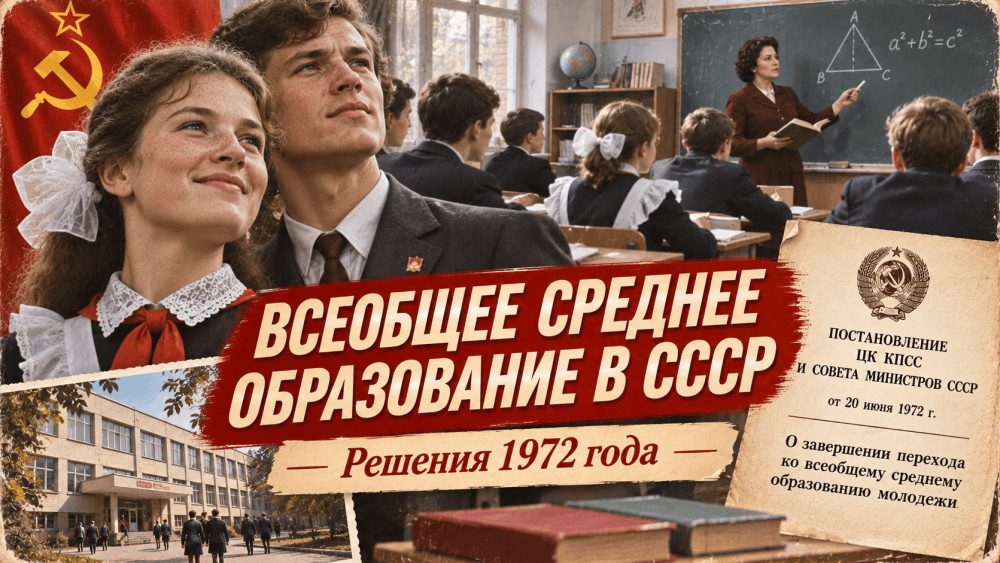
On 20 June 1972, the CPSU Central Committee and the USSR Council of Ministers adopted Resolution No. 463 on completing the transition to universal secondary education for young people. Its title can sound like an announcement that the task was already finished. The implementing documents tell a more practical story: institutions still had work to do, deadlines to meet and educational routes to coordinate.
The most useful companion is USSR Ministry of Education Order No. 80, issued on 3 July 1972. It turns the broad decision into instructions concerning teachers, curricula, evening schools and vocational institutions. Read together, the documents show why the policy cannot be reduced to adding places in the upper grades of ordinary daytime schools.
A resolution followed by an implementing order
The June resolution established the Union-wide direction. The July ministry order assigned work to education authorities, research bodies and ministerial departments. They were separate instruments with different dates and purposes.
The order called for concrete measures and the fulfilment of educational development plans for 1972-1975. It also required proposals on general education within vocational and specialised secondary institutions. These routes mattered because secondary education could be pursued through more than one institutional setting.
An especially revealing instruction concerned measurement. The ministry was to work with planning authorities, the republics and the central statistical agency on a common method for planning and recording participation across all forms of secondary education. Counting students was therefore part of the policy itself. A total drawn only from daytime schools would not describe the whole system contemplated by the order.
This also explains a limitation of the phrase “universal secondary education.” It identified an objective covering several educational routes. It was not a ready-made statistic showing that every member of an age group had completed the same course at the same kind of school.
Studying while already in employment
For a young worker or collective-farm employee, continuing school involved fitting lessons around employment. The order required annual plans for enrolling young workers, collective farmers and employees in evening, or shift, schools. It also envisaged expanding branches attached to workplaces and strengthening their facilities.
These provisions addressed a different situation from that of a pupil moving directly into the upper grades of a daytime school. Admission was only one part of the problem. Classrooms, equipment and the organisation of study also had to support people who were already working.
The RSFSR Council of Ministers subsequently issued Resolution No. 426 on 20 July 1972. Its available consolidated text identifies daytime general schools as the principal form of secondary education while also discussing evening and correspondence schools, vocational institutions and technical colleges. “Principal” therefore did not mean “only.”
The Russian republic's resolution should also be distinguished from the Union-wide decision. It belonged to another administrative level. Treating the USSR and RSFSR documents as interchangeable would obscure how a central policy was translated into republican responsibilities.
The staffing problem behind the expansion
More educational provision required teachers. The ministry order connected the work of teacher-training institutes and colleges with school needs. It addressed primary-school teacher preparation, further training for school leaders and the institutional base for improving teachers' qualifications.
One particularly specific assignment concerned rural applicants from remote areas. A plan was to be prepared for their admission to teacher-training institutions without competitive selection in 1973-1975, followed by placement back in those areas. The proposal linked recruitment to places experiencing staffing needs. The instruction itself does not establish how many trainees eventually returned or how long they remained.
The order also required a timetable for schools that had not yet adopted new curricula. Textbooks and teaching materials appeared alongside optional courses, advanced study of selected subjects, practical work and vocational guidance. The programme was thus concerned with what students would learn as well as where they would enrol.
Ideological requirements formed part of the same document. Omitting them would give an incomplete picture of the policy. The administrative expansion of schooling and the state's expectations about education were presented together.
Buildings and materials were part of the policy
The implementing instructions included educational equipment, furniture and technical teaching aids. There were also tasks concerning textbook production and educational television. Such provisions help explain why a declaration of universal provision could not by itself deliver it.
A school place depends on more than a line in an admissions plan. It requires staff, materials and a workable setting for instruction. The documents repeatedly move between these practical requirements. Their value lies in revealing the machinery that authorities intended to mobilise, rather than supplying a simple success rate.
How to read the evidence carefully
A policy document establishes an instruction, its intended recipients and sometimes a deadline. It does not automatically demonstrate compliance. Completion rates, dropout, regional differences and classroom experience require statistical reports or research into implementation.
There is also an edition issue. The linked reproduction of Union Resolution No. 463 incorporates amendments through 1988, while the available RSFSR resolution incorporates amendments through 1987. Neither should be presented without qualification as an unchanged reproduction of its original 1972 wording. The specific ministry assignments discussed here are drawn from Order No. 80 of 3 July 1972. A separate historical-library catalogue entry confirms the date and number of the Union resolution.
The policy's significance is clearer when its different parts are kept in view: daytime schooling, education for employed young people, vocational routes and teacher preparation. The 1972 decision sought to bring them into a coordinated programme. Whether that programme achieved its aims is a further historical question, requiring evidence beyond the decision that launched it.