Coeducation in 1954: How Soviet Boys’ and Girls’ Schools Changed
How Soviet schools moved to coeducation in 1954/55: the grade X exception, catchment areas, foreign-language continuity and Moscow’s timetable.
In autumn 1954, boys and girls returned to shared classrooms in Soviet urban schools that had previously taught them separately. The change involved considerably more than removing a sign from a building. Education departments had to move pupils between schools, preserve their foreign-language courses, notify families and prepare facilities. The instructions reveal an educational reform through the practical work needed to make it happen.
The decision of July 1954
The foundation was USSR Council of Ministers resolution No. 1342 of 1 July 1954. In the Russian republic, Education Minister Ivan Kairov issued implementing order No. 490 on 6 July. Its introduction referred to parents' wishes and teachers' opinions. That was the official rationale stated in the document; it should not be presented as the findings of a published opinion survey.
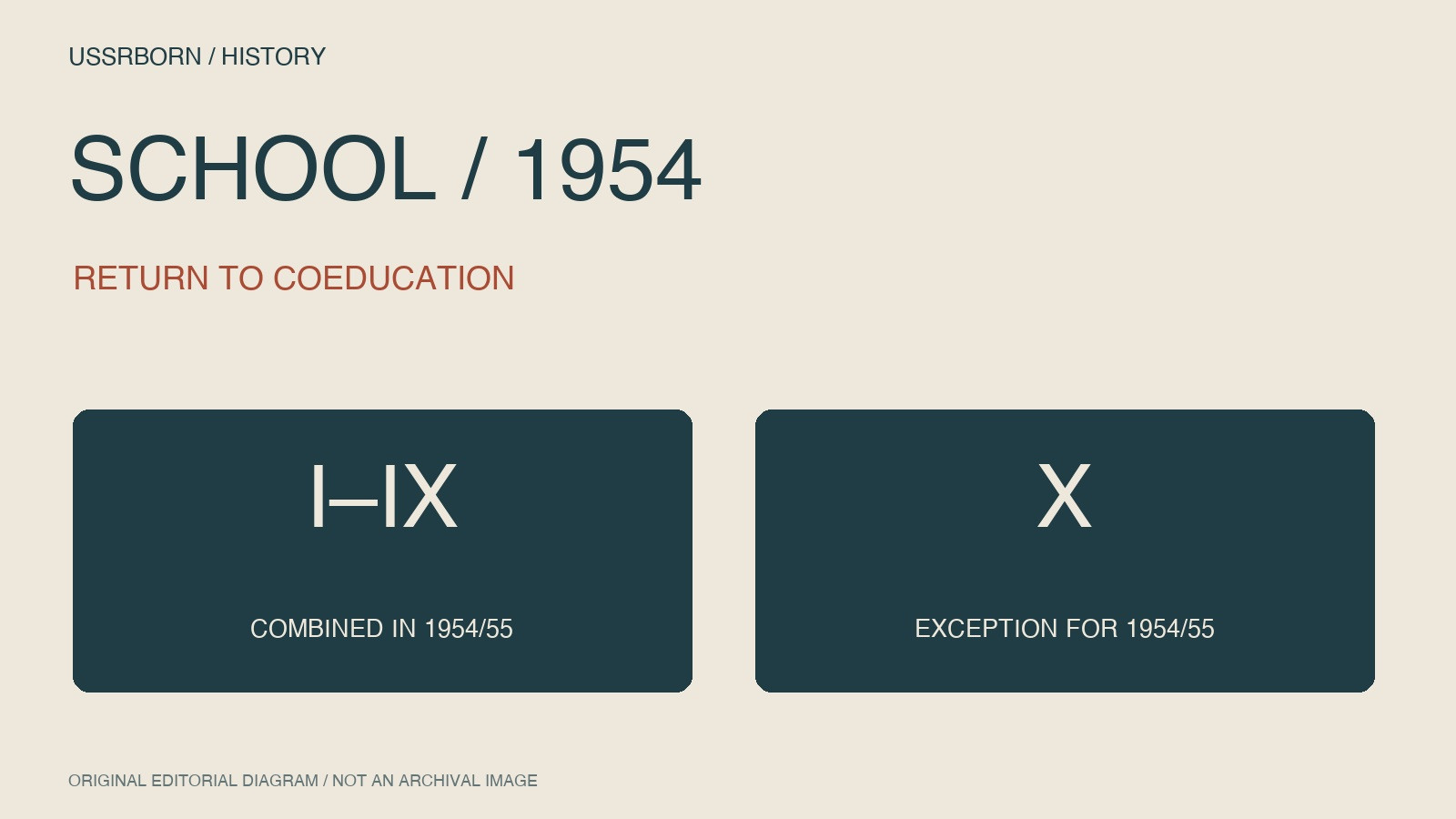
Coeducation was to begin in the 1954/55 school year in seven-year and secondary schools in RSFSR cities where separate education had existed. Grades I through IX were to be combined. Grade X was explicitly excluded for the coming school year. A photograph of an all-male or all-female graduating class in 1955 therefore does not, by itself, contradict the reform.
Why this was a return
Shared schooling was not a new Soviet invention in 1954. A People's Commissariat of Education decree published on 31 May 1918 introduced education for both sexes together and removed male and female designations from institutional names. It also set admission rules intended to bring the numbers of boys and girls closer to balance as pupils entered existing schools.
A subsequent policy turn is documented in an archival entry for an Orgburo decision of 7 July 1943 on separate schooling in 1943/44, approved by the Politburo on 16 July. The catalogue entry establishes the document's identity and dates. It is not a detailed account of what happened in every school.
The wording of the 1954 order matters here: it applied to cities and schools where separate education had previously operated. It does not justify a sweeping claim that all Soviet children had been separated during the preceding period. School history requires attention to location as well as national policy.
Class composition was also a different issue from compulsory attendance. The latter is discussed in our article on compulsory primary education in 1930. Changes to the length and structure of schooling belong to the later school reform of 1958.
A new catchment area before a new classroom
Local education departments were instructed to establish each school's catchment area, including those of railway schools, and prepare individual transfer lists. Residence was the basis for allocating pupils. Lists were to include children advancing normally, those repeating a year and those required to take autumn examinations again.
The last group had a specific safeguard. Pupils were to take their repeat examinations at their old school and then enter the appropriate grade at the receiving school according to the result. The instruction separated assessment from relocation. Changing the administrative map of schools did not mean that the new school should simply disregard the child's previous examination arrangements.
Under the ministry's instructions, transfer lists and class allocation were to be completed by 25 July. Every parent was to know the new school by 15 August. Publicly displayed lists had to identify the destination school and address; incoming pupils' lists were also to state their grade and shift. For a family, the relevant information was concrete: where the child would go and when lessons would take place.
Preserving continuity while combining pupils
Each class was supposed to contain approximately equal numbers of boys and girls. Officials were separately prohibited from selecting strong pupils for some classes and weak pupils for others. A pupil transferred from another school in the same city could not be moved down a grade during the school year.
Foreign languages received particularly careful treatment. To allow pupils in grades VI through IX to continue the language they had already studied, a school could offer two languages if necessary, or three in exceptional cases. Combining children was therefore not intended to mean starting their language education over again. This provision makes the reform easier to understand as an administrative problem involving existing courses, rather than simply a change in seating arrangements.
Teaching staffs were generally to remain together. School equipment, furniture and libraries were to stay with their existing institutions. Textbooks, by contrast, were to be allocated according to the number of pupils assigned to each school. The reform worked through an existing network of buildings and resources; it did not require the wholesale merger of two schools' possessions.
Moscow: desks, notices and repairs
Moscow's executive committee adopted decision No. 44/34 on 16 July 1954. Like the republican order, it excluded grade X from combination that year. It required catchment areas to be approved by 20 July, class lists to be prepared by 1 August and parents to receive written notification no later than 15 August.
The Moscow deadline for lists differs from the date in the ministry instruction. These are two separate documents issued by different authorities. Combining their deadlines into one supposedly uniform timetable would conceal that distinction.
The city's decision also addressed the size and placement of desks, requiring them to suit pupils' height. Sanitary facilities occupied for storage or housing were to be cleared, and necessary restoration and additional repairs were to be completed by 20 August. Such provisions show how an educational decision reached into the physical use of school buildings.
They remain requirements, rather than proof that every school met every deadline. To reconstruct one school's experience, a researcher would need local reports, transfer lists or staff-meeting records. The ministry itself required the transfer documentation to be retained under archival rules.
Building the new school community
The instruction called for class representatives to be elected and a pupil committee established during the first week of term. Meetings were to address friendship, cooperation and relations between boys and girls. The reorganisation also extended to Young Pioneer activities, showing that the authorities envisaged a newly organised collective as well as mixed classrooms.
This was not the same undertaking as the earlier literacy campaign. The central problem in 1954 was how existing boys' and girls' schools would make the transition to teaching together. The exception for graduating pupils, the protection of ongoing language courses and the practical arrangements for transfers are what make that transition historically specific.