Compulsory Schooling in the USSR in 1930: Four Years or Seven?
Who the 1930 schooling programme covered: two decisions, age groups, the four-year course, seven-year schooling in industrial areas and pupil support.
In the summer of 1930, universal primary schooling became an immediate programme for implementation across the Soviet Union. Behind the familiar statement that compulsory education was introduced lay two decisions, several age groups and different requirements for the length of schooling. Understanding those distinctions helps explain both educational policy and the school histories of individual families.
A Communist Party resolution was adopted on 25 July, followed by a decree of the USSR Central Executive Committee and Council of People's Commissars on 14 August. Both connected the new phase of the campaign with the 1930/31 academic year. They did not create schooling from nothing or instantly establish identical conditions in every settlement.
Why there are two dates
The July resolution set out a political programme covering enrolment, teacher preparation, finance, assistance to pupils and the participation of public organizations. The surviving text approved by the Politburo makes the breadth of the task clear. Declaring attendance compulsory required buildings, staff and resources to make the declaration effective.
The August decree established arrangements at the state level. Both dates are therefore correct when the institution and document are identified. Attributing the party resolution to the Council of People's Commissars, or combining both decisions under one date, obscures how the programme was organized.
Compulsory education was already an established ambition. The Presidential Library's historical account points to the 1918 regulations for a unified labour school in the Russian republic and planning during the 1920s. What distinguished the 1930 decisions was their concrete programme for rapidly extending schooling across the USSR.
Which children were to attend?
The principal intake for 1930/31 covered boys and girls aged eight, nine and ten who were not already at school. The minimum course was four years. Children already attending the first stage were required to complete it regardless of their age.
The July resolution separately envisaged extending the primary-school obligation to eleven-year-olds in 1931/32. At the same time, accelerated instruction was to begin in 1930/31 for children aged eleven to fifteen who had not completed primary schooling. These provisions described different educational routes, rather than one age range that can simply replace all the others.
The source uses a period term meaning over-age pupils. It referred to children older than the usual age for the relevant school stage. They were not being sent directly into advanced classes without acquiring the elementary course. One- and two-year accelerated schools or courses were envisaged. The published extract from the August decree also mentions groups attached to schools, organized according to pupils' prior preparation.
For a family historian, that distinction can be decisive. A teenager's attendance at a short course does not necessarily mean that ordinary primary schooling lasted only one year. It may identify a special route intended to address schooling previously missed.
Four years nationally, seven in specified areas
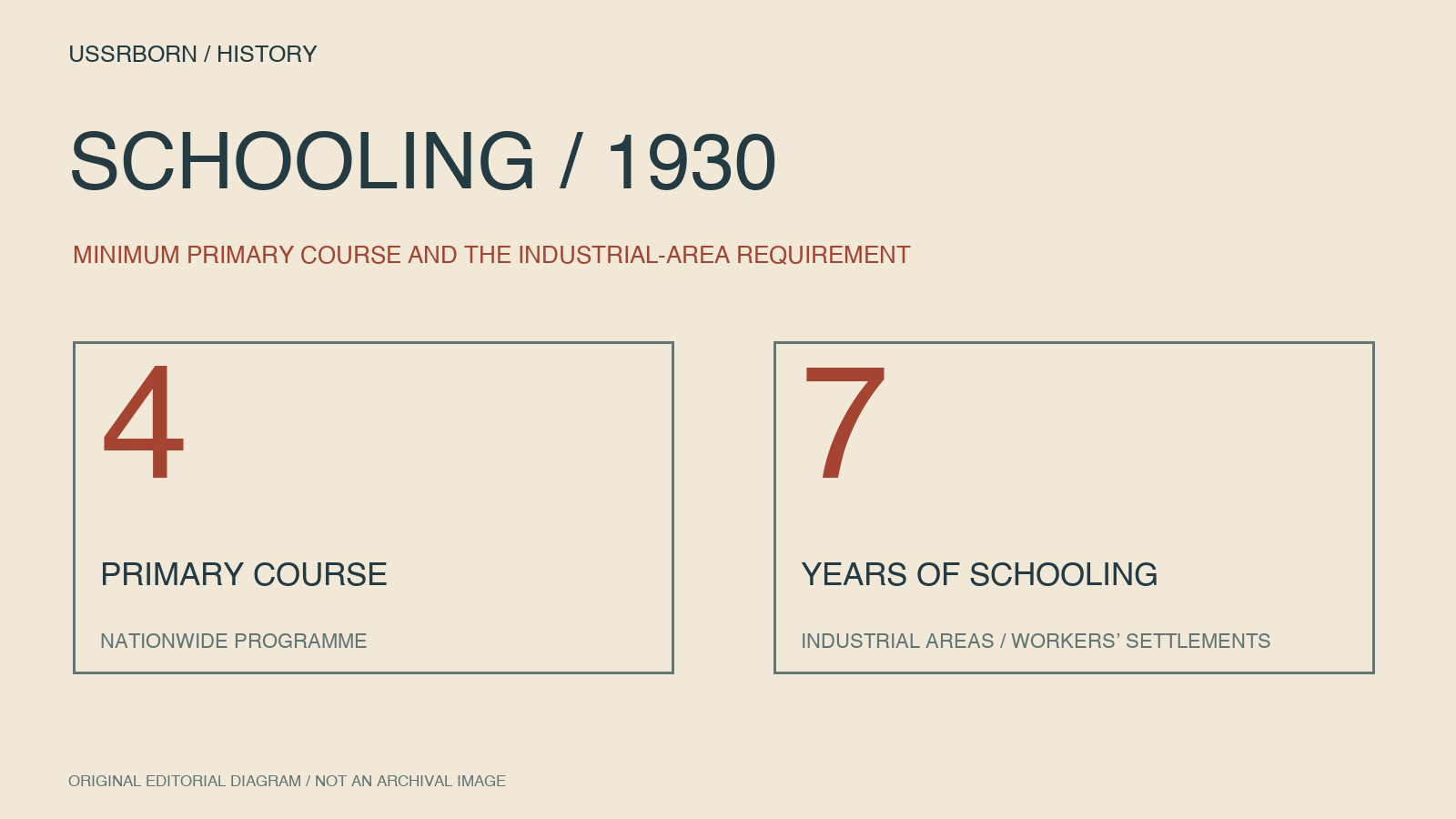
The general primary-school programme centred on a four-year course. Industrial cities, factory districts and workers' settlements were also assigned compulsory seven-year schooling. The published extract applies this requirement to children completing the first stage, beginning with those who finished in 1929/30.
It is therefore too broad to say that every Soviet child was required to complete seven years everywhere in 1930. Location and settlement type mattered. Authorities could extend compulsory seven-year education to other areas, but that power should not be confused with evidence that the same arrangement was already operating throughout the country.
The school reform of 1958 belongs to a later stage, when the compulsory course was extended to eight years. Combining decisions from different decades can make recollections of four, seven and eight years seem inconsistent. They may instead describe different periods and local circumstances.
Families and local authorities had different duties
Parents, other guardians and institutions caring for children were responsible for sending them to school. Penalties for failing to fulfil that duty were to be determined under the legislation of the constituent republics. The requirement addressed adults' responsibilities as well as children's enrolment.
Local soviets and district executive committees were charged with practical implementation. The documents refer to repairing buildings and furniture, securing fuel and preparing textbooks and writing materials before the academic year. A school network had to function through an entire course, not merely announce that registration was open.
These provisions explain why a decree is not equivalent to an achieved result. Enrolling a child, maintaining attendance and enabling completion are related but separate tasks. The decree alone cannot establish how successfully each was performed in a particular village.
What made schooling accessible?
The July resolution called for expanding teacher preparation through institutes, technical colleges and special courses. It also sought improvements in teachers' material conditions. Rapidly increasing the number of pupils required more teaching staff as well as more desks.
Assistance was proposed for less well-off children of workers, agricultural labourers and poor peasants. It included learning materials, footwear, clothing, food and transport. This reflected the campaign's social priorities and a practical understanding of access: lessons could be free while still being difficult to reach or attend regularly.
Finance was to be combined with contributions from economic bodies, trade unions, cooperatives and other organizations. School buildings occupied for unrelated purposes were to be returned to educational use. Former landed estates and confiscated houses belonging to peasants classified as kulaks were also proposed as premises. The educational programme operated within the political and social transformations of the period, including coercive property seizures.
Reading these details together prevents school expansion from becoming an abstract sequence of decrees. A classroom needed teachers, heat, supplies and children able to get there. The programme assigned responsibilities for those requirements, even though assignment itself did not guarantee delivery.
Education and political mobilization
The resolution explicitly connected universal schooling with communist education. Teacher preparation included ideological requirements, and party organizations were instructed to discuss implementation regularly. The programme therefore involved more than a politically neutral increase in places.
Trade unions and the Komsomol were among the organizations named for assistance committees. Their participation did not replace teaching, construction or budgetary administration. The Pioneer movement likewise belonged to the wider social environment of Soviet childhood, but organizational membership and completion of an academic course were different matters.
Maintaining those distinctions makes it possible to discuss expanded educational opportunities and political organization at the same time. Neither aspect needs to disappear in order for the other to be recognized.
Universal schooling was not identical to likbez
The literacy campaign known as likbez addressed people unable to read and write, including adults. Universal primary schooling aimed to bring children systematically into school education. The programmes overlapped, particularly for adolescents who had missed the elementary course, but their audiences and institutional forms were not identical.
When examining an educational biography, establish the person's age, the institution and the course first. An accelerated course for an adolescent, an ordinary four-year primary school and adult literacy classes could leave different records. The statement that someone attended classes does not, by itself, identify the qualification or course completed.
Reading the programme without overstating its results
The documents allowed limited delays for certain remote or non-urban areas, subject to authorization by the relevant union-republic government. Organizational difficulty was therefore acknowledged within the plan itself.
The published extract of the August decree linked below also references a legislative publication from 1931. Anyone establishing the original wording of a particular provision should compare it with the first official edition. Here, the main directions are checked against the July text, and the later extract is used with that qualification retained.
The 1930 decisions show the programme's design and distribution of duties. Assessing results requires school registers, reports, attendance evidence and information on course completion. This approach preserves the difference between an obligation established in law and the work needed to fulfil it in a specific community.
Sources
- Resolution approved by the Politburo on 25 July 1930: ages, timetable, teachers and material assistance; includes an RGASPI archival reference.
- Published extract of the 14 August 1930 decree: primary and seven-year courses, responsibilities and premises; the publication also references a 1931 act.
- Presidential Library: compulsory primary education: historical background and the distinction between party and state decisions.
- Electronic Library of Historical Documents: July resolution catalogue record: bibliographical identification of the document.
The cover is an original diagram of the two educational stages and the geographical scope of the requirements, not a historical teaching poster.