Collective-Farm Pensions: What the 1964 Soviet Law Established
How the 1964 law established collective-farm pensions: age and service requirements, the twelve-ruble minimum, calculation rules and implementation in 1965.
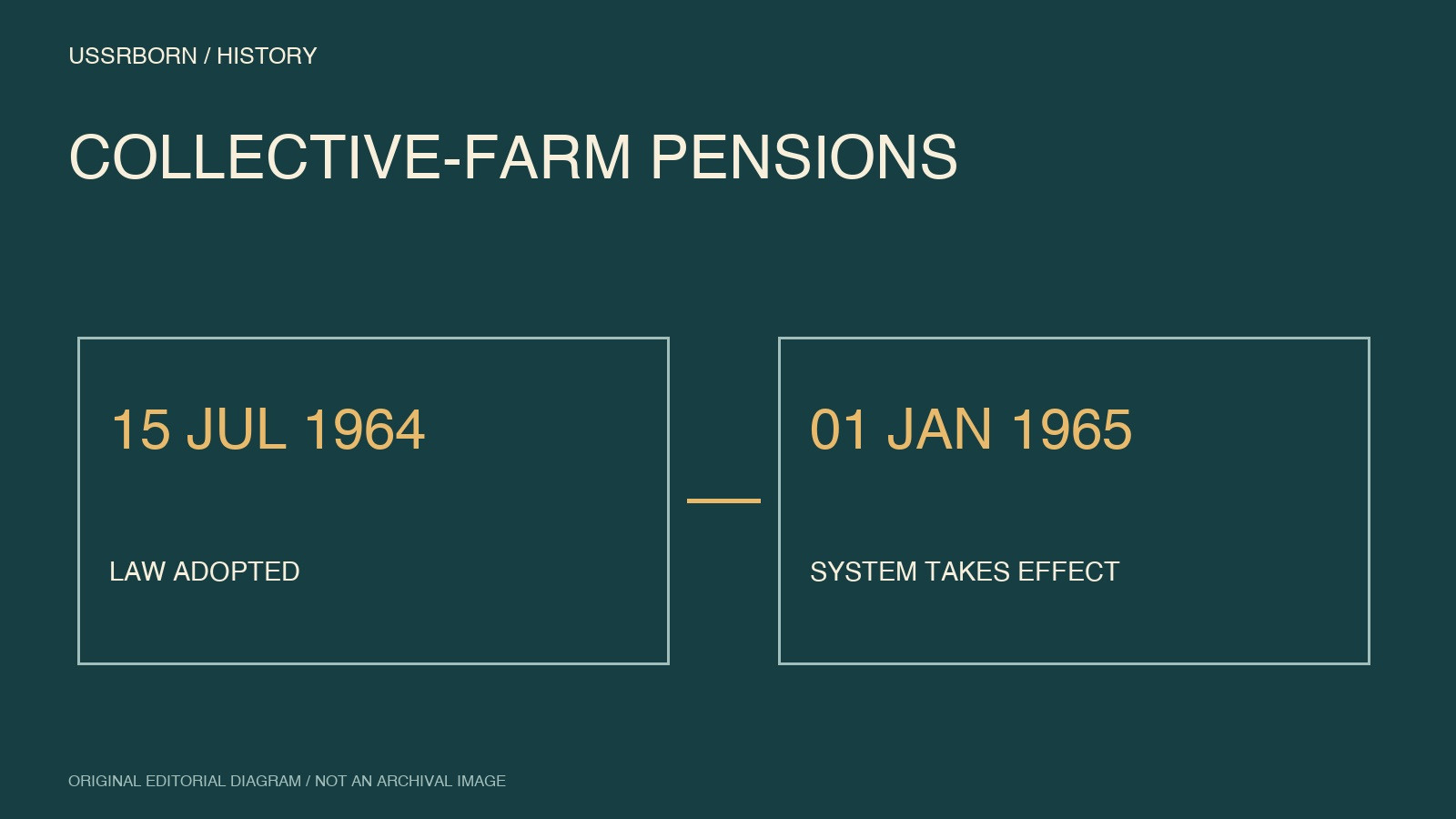
The Soviet law on pensions and benefits for collective-farm members was adopted on 15 July 1964, while the new system took effect on 1 January 1965. Those dates are often treated as interchangeable. Another common shortcut suggests that every elderly rural resident immediately received the same twelve rubles. In fact, the legislation defined eligible groups, age and service requirements, a calculation formula and several kinds of support.
Who the reform covered
The law concerned members of collective farms, or kolkhozes. It was not a single new pension rule for everyone living outside a city. A collective-farm member and an employee of a state farm had different legal positions. Understanding the organization of the kolkhoz helps explain why a separate law was needed for its members.
The central innovation was a Union-wide framework with defined rules and a centralized source of money. Saying that no support for elderly people had previously existed in the countryside is too sweeping: the law's own introduction referred to the development of social provision in collective farms. The reform changed the organization and guarantees of support. It did not mark the invention of rural mutual assistance.
Its scope also extended beyond old age. The legislation provided for disability pensions and pensions for eligible surviving family members after the death of a breadwinner. Maternity benefits for women who belonged to collective farms formed another part of the measure. A history focused only on elderly men and women misses these other households and circumstances.
The original age and service conditions
Under the general old-age rules, men needed to be at least 65 and have 25 years of qualifying service. Women needed to be at least 60 and have 20 years. Both conditions mattered. These were the initial conditions of the reform, not an unchanging description of Soviet pensions in every later decade.
Special provisions existed. Women who had borne at least five children and raised them to the age of eight could qualify at 55 with at least fifteen years of service. The child's age deserves attention when consulting later summaries: some retellings reproduce it incorrectly.
Qualifying service was not restricted to years spent as a member of one collective farm. The law also included employment as a worker or salaried employee, service in the armed forces and other recognized periods. It would therefore be wrong simply to start every applicant's service clock on the date a particular farm was established. A person's employment history had to be considered under the applicable rules.
Twelve rubles was a minimum
The original monthly old-age pension had a minimum of twelve rubles and a maximum of 102. Between those limits, the basic formula awarded half of the qualifying monthly earnings up to fifty rubles, plus a quarter of earnings above fifty. The existence of this formula is enough to show why the minimum should not be presented as the payment received by every pensioner.
Consider two hypothetical calculations, excluding individual complications. Qualifying earnings of forty rubles would produce twenty rubles under the basic formula. With eighty rubles of earnings, the first fifty would produce twenty-five rubles and the remaining thirty would produce seven rubles and fifty kopeks. The resulting basic amount would be 32 rubles and fifty kopeks. These are worked examples of the rule, not statistics describing actual recipients.
The law connected the calculation to average actual monthly earnings over five consecutive years selected from the fifteen years before the application. Where a member had worked in the collective farm for fewer than five years, the relevant calculation used the period actually worked. Records of earnings consequently mattered alongside evidence of age and qualifying service.
Any comparison with Soviet wages and prices must also identify the currency involved. These were rubles after the 1961 monetary reform. A figure of twelve rubles, taken alone, tells us neither a family's total income nor the resources available in a particular household.
A centralized fund
Payments were financed through a centralized Union social-security fund for collective-farm members. Its resources came from deductions from collective-farm income and annual appropriations from the USSR state budget. The law specifically provided for support without deductions from the personal earnings of collective-farm members. Pensions were exempt from taxation.
Those are distinct financial relationships. A contribution made by a farm is not the same as a deduction from an individual worker's earnings. The Union-wide fund also means that the legal scheme cannot be reduced to assistance paid solely out of the cashbox of the farm where a person happened to work. Separate government decisions addressed the amounts and procedures for collective-farm contributions.
This institutional arrangement is a major part of the reform's historical significance. The rules connected an individual's entitlement to a wider system of financing and administration. Describing only the minimum monthly amount leaves that structural change out of the account.
From entitlement to an assigned pension
Council of Ministers Resolution No. 859 of 17 October 1964 approved detailed regulations for assigning and paying pensions. Those regulations likewise took effect on 1 January 1965. Administration involved social-security councils for collective-farm members and state social-security authorities.
The regulations allowed an eligible person to apply after the right arose without a fixed deadline for making the application. Old-age pensions were assigned for life. Where the required age and service conditions had been met, assignment was not dependent on the person stopping work in the farm. The reform should therefore not be pictured as a single moment when all older rural workers left employment together.
The history of the Soviet passport illuminates another aspect of the countryside's relationship with state administration. Passport changes and pension provision, however, were separate processes with different documents, timetables and purposes. Combining them into one event obscures how each developed.
What the documents can establish
The reform established common pension rules for collective-farm members and specified where the financing would come from. A legal text cannot establish that all recipients subsequently enjoyed the same standard of living. Studying everyday life in the USSR also requires evidence about pensions actually assigned, household resources, prices and access to goods.
The distinction is useful when reading family records. A law supplies the framework within which a decision was made. An individual pension file can show which service periods and earnings were accepted. Household evidence helps explain what the resulting payment meant in practice. Each answers a different question, and the history becomes clearer when none is asked to stand in for the others.
Sources
- Electronic Library of Historical Documents: the law adopted on 15 July 1964.
- Resolution No. 859 and regulations for assigning and paying collective-farm pensions.
- Electronic Library of Historical Documents: the 3 September 1964 decision on contributions to the Union fund.
- Smolensk newspaper retrospective on the pension conditions announced in July 1964.
- Leninskoye Znamya, 18 July 1964: original text of the law, pages 1-2.