Moscow’s 1957 Youth Festival: Encounters, Preparations and Memory
Explore Moscow’s 1957 youth festival through its dates, international delegations, school preparations, personal archives and surviving festival souvenirs.
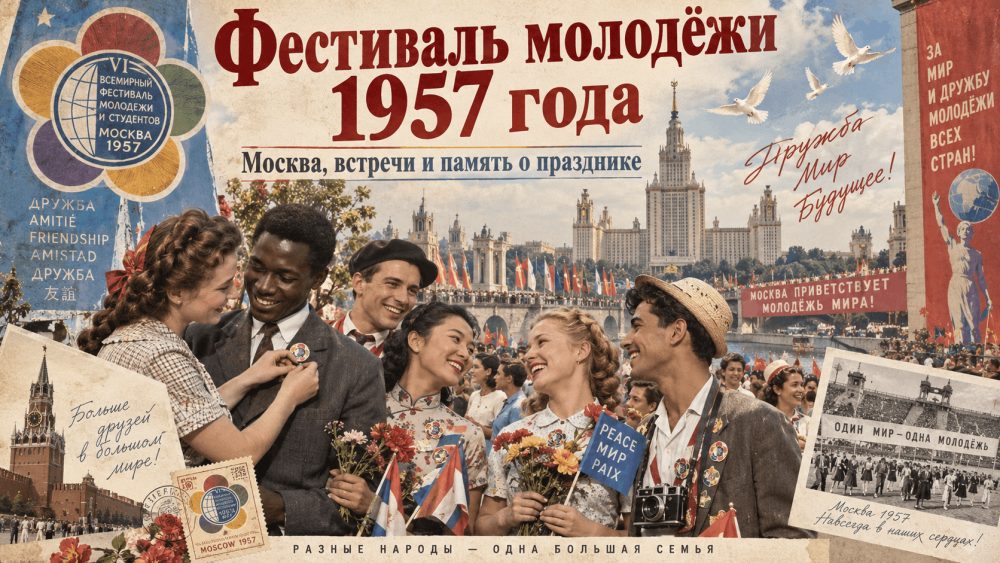
For two weeks in the summer of 1957, Moscow hosted a large gathering of young people from around the world. The Sixth World Festival of Youth and Students ran from 28 July to 11 August. Its scale is usually expressed as roughly 34,000 participants representing 131 countries. Yet some of its most revealing traces are much smaller: a language club at a school, a concert programme, an autograph book or a souvenir matchbox label.
Together, these sources show how an international event entered local routines and personal memory. They also help distinguish the planned public celebration from the experiences of the people who encountered it.
An international festival during the Thaw
The festival took place during the Khrushchev Thaw. Its public message emphasized international friendship. At the same time, meetings between individuals could create experiences that were not fully captured by a slogan or an official programme.
Those aspects do not cancel one another out. A state-organized celebration could provide opportunities for direct contact. The existence of those contacts, however, does not mean that political restrictions disappeared or that Soviet citizens suddenly gained unrestricted opportunities to travel abroad. An exceptional fortnight should not be mistaken for the everyday conditions of an entire country.
The history of Intourist offers useful context. Foreign visitors required accommodation, transport and arrangements for their stay. The youth festival was a special event within a wider system of international contact, rather than a complete replacement for that system.
The journey to the opening became part of the spectacle
Arzamas's presentation of contemporary newsreel describes delegations travelling to the opening in Luzhniki in decorated open trucks. Spectators greeted them along the route. Their journey through Moscow thus became part of the public celebration, rather than merely a transfer to a stadium.
There were two tasks behind the same scene. One was practical: moving large numbers of people between locations. The other concerned presentation: arranging the procession and making its vehicles and delegations recognizable. A photograph merges those tasks into a single festive image.
This street-level view matters because the opening cannot be understood solely through what happened inside the stadium. People watching the passing vehicles were involved in the event without necessarily belonging to an official delegation. The city itself became a setting in which participants and spectators encountered one another.
Preparation before the visitors arrived
A study by Elena Efimova of the Museum of the History of the Children's Movement describes preparations in Moscow's Pioneer House and schools during 1956 and 1957. These included foreign-language activities, learning about other countries, making gifts and planting flowers and greenery.
Such work adds an everyday dimension to the familiar opening images. An international occasion produced local assignments: a rehearsal, a classroom display, a gift or a bouquet. The institutional background is explored in our article on the Pioneer organization.
Efimova discusses school language groups and correspondence with young people abroad. These activities did not automatically produce a deep understanding of another society. They did, however, give pupils specific reasons to learn words, collect information and prepare to explain their own city. “Preparation” meant a series of concrete tasks, rather than simply waiting for the official opening.
This perspective also expands the festival's chronology. The public programme occupied two weeks, but the work of making it possible had already affected schools and other institutions before July began.
What personal archives preserve
A report from Moscow's archives, relayed by the Moscow news agency, lists country guides, invitations, concert programmes, information sheets and diary entries. The personal collection of Nina Byalosinskaya also preserved an autograph book.
Each type of object offers a different kind of evidence. A programme records what organizers intended to present. An invitation documents a particular occasion. A diary tells us how one person understood an experience. An autograph preserves a trace of contact, although it may reveal little about the circumstances unless other evidence survives with it.
These distinctions are useful when reading family collections. A single object cannot answer every question about the festival. A programme and a diary can be more informative together, allowing the planned event and an individual's response to remain visible side by side.
An archive is therefore more than a store of attractive illustrations. Its descriptions can help identify who preserved an item, which event it concerned and what can reasonably be inferred from it.
A festival on a matchbox label
The Presidential Library catalogue describes a sheet of 17 souvenir matchbox labels associated with the 1957 festival. The selection contains three image variants in different colours and concerns music. Its description identifies several factories that produced festival souvenir sets.
This small printed object demonstrates that the celebration's visual identity extended beyond stadiums and concert halls. A label could be retained in a collection long after the event ended. Its date, manufacturer, series and provenance help establish what it is; an appealing picture alone is not enough.
There is a useful connection with Soviet poster art. Although the physical scale differed, both formats could place an event's imagery in everyday surroundings. The existence of a surviving label collection does not prove that identical items reached every household or were equally available everywhere.
That qualification does not reduce the labels' value. It makes their value more precise: they document a particular form of production and commemoration.
What the participation figures mean
The figures of 34,000 participants and 131 countries describe the festival's international composition. They should not be converted into a count of every Muscovite who watched a procession or every visit to a performance. One participant could attend several events, while a person watching from the street might not belong to a delegation at all.
Recollections need similar care. A witness's excitement is valuable evidence about that person's experience. It cannot, on its own, establish the feelings of the entire population. Keeping individual experience and aggregate numbers distinct produces a more useful history than treating either as a complete explanation.
The festival's importance can be explored through both its scale and its small surviving traces. Programmes, school activities and collected souvenirs reveal how an international gathering occupied the city and then continued to exist in personal memory.
Sources
- Elena Efimova. Moscow's Pioneer House and the 1957 youth festival.
- Moscow news agency. Festival documents preserved in Moscow's archives.
- Arzamas. The 1957 Moscow youth festival and contemporary newsreel.
- Presidential Library. Souvenir matchbox labels for the 1957 festival.