The Soviet poster: art that shouts from the wall
One night to create it, one morning to paste it up: that was the pace of the visual machine through which the country talked to itself for seventy years. From Mayakovsky's stencils to The Motherland Calls and Don't Chatter!, the story of the genre through which the USSR influenced world design more than through anything else.
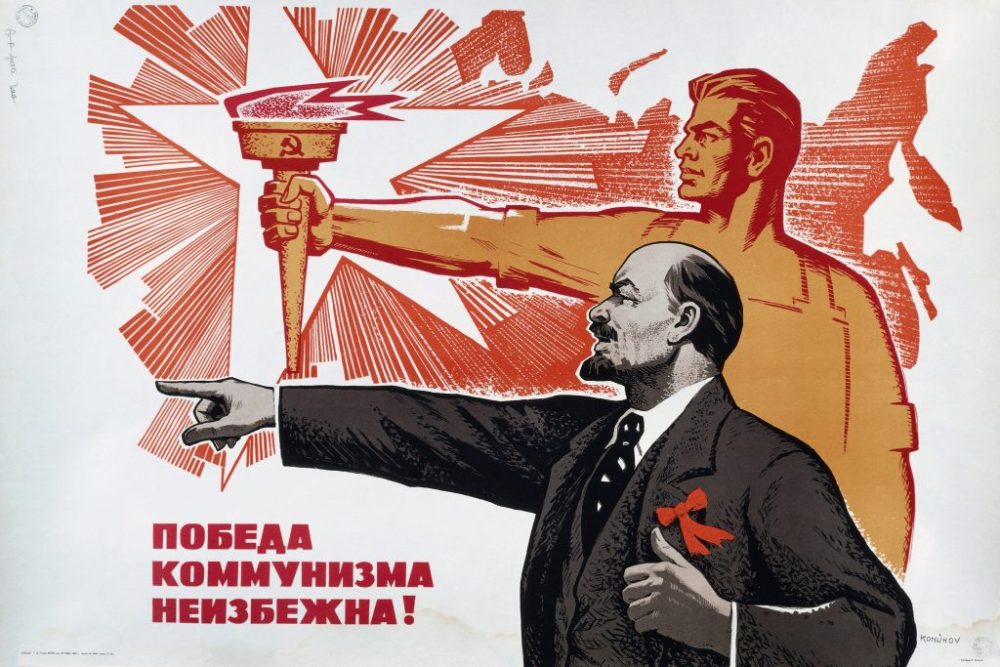
Why the poster, of all things
Soviet power faced a problem no European state had met: the country it needed to persuade was, in its majority, unable to read. The answer was the poster: an art form legible to the illiterate, cheap to print, and working at the speed of a glance. Over seventy years the genre traveled from revolutionary stencil to museum classic, and today the Soviet poster is probably the most recognizable visual trace of the USSR in the world: museums from MoMA to the Tate collect it, and its devices live on in global design and advertising.
Our story follows the genre era by era, because the poster changed with the country and honestly recorded every one of its turns.
The ROSTA Windows: news at the speed of a brush
The first great poster machine was launched by the Civil War. From the autumn of 1919 the Russian Telegraph Agency began issuing the ROSTA Satire Windows: posters displayed in the empty shop windows of hungry cities, serving as a newspaper for the illiterate: the day's report from the front, a caricature of the enemy, the day's appeal. They were made by stencil, by hand and at a run: hours passed between the news and the pasting. The project's engine was the poet Vladimir Mayakovsky, who personally wrote and drew hundreds of the Windows; more than three thousand designs appeared in the first years, and Moscow's lithography workshops grew from 26 to 453. Agitation trains and steamboats, covered in posters and carrying printing presses, took the pictures where newspapers did not reach.
The genre's archetypes were born then too: Dmitry Moor's Red Army man staring point-blank from the poster asking Have You Volunteered?, and Viktor Deni's slashing caricatures. The device of direct address, the finger, the eyes locked on yours, the question aimed at you personally, would never leave the poster again.
Constructivism: a revolution of form
In the 1920s the avant-garde took up the poster, and one of history's rarest coincidences occurred: political commission and artistic revolution wanted the same thing. The Constructivists, Alexander Rodchenko, El Lissitzky, Gustav Klutsis, declared art an instrument and the street a canvas. Geometry, diagonals, photomontage, chopped typefaces: this language was so new that the world is still learning from it. Rodchenko's advertising poster for the state publisher, with Lilya Brik shouting the word "Books," became one of the most quoted images of the 20th century, and the Stenberg brothers' film posters for Battleship Potemkin and other pictures turned the movie bill of Soviet cinema into an art of its own.
That freedom ended the way everything did in that era: from the mid-1930s the avant-garde was denounced as formalism, and socialist realism became the only permitted language: open-faced workers, Stalin against a field of banners, happiness in approved poses. Klutsis, who had created the canon of the Stalinist photomontage poster, was shot in 1938; the genre outlived its master without noticing the loss, and that too belongs to its honest biography.
The war: the poster as a weapon
The genre reached its absolute peak in the Great Patriotic War. In the war's first days Irakli Toidze created The Motherland Calls: a woman in red holding the military oath, drawn from the artist's wife. Five days later the poster went to press, within a month the whole country knew it, and soldiers at the front carried its postcard version in their breast pockets next to photographs of their families. Beside it stood Don't Chatter!, with its finger pressed to the lips, and the revived TASS Windows, taking over the post once held by the ROSTA Windows. Over the war the artists produced thousands of designs in print runs of millions: the poster was officially counted as a weapon, and that was no exaggeration.
From space to "No!"
After the war the poster settled into every genre of Soviet life. The space series of the sixties, with Gagarin and rockets tearing upward, is perhaps the brightest page in the genre's history. Industrial safety posters with their falling workers became a culture of their own, as did the health, sports and antireligious ones. The anti-alcohol No!, with its palm pushing away a glass, traveled the world as a meme long before the word existed. And the Cold War poster, with its peace doves and hostile blocs' missiles, fought a decades-long duel with American propaganda in the same visual language.
By the late stagnation years the genre had run out of breath along with the ideology: dutiful Lenin profiles and slogans nobody read. Perestroika, though, gave the poster one last bright flare: angry, honest satire on shortages, bureaucracy and the country itself, unthinkable five years earlier.
The legacy: from the wall to the museum
With the end of the USSR the poster performed the classic Soviet posthumous maneuver: from an instrument of propaganda it became an object of art and collecting. Originals by Rodchenko and Klutsis sell at auction for tens of thousands, the world's museums keep Soviet poster collections as jewels of their design departments, and the devices of Constructivism, the diagonal, the photomontage, the chopped typeface, have dissolved into global visual culture, from album covers to the political advertising of every country and camp.
The genre's honest verdict is double, and we will not straighten it. The Soviet poster was an instrument of the state, including its worst campaigns, and it was also one of the summit achievements of 20th century graphic design. Both truths hang on the same wall.
Frequently asked questions
What were the ROSTA Windows? Posters of the Russian Telegraph Agency (1919 to 1921): stenciled sheets of news and satire displayed in empty shop windows. Their chief author was Vladimir Mayakovsky; mere hours passed between the news and the pasting.
Who are the most famous Soviet poster artists? Each era had its masters: Moor and Deni in the Civil War, the Constructivists Rodchenko, Lissitzky and Klutsis in the 1920s, Toidze and the TASS Windows artists in the war.
What is The Motherland Calls? The chief poster of the Second World War, created by Irakli Toidze in the war's first days; the model was the artist's wife. Soldiers carried its reduced copies in their breast pockets.
Why are Constructivist posters so valued? Because they changed world graphic design: the photomontage, diagonal compositions and chopped typography of the 1920s are used to this day. Originals sell for tens of thousands of dollars.
How did the poster differ from other Soviet arts? In speed and reach: it was made in hours, printed in millions and hung everywhere, from the factory floor to the village council. It was the country's most massive visual medium before television.
Where can Soviet posters be seen today? In the world's major museums, including MoMA and the Tate, in Russian museums and specialized collections; reproductions are sold everywhere, and originals have become collectors' items.
Related
- The October Revolution of 1917: the event that gave birth to the genre.
- The Great Patriotic War: the time of The Motherland Calls and the TASS Windows.
- Soviet cinema: the art whose posters became a genre of their own.
- The hammer and sickle: the chief symbol that lived on these posters.
Sources
The facts in this article can be verified against authoritative sources:
- Comrade Gallery, "The Definitive History of the Soviet Propaganda Poster": https://www.comradegallery.com/journal/the-definitive-history-soviet-propaganda-poster
- Wikipedia, "ROSTA windows": https://en.wikipedia.org/wiki/ROSTA_windows
- Brown University, exhibition catalog "Views and Re-Views: Soviet Political Posters and Cartoons": https://library.brown.edu/cds/Views_and_Reviews/brochure.pdf
- MoMA, Alexander Rodchenko works in the collection: https://www.moma.org/collection/works/405578
- SovietPosters.com, historical overview of the genre: https://sovietposters.com/
Judgments about the genre's influence rest on museum and academic sources; the poster's double nature (propaganda and art) is stated in the text directly.