Carnival Night (1956): Screenplay, Casting and the Finished Film
How Ryazanov’s comedy developed through screenplay discussions in 1955, changing casting decisions and approval of the completed film in November 1956.
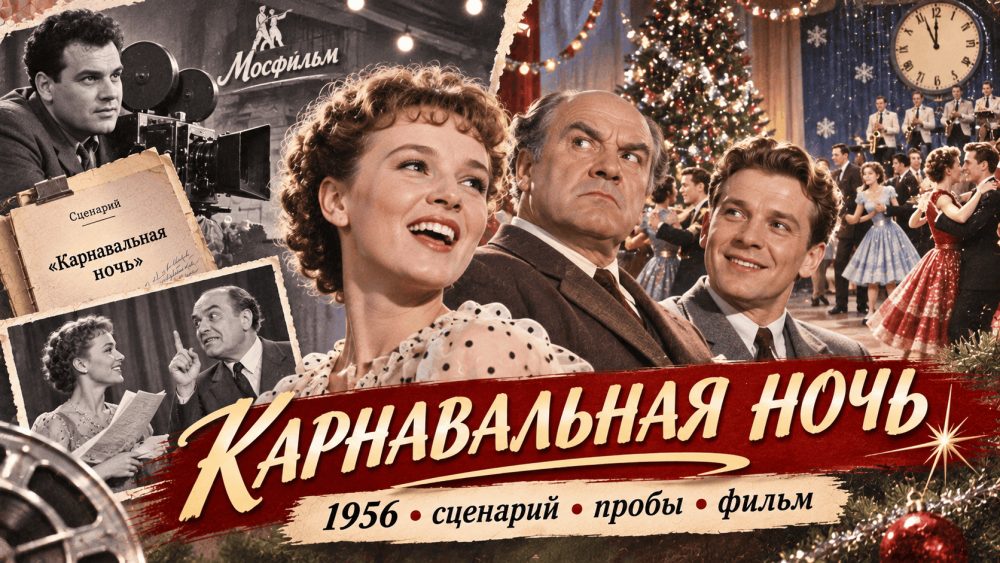
Carnival Night is Eldar Ryazanov’s 1956 musical comedy made at Mosfilm. Young club employees are preparing a New Year concert when Ogurtsov tries to reshape the celebration according to his own notions of seriousness. The conflict begins with an everyday question: who gets to decide what a shared evening should be like?
Behind the familiar festive film lay a process of experiment and revision. Surviving screenplay versions and artistic council decisions reveal that process without pretending the finished picture existed unchanged from the beginning.
Ryazanov’s route to comedy
Before joining Mosfilm, Ryazanov spent several years making documentaries and newsreel material. In 1955, he and Sergey Gurov directed the concert film Spring Voices. Carnival Night took him into fictional action in which musical performances had to work together with a comic story.
Boris Laskin and Vladimir Polyakov wrote the screenplay, Anatoly Lepin composed the music, and Arkady Koltsaty photographed the completed film. Its apparent lightness depended on different kinds of craft. Musical structure, performance and the visual treatment cannot all be reduced to a single directorial decision.
What the studio discussed in 1955
The transcript of the artistic council meeting on 18 November 1955, published by Iskusstvo Kino, identifies the project as a comedy revue. Editor Nikita Orlov supported the premise but found the preparations for the concert less convincing than the concert itself. He called for clearer development of Lena and Grisha’s relationship and sharper clown routines.
This identifies a central creative problem: connecting individual performances with developing action. A succession of acts can produce a filmed concert. A comedy also needs anticipation, obstacles and relationships to hold attention between appearances on stage.
Ideas that changed along the way
Published screenplay drafts preserve an opening built around an enormous clock face, with characters appearing through numbered windows. Another early scene showed the director leaving and handing responsibility to Ogurtsov. These are examples of material altered or omitted during development, not descriptions of the finished film’s editing.
A screenplay is useful precisely because it is a working document. It records a possible film at a particular stage. A familiar line or an actor’s name in a draft does not establish that the corresponding sequence was filmed and retained in the release version.
Why one casting document is not enough
The council’s decision of 12 June 1956 approved Lyudmila Kasyanova for Lena. In the completed film, Lena was played by Lyudmila Gurchenko. That comparison alone shows why an intermediate approval cannot be treated as a definitive cast list.
On 30 November, the council reviewed the finished picture, praised Gurchenko, Yury Belov and Igor Ilyinsky, and recommended release. The June and November documents concern different stages of production. They are compatible evidence of a process in which decisions changed between screen tests and completion.
How a celebration becomes comic action
Ogurtsov can be understood as a man trying to administer other people’s enjoyment. The young organisers are defending the possibility of a lively evening rather than an abstract programme. On this reading, the comedy grows from the gap between holding an official position and understanding an audience.
The concert setting gives that gap a visible form. A performance has timing, duration and a response from spectators; an administrative instruction cannot supply those qualities. Music consequently does more than decorate the plot. It allows the celebration itself to become an activity that cannot remain entirely under the manager’s control.
This is an interpretation of the comedy’s construction, not a claim that it documents every Soviet club. Fiction concentrates the conflict in one setting and exaggerates it for comic effect. Reading the film as a literal survey of social life would miss the work done by that concentration.
What the archive adds
Three stages make the production history easier to follow: discussion of the literary screenplay in November 1955, screen tests in summer 1956, and approval of the completed film in November. Between them lie choices that are largely invisible when watching the result.
Archival evidence does not replace enjoyment of the film. It explains how apparent ease could emerge from decisions about cutting material, assigning roles and connecting music with story. Comparing plans with results makes the history of the comedy more informative than a collection of backstage anecdotes. It also leaves room for uncertainty: an unfinished proposal records what someone wanted to try, while the released film shows what ultimately reached the audience.