Ballad of a Soldier: The 1959 Film, Cannes, BAFTA and an Oscar Nomination
Chukhrai’s film, Alyosha’s journey to his mother and its award history: Cannes 1960, a shared BAFTA and the 1962 original-screenplay Oscar nomination.
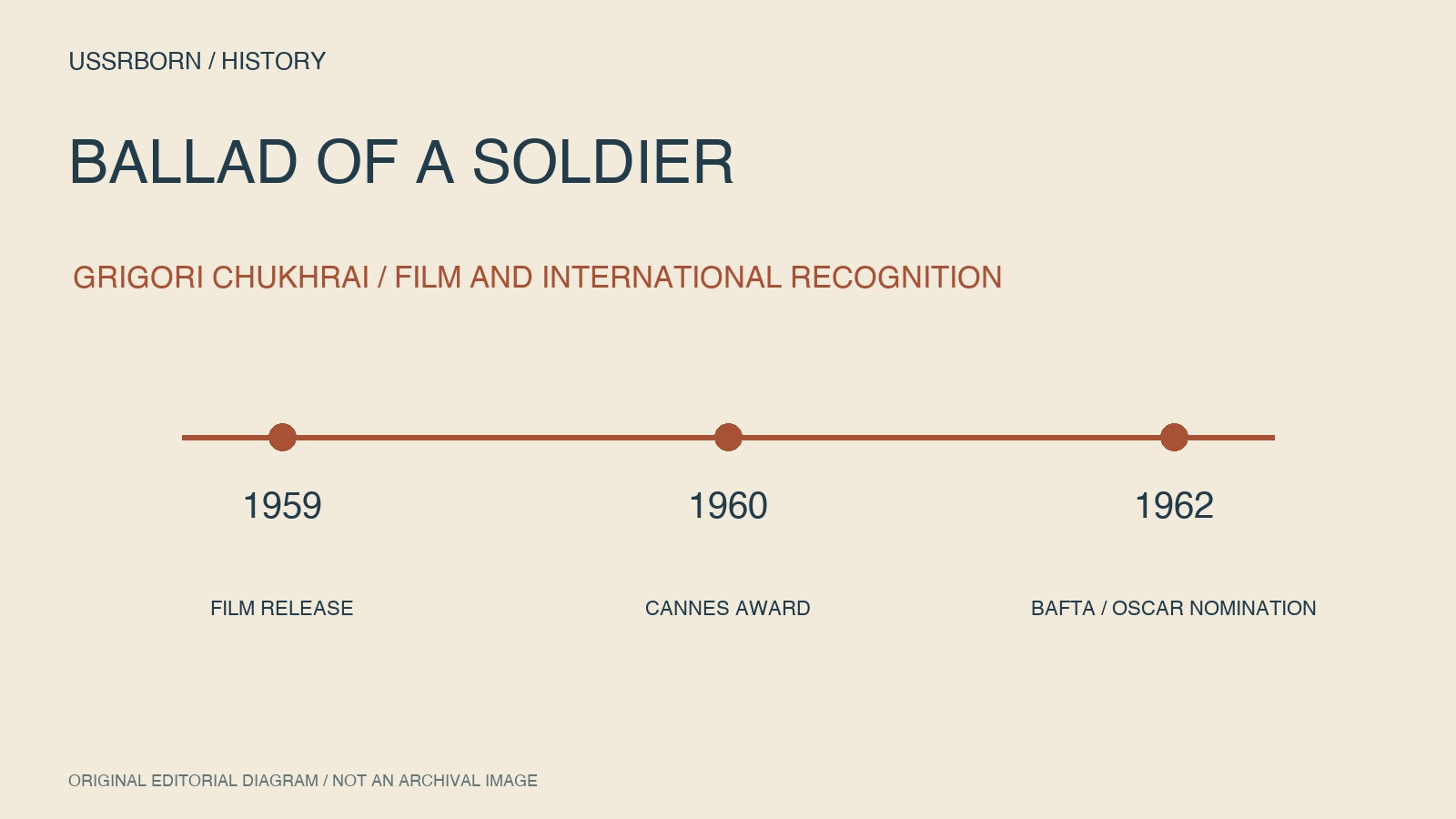
Grigori Chukhrai's Ballad of a Soldier was released in 1959. Its protagonist, Alyosha Skvortsov, receives a short period of leave and travels to see his mother. His journey is repeatedly delayed: people he meets need help, while the time available for his visit keeps shrinking.
The story's significance cannot be reduced to its awards. Its award history nevertheless deserves precision: recognition at Cannes in 1960, a British Academy prize in 1962 and an Oscar nomination belong to different occasions and categories.
Who made the film?
Mosfilm's record credits Grigori Chukhrai as director and Valentin Yezhov and Chukhrai as screenwriters. Vladimir Ivashov and Zhanna Prokhorenko played the leading roles. Mikhail Ziv composed the music; Vladimir Nikolayev and Era Savelyeva are credited as cinematographers.
These credits usefully qualify the habit of explaining a film through its director's name alone. The screen experience combines writing, performance, photography and music, while international recognition may single out different aspects of that shared work.
A journey rather than a military panorama
In her Criterion essay, film scholar Vida Johnson treats the picture as an example of thaw-era cinema's attention to the individual and the personal cost of war. Alyosha helps people along the way, meets Shura and eventually has only a brief reunion with his mother.
This construction makes the viewer conscious of disappearing time. Helping others reveals his character, but also takes minutes away from his own purpose. The journey home therefore becomes dramatic action in its own right, without requiring every episode to turn into a battle scene.
What did Cannes recognise?
The official Cannes archive places the film in the 1960 competition and records the Prix de la meilleure participation, marked as shared and unanimously awarded. Mosfilm explains it as recognition of the Soviet selection comprising Ballad of a Soldier and The Lady with the Dog.
This was neither the Palme d'Or nor a directing award. A compressed retelling can lose the historical category and convert international recognition into a different, more familiar prize. The precise wording is more useful than an impressive but inaccurate abbreviation.
The British award and Ivashov's nomination
BAFTA's 1962 archive lists Ballad of a Soldier as a winner in the Film From Any Source category. It shared the award with the American film The Hustler.
Vladimir Ivashov also appears among the nominees for Foreign Actor. That was a separate nomination, not an acting win: Paul Newman received the award that year. The film's winning status cannot be transferred to every member of its cast and crew.
Did the film win an Oscar?
At the 1962 ceremony, the picture received one nomination, for a story and screenplay written directly for the screen. The Academy lists Valentin Yezhov and Grigori Chukhrai. The winner was William Inge for Splendor in the Grass.
It is therefore accurate to describe an original-screenplay nomination, rather than an Oscar for a foreign-language film. The gap between the film's 1959 production year and the 1962 ceremony does not indicate a remake: these are different stages in its international history.
Awards help trace the picture's reception beyond the Soviet Union. Its story remains much more specific: a young man wants to see his mother and cannot refuse to help others on the way. Chukhrai builds his account of a life cut short by war around that journey and its relentlessly limited time.