The Cranes Are Flying: The 1957 Film and Its Cannes Triumph
Explore The Cranes Are Flying through its characters, Urusevsky’s camera, Thaw-era cinema, the 1958 Palme d’Or and its later restoration.
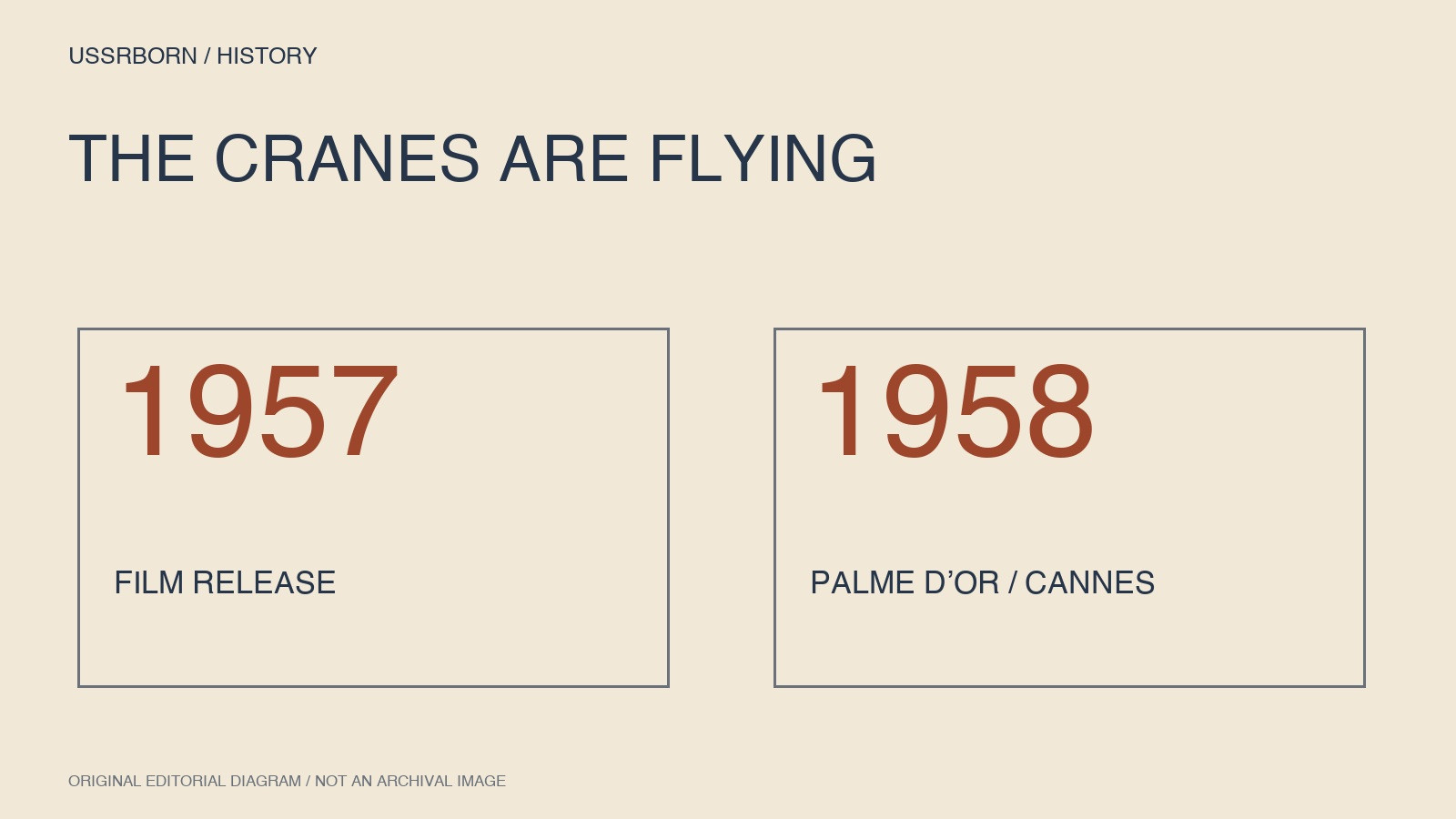
Mikhail Kalatozov's The Cranes Are Flying was released in 1957 and won the Palme d'Or at Cannes in 1958. Those dates mark different events: the film's original appearance and its international recognition. The famous award can nevertheless overshadow the work itself, a story about Veronika and Boris whose relationship is broken apart by war.
War on the scale of an individual life
Boris leaves for the front. Veronika remains in a world where familiar relationships and a sense of safety no longer hold. Separation, waiting and vulnerability move to the center of the story. The choice of scale matters: war appears not only as the movement of armies but as an intrusion into lives whose owners cannot control the wider events.
This is another way of asking questions about the same historical catastrophe. A chronology of the Great Patriotic War establishes the sequence of military and political events. A feature film can explore what happens to attachment, hope and a person's understanding of themselves within that sequence. It does not have to function as an instructional map to take war seriously.
Criterion's description specifically draws attention to the pressure exerted on Veronika by Boris's cousin. Reducing her situation to a simple question of fidelity misses the circumstances in which she is placed, her vulnerability and the violence she experiences. A character's behavior cannot be understood by listing decisions while leaving out the conditions under which they occur.
The people behind the image
Kalatozov directed the picture, Viktor Rozov wrote the screenplay and Sergei Urusevsky was the cinematographer. Mieczyslaw Weinberg, credited in Russian as Moisey Vainberg, composed the music; Yevgeny Svidetelev was the production designer. Tatiana Samoilova and Alexei Batalov played the leading roles. Mosfilm's catalog identifies these principal contributors.
The division of responsibilities is worth remembering. A viewer may retain the memory of an actor's face, but a scene also depends on camera movement, space, lighting, sound and performance. An expressive image is not automatically the achievement of only the director or only the actor. Several kinds of authorship meet within it.
In the history of Soviet cinema, The Cranes Are Flying provides a particularly useful case for examining this collaboration. Samoilova became a central human image of the film, while Urusevsky's work shaped how audiences encountered that image. Crediting both does more than expand a list of famous names: it makes the film's construction easier to see.
A camera that participates
Mosfilm's account of the film's French rerelease highlights Urusevsky's mobile camera, the celebrated staircase shot and the final scene. It also notes that these solutions preceded Steadicam. A contemporary viewer should not infer the use of a familiar modern device simply because a movement on screen feels fluid or immediate.
The camera can be understood as more than an observer standing outside the action. Movement can convey urgency, confusion or the difficulty of keeping someone close. Changing the distance from a person changes our relationship with the scene: a wider image reveals the surroundings, while a closer one draws attention to a face or response. This is a way of reading the film's expressive language, not a claim to identify the apparatus used for every shot.
One useful viewing exercise is to notice how movement works with stillness. An impressive tracking shot does not explain itself. Its meaning depends on whom the camera approaches, what it leaves outside the frame, and when it returns attention to a person's expression. Watching those choices can be more rewarding than treating the picture as a collection of technical feats.
Its place in the Thaw
The film appeared after Stalin's death, during the period of cultural change commonly called the Thaw. Criterion presents it as a turning point in post-Stalin Soviet cinema. That context helps explain the prominence given to private pain and difficult inner experience.
The label should not, however, take the place of discussing the film. A broad description of an era cannot account for every artistic decision, audience response or institutional judgment. The work is interesting because its characters' experiences exceed a simple public formula, not merely because it can be placed underneath a political heading.
Historical context and close attention to form therefore complement each other. The former explains the setting in which a film becomes possible and significant; the latter asks what the film actually does with faces, movement, sound and narrative. Neither should be expected to perform the other's entire task.
Cannes in 1958
The film won the Palme d'Or at the 1958 Cannes festival. The city of Cannes's historical account singles out Samoilova and Kalatozov's picture as a notable episode in the festival's Cold War years. Soviet cinema attracted international attention through an intimate story that could reach viewers beyond the USSR.
Mosfilm separately lists a special diploma for Samoilova. That distinction should not simply be renamed the regular best actress award. Precise award categories matter, just as the film's 1957 release date should not be replaced by the date of its festival success. Recognition of the film and recognition of a performer remain separate entries even when they belong to the same event.
International success did not make all audiences identical or remove the political setting. It showed that the work could cross a linguistic and cultural boundary. Comparing it with the later Stalker is useful as a comparison of different artistic languages, rather than a search for one formula that defines every major Soviet film.
Restoration and a later audience
Mosfilm's catalog identifies 2017 as the restoration year. The restored version appeared at international film events in 2018, and the studio's 2019 announcement described its return to French theatrical distribution. These dates belong to the film's later life; they do not change its original year of release.
A first viewing needs no long list of achievements to be meaningful. Three points offer a useful starting place: the relationships between the characters, the movement of the camera, and the difference between an individual's experience and the larger historical event. With those in view, the Cannes prize becomes part of the film's history rather than the sole explanation for its enduring interest.