The Master and Margarita: How the Novel Reached Print in 1966-1967
Follow The Master and Margarita from Bulgakov’s drafts and Elena Bulgakova’s work to the censored Moskva serialization and the 1973 Soviet book edition.
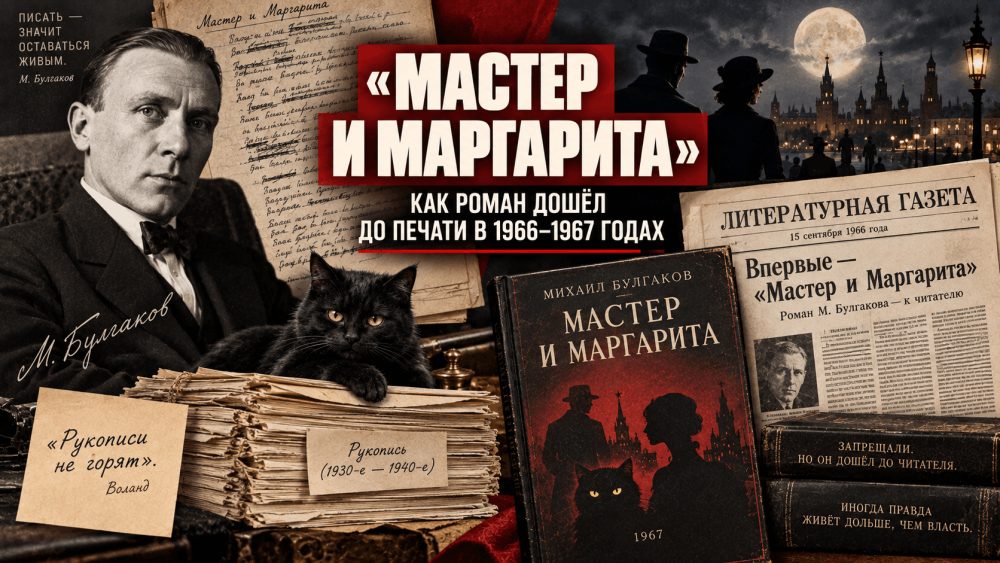
The Master and Margarita first reached Soviet readers through the journal Moskva. Its publication began in issue 11 of 1966 and continued in issue 1 of 1967. Mikhail Bulgakov had died in 1940. Decades separated the author's work on the novel from its appearance in print, and the journal version contained censorship cuts.
The question “When was the novel published?” therefore needs a qualification. It may refer to the first serialization, a separate book or a particular version of the text.
A novel developed through several versions
The Mikhail Bulgakov Museum dates work on the novel to 1928-1940, with interruptions and several stages of revision. Early versions differed substantially from the familiar text. The museum specifically notes that neither the Master nor Margarita appeared in the earliest drafts; those characters emerged in the early 1930s.
The finished title can make the book seem as if its central pair and structure were present from the beginning. The manuscript history shows a developing conception. Bulgakov changed more than individual words: the characters and the organization of the work evolved.
An early draft should consequently not be treated simply as the final novel containing mistakes. It records a different stage of composition. Differences between versions are evidence of that process, rather than obstacles to be removed from the story of the book.
Burning an early manuscript did not end the project
The museum's account of the manuscript describes Bulgakov's destruction of an early version in 1930. A partly burned notebook containing an early draft survives in the Russian State Library's archive.
Destroying one version did not mean that every trace of the work disappeared. Nor should the later novel be imagined merely as an exact reconstruction of the destroyed manuscript. Bulgakov returned to the project and continued to reshape it.
The physical archival object and a literary image belong to different levels of evidence. A scorched notebook documents a particular episode in the work's production. The fictional narrative cannot replace the dating and description of that object, however powerful the association between them may be.
This is one reason the manuscript history deserves attention independently of the famous book's later reputation.
Elena Bulgakova's role
After the writer's death, Elena Bulgakova played a central role in preserving the novel and preparing it for publication. The museum treats her sustained efforts as a distinct stage in the work's history. She recorded revisions during the author's final months and continued working with the surviving materials afterwards.
Preparing a posthumous edition is more complicated than delivering a single folder to a printer. Manuscripts, typescripts, corrections and the order of different versions all have to be considered. Recognizing that work does not transfer authorship of the novel to its editor or custodian. It explains why the route to publication depended on more than the author's completed writing.
Literary history usually remembers the name on the cover. The history of an edition also needs to recognize the people who preserved its documents and worked to make publication possible.
What the 1966-1967 publication achieved
Moskva printed the novel across two issues, but this first appearance was not an unaltered publication of the complete prepared text. Both the museum and the Russian State Library for the Blind identify censorship cuts in the journal version.
The distinction between public availability and textual completeness is fundamental. Readers could encounter the novel, while the printed version still differed from the full material prepared for publication. Official publication did not mean the absence of censorship.
Interest also extended beyond the journal's circulation. The museum describes the copying of the text on typewriters. Publication in print and unofficial circulation could therefore coexist. They should not be represented as mutually exclusive categories in which a work was either officially published or impossible for anyone to read.
A related but different publishing history is that of Boris Pasternak's Doctor Zhivago. The comparison can raise useful questions about readership and publication, but the circumstances of one novel cannot simply be assigned to the other.
Why 1973 is another important date
The Russian State Library for the Blind dates the first separate Soviet book edition to 1973. The years 1966-1967 and 1973 consequently identify different forms of publication, rather than rival answers to the same narrowly defined question.
Three stages provide a basic chronology:
- 1928-1940: the author's work on the novel;
- 1966-1967: the first journal publication;
- 1973: a separate book edition in the USSR.
Foreign editions and translations followed their own histories. A claim about the “first complete edition” therefore requires further information: the language, country and textual version concerned. Giving a single year without those qualifications may create an appearance of certainty that the publishing history does not support.
Serialization also shaped the form of the initial encounter. A novel appearing in successive journal issues was a different physical publication from a single bound volume. Bibliographical details identify that difference even when a modern reader approaches the work as one continuous book.
An apartment and a place in cultural memory
The museum connects the novel's growing readership in the 1970s and 1980s with the emergence of Apartment 50 on Bolshaya Sadovaya as a literary destination. A real address and a fictional setting, however, should not be treated as entirely identical.
The history of the communal apartment helps explain the everyday setting of shared domestic space. It does not turn the novel into a documentary guide to every Moscow apartment. Fiction creates its own world from recognizable circumstances.
Political chronology requires similar precision. The Khrushchev Thaw matters to the history of post-Stalin culture, but the journal publication appeared after Khrushchev's removal from office. The wider availability of Bulgakov's work during perestroika was another stage, not the moment when Soviet readers first encountered The Master and Margarita.
What to examine in an older edition
Start with the publication details: publisher or journal, year, issue and information about the preparation of the text. Then read any editorial explanation. It may identify the material used and the task the editors believed they were performing.
This allows a first edition to be valued as a historical event without assuming that it settled every question about the text. The Master and Margarita has a history of composition, a history of publication and a history of reading. They overlap, but each has its own dates and evidence.
Sources
- Mikhail Bulgakov Museum. An exhibition on the novel's composition.
- Mikhail Bulgakov Museum. The manuscript's history and Elena Bulgakova's role.
- Mikhail Bulgakov Museum. How the novel reached its readers.
- Russian State Library for the Blind. The Master and Margarita: publication history.