Pasternak and Doctor Zhivago: The Nobel Prize and the Ban
Doctor Zhivago appeared in Italy before its author won the Nobel Prize. Its path to Soviet publication reveals the limits of the cultural Thaw.
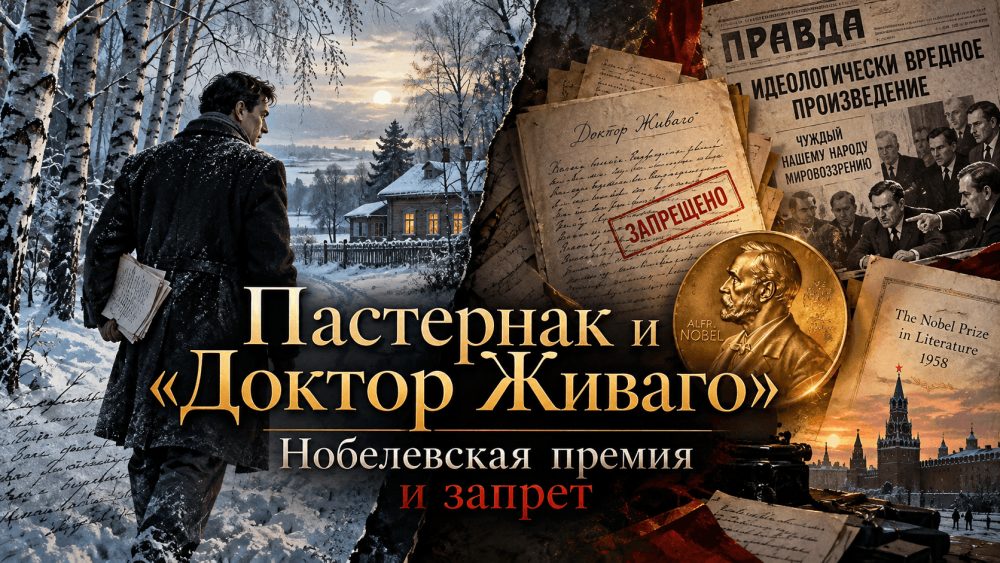
Three dates organize the history of Doctor Zhivago: 1957, when the novel first appeared in print; 1958, when Boris Pasternak received the Nobel Prize in Literature; and 1988, when the book reached official Soviet publication. Keeping those events separate makes a complicated story easier to follow. International recognition and publication in the author's own country were separated by decades.
Why Doctor Zhivago was first published in Italy
Giangiacomo Feltrinelli's publishing house issued Doctor Zhivago in 1957 in an Italian translation. Pasternak wrote in Russian, but Russian was not the language of the first published edition. That distinction matters whenever a short account describes the novel simply as a Russian book published in 1957.
Publication abroad offered a route around the Soviet publishing system's refusal to print the work. Feltrinelli acquired the manuscript and proceeded despite political pressure. What could have been a decision about a book became an international confrontation over who could authorize a writer's account of revolution and Soviet experience.
The novel places private lives within historical upheaval. Love, loss and the individual's inner freedom offer ways into its world. A reader can therefore approach it through the human consequences of events, rather than assuming that a historical transformation justifies every sacrifice demanded along the way. This is a way of framing the book's questions, not a substitute for reading its characters and language.
What the Nobel Prize actually recognized
Pasternak became the 1958 Nobel laureate in literature. Saying that he won “for Doctor Zhivago” is familiar shorthand, but the official citation was broader. It recognized his contribution to contemporary lyric poetry as well as the Russian epic tradition. He was an established writer whose reputation did not begin with a single internationally successful novel.
The Nobel Prize's own record also makes a crucial sequence explicit: Pasternak initially accepted the award, then was compelled by the authorities of his country to decline it. An author rejecting a prize on personal principle and an author renouncing it under pressure are different historical situations. Treating them as interchangeable removes the central fact of the episode.
Pasternak remains listed as the 1958 laureate. His inability to receive the award did not erase the literary decision or leave that year's record without a winner. This is one reason to consult the awarding institution rather than relying on the compressed phrase “he refused the Nobel Prize.”
The limits of the Thaw
The campaign against Pasternak took place during the Khrushchev Thaw. The contrast is revealing. A relaxation of some earlier restrictions did not establish a dependable right to publish abroad or an unrestricted space for interpreting the past.
Public attacks and expulsion from the Writers' Union followed the novel's international success. The controversy therefore affected more than reviews and literary reputation. It put pressure on the author's place within his profession. A debate that might have involved readers assessing a work was transformed into a demand for political alignment.
The episode belongs to the period of Nikita Khrushchev's leadership, but its significance extends beyond one leader's biography. A system could acknowledge literary achievement while punishing the author's independent publication decision. International fame made that contradiction visible. It did not automatically protect the person at its center.
There is also a useful distinction between permission and security. A changing cultural climate can make certain publications possible without giving writers a stable guarantee against a later campaign. The Pasternak affair is a concrete reason to avoid treating the word “Thaw” as a synonym for complete freedom of expression.
Where the CIA enters the story
Doctor Zhivago also became part of the Cold War. The CIA participated in the covert publication and circulation of Russian-language copies. Its museum presents a miniature volume and notes that records concerning the operation were declassified in 2014.
That establishes a role in the book's political use and distribution. It does not establish that an intelligence service wrote the novel or determined the Nobel jury's judgment. Those are separate propositions, requiring different evidence. The distinction between creating a work and exploiting its international reception is essential here.
The CIA museum is an institutional source about the agency's own activity. Its interpretation of that activity should be read with the author's position in mind. For the award, the Nobel Prize record is the more direct reference; for the first edition, the publisher's history matters. Putting these sources alongside each other prevents one dramatic part of the story from swallowing the rest.
Soviet publication in 1988
Novy Mir published the novel in the Soviet Union in 1988, during perestroika. Pasternak had died in 1960.
Calling 1988 the first Soviet publication does not mean that no Soviet citizen had previously read the novel. Foreign editions could reach readers before official publication. The change concerned the book's availability and public standing within Soviet literary life: it could now be discussed as a work that had appeared in a domestic journal.
The long delay also changes how the story reads. The author did not live to see his novel officially published in his country. The later recovery of his public reputation was a historical correction, but it could not give those years back to him.
Two timelines worth keeping apart
One timeline follows the work: manuscript, translation, printing and circulation. Another follows the writer: recognition, pressure and posthumous acceptance. Confusing the two can turn the year of publication into the year of the prize, or make an intelligence operation appear to explain the entire novel.
The history of censorship should not replace the book itself, either. The conflict explains how Doctor Zhivago became an international event. It does not settle every literary question a reader may bring to it. The opportunity to disagree about a work after reading it, rather than in place of reading it, was part of what official publication restored.
Frequently asked questions
Did Pasternak voluntarily reject the Nobel Prize? He sent a refusal, but the Nobel Prize record attributes it to pressure from his country's authorities. He had initially accepted.
Was Doctor Zhivago first published in Russia? No. Its first publication was an Italian translation issued in Italy in 1957.
Why is 1988 an important date? It marks publication in the Soviet journal Novy Mir, not the novel's composition or the Nobel award.