The Irony of Fate: The 1975 Film, Its 1976 Premiere and Its Voices
Why The Irony of Fate has two dates, when it premiered on television and how Brylska, Talyzina and Pugacheva contributed to Nadya’s screen character.
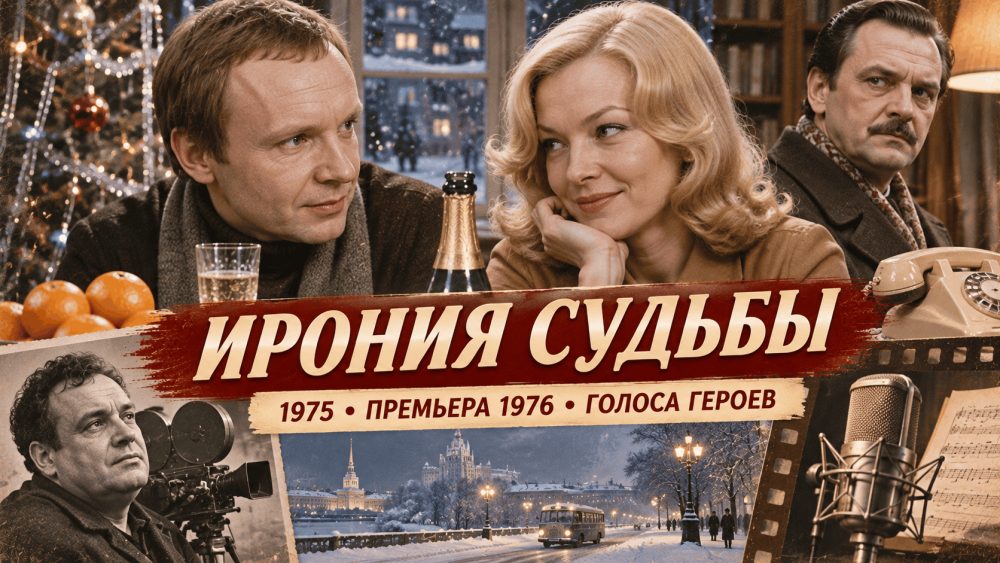
The Irony of Fate, or Enjoy Your Bath! is associated with both 1975 and 1976. The first is its production year; the second marks its arrival before television viewers. Its television premiere took place on 1 January 1976. Different dates in catalogues therefore need not be contradictory: they may identify different events.
Another distinction concerns Nadya Shevelyova. Barbara Brylska played her on screen, Valentina Talyzina supplied her speaking voice and Alla Pugacheva sang her songs. The audience encounters one character, although several performers contributed to the finished result.
Production, television and cinema
Film researcher Nikolai Mayorov's Pervye v Kino catalogue dates the production to 1975 and records its television premiere at 17:45 on 1 January 1976. It separately dates the cinema version's Soviet release to 16 July 1976.
Mosfilm's official catalogue uses 1976 in its release-date field and describes the work as a two-part television film. The entries address different aspects of the same history. Production, first broadcast and theatrical distribution are not automatically simultaneous.
Both years can help identify the film. When the question is when viewers first encountered it on television, however, the relevant date is New Year's Day 1976. A production date should not silently replace a premiere date, or vice versa.
A familiar address becomes unfamiliar territory
Mosfilm's synopsis begins with Zhenya Lukashin and his friends visiting a bathhouse before New Year. A mistaken journey takes him to Leningrad and into another person's apartment. Mayorov's plot description explains the coincidence: the address matches his Moscow address, and the apartment is of the same standard type.
The premise can be read as a comic exaggeration of a recognisable urban experience. Surroundings seem familiar before the character understands where he is. But the coincidence is not documentary evidence that Soviet apartments were identical in every detail. The story uses an improbable match to make ordinary habits unreliable.
This distinction permits a connection with the history of mass housing without treating a fictional plot as a statistical source. A comedy can take an everyday feature and amplify it into a situation that is unlikely yet immediately intelligible.
The mistaken apartment also narrows the story's space. A journey between cities leads to an encounter indoors, where recognising a room is less important than understanding another person. That is an interpretation of the premise rather than a claim about an explicitly recorded intention of the filmmakers.
The work behind the director's name
Eldar Ryazanov directed the film and co-wrote its screenplay with Emil Braginsky. Mikael Tariverdiev composed the music, Vladimir Nakhabtsev was the cinematographer and Aleksandr Borisov the production designer. Andrey Myagkov, Barbara Brylska and Yuri Yakovlev played the central roles.
These credits identify different contributions to a scene. Dialogue, performance, camera position, objects and recorded sound combine into the finished encounter. Attributing the entire effect to a director alone leaves much of that process invisible.
A cast list likewise describes only part of what reaches the audience. On-screen acting and the recorded voice can be supplied by different people. In this film, that distinction is particularly important to the central female character.
Three performers, one Nadya
In a 2004 interview with Moskovsky Komsomolets, Talyzina discussed the relationship between image and sound in The Irony of Fate. The published interview identifies Brylska's screen performance, Talyzina's dubbing and Pugacheva's singing as separate contributions. It is a participant's retrospective account, recorded decades after production, rather than a contemporary studio report.
Talyzina also appears as one of Nadya's friends. Her visible supporting role and her contribution to the heroine's voice were different jobs. A reader consulting the cast list should not assume that the listed on-screen part describes everything the performer did.
The finished character raises an interesting question about reception. Viewers usually follow a conversation or an emotional change without dividing it into image, dialogue recording and song performance. That observation offers one way to understand the film's construction; it does not establish what every spectator heard or what every collaborator intended.
Music beyond the complete film
The music has also had a life outside the full narrative. Mosfilm's account of its January 2024 centenary concert records a performance of Tariverdiev's setting of a Marina Tsvetaeva poem associated with The Irony of Fate. It is a concrete example of the film being remembered through music rather than a complete screening.
Its history can therefore be followed through several distinct layers: production in 1975, television premiere in 1976, the assembly of screen performance and voice, and later cultural remembrance. Keeping those layers separate brings a familiar holiday title back into focus as a specific collaborative work.