Office Romance 1977: From a Play to Screen Moscow
How Co-workers became Office Romance: the filmmakers, the separate locations behind one fictional office, urban space and dialogue beyond the screen.
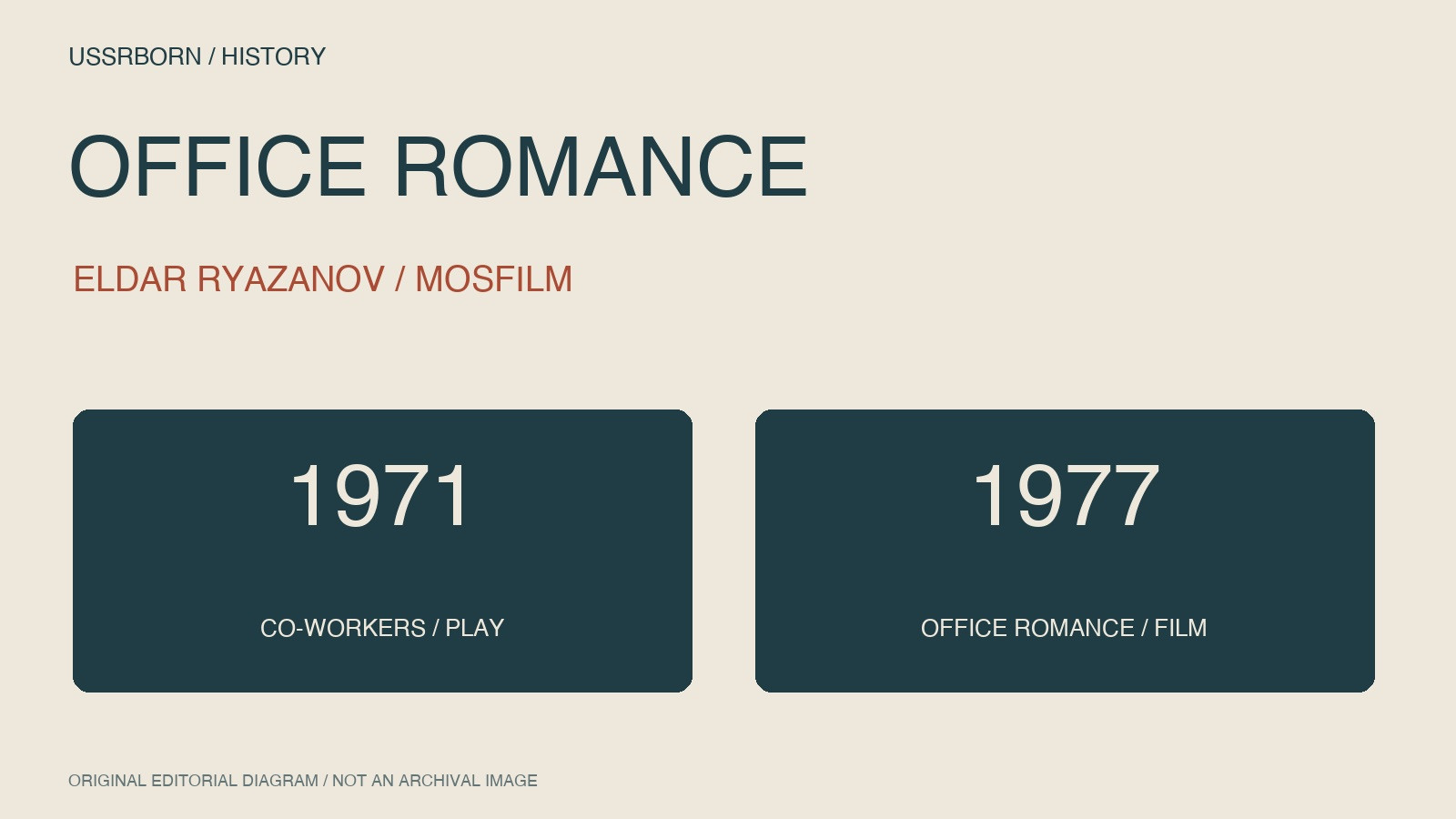
Eldar Ryazanov's Office Romance was released in 1977. Its story centres on a statistical institution, but an office manoeuvre becomes a problem of recognising the person behind a professional role. Three aspects help explain the film: its origins in a play, the construction of its screen geography and the afterlife of its dialogue in everyday speech.
From a play to a two-part film
The screenplay grew out of Co-workers, a play written by Ryazanov and Emil Braginsky. Mosfilm dates the play to 1971. Both writers also worked on the film's screenplay. The adaptation was therefore a return to their own dramatic material rather than the discovery of an unrelated story about a supervisor and an employee.
The studio catalogue identifies the film as a comedy in two parts. Ryazanov directed; Vladimir Nakhabtsev was the cinematographer, Andrei Petrov the composer, and Sergei Voronkov and Alexander Borisov the production designers. Alisa Freindlich and Andrei Myagkov play the central characters, alongside Svetlana Nemolyaeva, Oleg Basilashvili, Liya Akhedzhakova and Lyudmila Ivanova.
A theatrical origin does not require a film to remain a recording of conversations in one room. Cinema can alter the viewer's distance from a character, combine locations, follow journeys to work and place a person against a city. These possibilities offer a useful starting point for thinking about what happens when a dramatic premise moves from stage to screen.
The difficulty created by a career calculation
In the studio's synopsis, Samokhvalov advises Novoseltsev to court his superior in the hope of promotion. A genuine attachment develops from that calculation. The premise makes the relationship more complicated than an ordinary meeting: its future carries a question about its beginning.
One way to read this is as a conflict between two approaches to another person. Initially, the superior is treated as a means of obtaining a job. A personal relationship requires responsibility towards her as an individual. This interpretation does not reduce the plot to a moral formula, but it explains why announcing a sincere feeling cannot automatically erase the significance of an earlier motive.
A second question concerns the audience's first impressions. A collective nickname, an official manner and a person's appearance can seem to supply a complete biography. The comedy has room to develop because those impressions are incomplete. A viewer can sympathise with the heroine while also questioning the expectations imposed on the appearance of a woman in authority. Accepting the emotional story does not require endorsing every judgement made by the office around her.
One institution assembled from several places
The institution on screen does not correspond to one real building. Mosfilm identifies a facade on Kuznetsky Most, interiors constructed in its studio pavilions and a rooftop in Bolshoy Gnezdnikovsky Lane. The Russian Cinema Map likewise identifies the Nirnsee House as the rooftop location.
On screen these elements become a continuous working environment. Finding the facade consequently does not mean finding Kalugina's office behind the same windows. It is a useful example of how a film can produce convincing geography from physically separate spaces. The address of a shoot and the location of a fictional institution answer different questions.
This distinction also helps when exploring other Soviet films. A recognisable exterior is material for a constructed screen world. Its apparent continuity with an interior may be an achievement of production design and editing rather than a fact about the original building.
Moscow between the office scenes
Mosfilm describes the city views as a way of opening out action otherwise concentrated in interiors. Moscow connects office life with journeys, homes and private time. In our reading, such transitions matter because an official role does not operate with equal force at a desk, in the street and at home.
The Cinema Map separately lists Novoseltsev's house in Chernyshevsky Lane and Losinoostrovskaya station among the shooting locations. A list of addresses is not, however, an interpretation in itself. The movement between places reminds the viewer that employees arrive at work from different circumstances. The institution brings them together without making their lives identical.
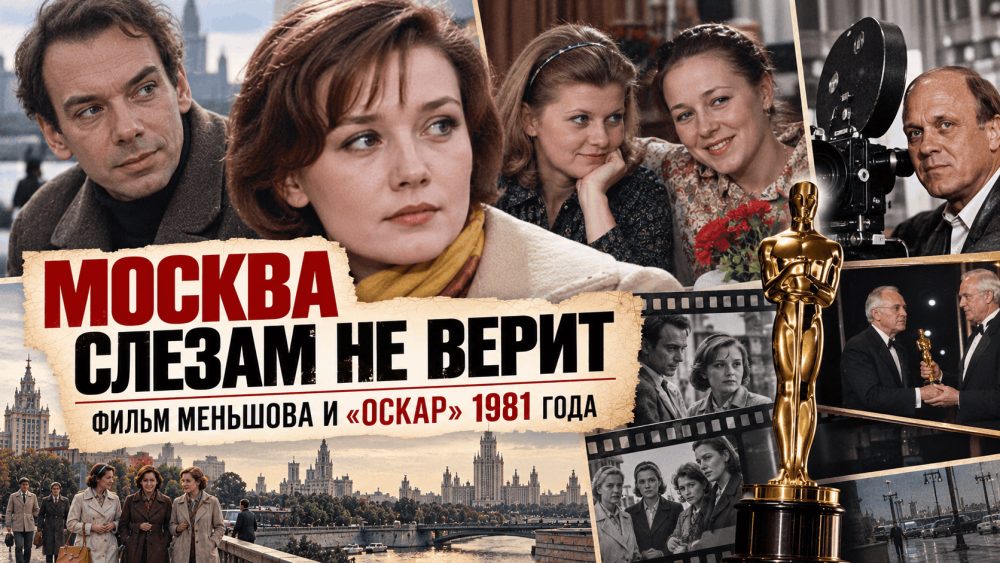
The emphasis on urban life, employment and personal relationships invites comparison with Moscow Does Not Believe in Tears. This is a comparison of themes, not a claim that the films tell the same story or use the same dramatic structure. A useful comparison asks what each work chooses to make visible about the connection between public responsibilities and private hopes.
Music and the life of dialogue
Andrei Petrov composed the music. Discussing the musical dimension requires distinguishing musical composition from the authorship of lyrics, and both from the screenplay. A familiar song should not obscure the collaborative nature of a film. Performers, writers, designers and other members of the production contribute different kinds of work.
The Pushkin Institute's cultural dictionary gives Office Romance a separate section on language and speech. It treats lines from the film as expressions used outside their original scenes. This points to another kind of cultural presence: a person may recognise an intonation or situation without remembering the sequence of the story.
That presence is not the same as an audience total. It concerns how people reuse familiar material to describe daily experience. A line may acquire a new context in conversation while retaining an association with a character or attitude. Studying that process means asking how the film is remembered, rather than simply how many times it has been watched.
When reading about life in the USSR, it is useful to distinguish such shared images from documentary evidence about the actual organisation of offices. Both are historically interesting, but they support different conclusions.
A comedy is not a survey of every workplace
The film contains recognisable professional roles and interpersonal situations. It cannot be treated as a representative sample of all Soviet working collectives. Comedy selects and arranges circumstances for dramatic purposes. Administrative history requires other evidence, just as the introduction of the five-day working week has to be reconstructed from the relevant decisions and practices.
Office Romance remains interesting as an artistic exploration of the boundary between a public role and a private life. A productive question on revisiting it is what we have already assumed about a character because of their position, and what we have yet to notice. Behind the familiar title lies a story about attention, calculation and the difficulty of earning trust.