Moscow Does Not Believe in Tears: Menshov’s Film and the 1981 Oscar
Three friends, urban life and an international award: why Mosfilm dates Moscow Does Not Believe in Tears to 1979, while its Oscar was presented in 1981.
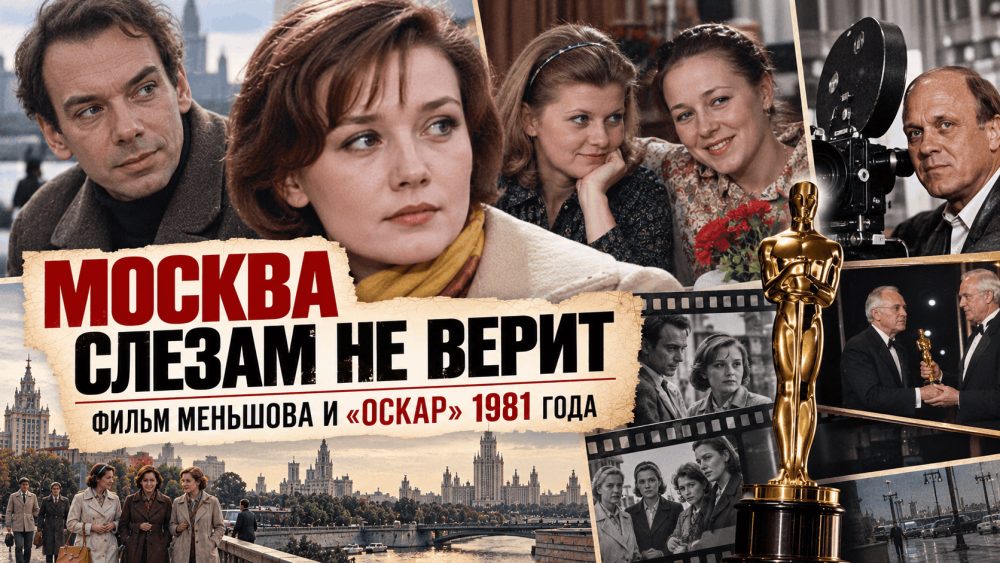
Vladimir Menshov’s Moscow Does Not Believe in Tears won an Academy Award on 31 March 1981. Its victory was in the Foreign Language Film category, not Best Director for Menshov or the overall Best Picture category. The Academy’s archive lists the Soviet Union alongside the winning title.
Mosfilm’s catalogue dates the film to 1979, while the 1981 ceremony honoured films released in 1980. These labels belong to different cataloguing and awards contexts. The date of the ceremony should not replace the film’s year in the studio catalogue.
Three friends in a large city
The studio synopsis begins in 1950s Moscow, where three young newcomers share a hostel and seek love, prosperity and a place in the city. Their friendship continues through changing circumstances. Valentin Chernykh wrote the screenplay; the ensemble includes Vera Alentova, Irina Muravyova, Raisa Ryazanova and Aleksey Batalov.
That starting point offers several ways into the film. One viewer may follow the romantic story most closely, another the difficulty of establishing a life in an unfamiliar city, and a third the relationships between friends. These approaches can coexist.
The hostel establishes a particular starting position: private ambitions must take shape in a shared living environment. For historical context, an account of everyday life in the USSR provides a useful comparison. A fictional narrative, however, is not a representative survey of all Soviet women.
A character can be convincing without standing for an entire population. Keeping that distinction in mind allows the film to suggest historical questions while retaining its freedom to build a particular story.
Melodrama and social position
A melodramatic narrative connects large ambitions with immediate relationships. Love, prosperity and recognition sound abstract until someone has to decide whom to trust and what would count as a successful life. The question “Has the heroine found happiness?” can therefore sit beside another: “Whose standards define her success?”
This is a proposed interpretation, not a documented statement of every filmmaker’s intention. It offers a way to see more in a story of migration to the capital than a sequence of romantic coincidences.
Read this way, the city becomes a space of comparison. Personal expectations meet other people’s ideas about an appropriate family, social standing and well-being. When these measures diverge, an ordinary conversation can carry a dramatic conflict without a major public event taking place behind it.
An account of the communal apartment provides another perspective on the relationship between personal space and collective life. A hostel and a communal flat are different arrangements. Treating both as an undifferentiated form of “Soviet housing” would conceal useful distinctions. Comparison is valuable precisely because it helps reveal them.
The same care applies to reading on-screen material surroundings. They can prompt questions about privacy, aspiration and status, but their presence in a film is not sufficient evidence of how frequently a particular experience occurred across society.
What the Oscar establishes
The record of the 53rd Academy Awards lists one nomination and one win for the film. The historical category name was Foreign Language Film. This identifies a particular competition, not a universal ranking of every film made in the world.
The prize establishes international recognition, but does not disclose each Academy voter’s motivation. A winners’ list cannot demonstrate that the film was chosen solely for a political message, its cast or a particular scene. Those claims would require additional evidence.
Mosfilm’s institutional history places the award among the studio’s international achievements. Its later re-release announcement also connects the victory with those of War and Peace and Dersu Uzala. This is helpful context, provided that awards are still distinguished by their categories.
The success of The Cranes Are Flying at Cannes, for example, belongs to a different festival and selection process. Calling every such distinction simply “best film” erases part of the history.
An award can make a work easier to discover. It cannot dictate how a later viewer should respond to every character or resolve disagreements about the story’s treatment of relationships.
Songs and a return to cinemas
In its 2021 re-release announcement, Mosfilm highlighted Sergei Nikitin’s contribution: he composed music for the film’s songs and performed them with Tatyana Nikitina. Aleksandra is among the titles listed. No lyrics are reproduced here.
A useful way to approach a musical passage is to consider it alongside the image. Does it alter the pace? What feelings remain unspoken in dialogue? How does sound connect separate impressions? These are questions for viewing, not assumptions that every audience member responds alike.
The same studio announcement described a restored cinema re-release in August 2021 marking the award’s fortieth anniversary. The film’s history therefore extends beyond its initial circulation. Later screenings, restoration and different viewing settings become separate parts of its life.
The announcement is a dated record of that re-release, rather than a claim that those screenings are still taking place. It demonstrates how an established film can acquire new occasions for public viewing long after its original production.
Approaching the film today
It is worth encountering the complete story before returning to the award record. The Oscar may draw attention to it, but need not preselect the viewer’s emotional response.
For a wider setting, the overview of Soviet cinema places it within a more varied filmmaking history. Moscow Does Not Believe in Tears is interesting for the relationship between personal expectations, urban life and international recognition, without needing to serve as the single definitive portrait of an era.
What is the film’s year? Mosfilm’s catalogue lists 1979.
When did it win the Oscar? At the ceremony on 31 March 1981, honouring films released in 1980.
Which award did it win? Foreign Language Film, representing the Soviet Union in the Academy’s record.