Ivan’s Childhood (1962): Tarkovsky’s First Feature and Its Venice Prize
Bogomolov’s story, Ivan’s dreams and Tarkovsky’s first feature: how Ivan’s Childhood shared the Golden Lion at Venice in 1962.

Released in 1962, Ivan's Childhood was Andrei Tarkovsky's first feature film. Its story of a boy working as a wartime scout brought the director a Golden Lion at the Venice Film Festival. Yet the film's significance is not exhausted by the award. Its title directs attention beyond the military assignment to the child's life that war has destroyed.
Bogomolov's story and Tarkovsky's film
The film is based on Vladimir Bogomolov's story Ivan. Its central character is a twelve-year-old boy who has lost his parents and undertakes reconnaissance assignments. Mosfilm's catalogue credits Bogomolov and Mikhail Papava for the screenplay, Vadim Yusov for cinematography and Vyacheslav Ovchinnikov for music. Nikolai Burlyayev played Ivan.
The two titles suggest slightly different emphases. A personal name identifies an individual; adding “childhood” also identifies a part of his life that cannot be reduced to military service. This is a way of reading the title, not a claim that the film mechanically corrects its source. A useful comparison asks how each medium gives access to a character's experience.
Within the history of Soviet cinema, the adaptation deserves attention as a work in its own right. Knowing its literary basis is valuable, but that knowledge cannot replace attention to the arrangement of images, sound and episodes.
Dreams and the child's inner life
In the British Film Institute's programme notes, critic Ian Christie draws attention to a difference in narrative organization. Bogomolov's story is told by Lieutenant Galtsev, whereas the film introduces Ivan's dreams and does not maintain a single viewpoint. Christie treats the dreams as a distinct narrative strand that gives space to the child's inner life.
This suggests a productive question for a viewer: what do military events tell us about Ivan, and what becomes accessible outside the sequence of assignments? Completing a task successfully cannot, by itself, describe the experience of grief. A summary confined to actions can therefore miss the film's central concern even when it accurately recounts the outward plot.
It is not necessary to search for a fixed dictionary in which every object translates into a ready-made symbol. A more useful approach is to notice changes in an episode's emotional register, the relationship between anticipation and danger, and the difference between what a character can say and what remains beyond speech. These are questions for attentive viewing rather than a universal key to the director's work.
They also keep interpretation connected to the film instead of turning it into a test with one approved answer. Different viewers may emphasize different details while still supporting their readings through what the work presents.
Venice: a shared Golden Lion
The Venice Film Festival's official history lists two winners for 1962: Tarkovsky's Ivan's Childhood and Valerio Zurlini's Cronaca familiare, also known as Family Diary. The precise formulation is that the film shared the Golden Lion. It was not the sole recipient of the festival's principal award that year.
Sharing the prize did not make it a lower-ranking award. It meant that the jury recognized two films at the highest level. Conversely, a jury's decision should not be described as a poll of every viewer or as an objective league table of world cinema.
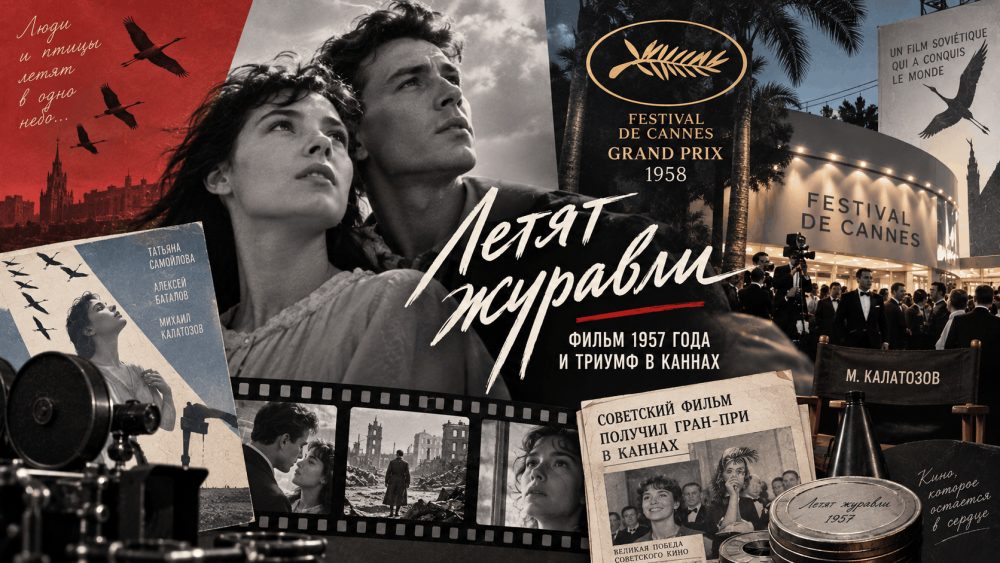
The history of The Cranes Are Flying and its 1958 Cannes success offers a useful comparison. These were different films, directors, festivals and awards. Their relationship concerns international attention to Soviet filmmaking, not participation in one continuous competition.
A festival record establishes what was awarded and to whom. Explaining why a particular viewer finds a film powerful requires another kind of discussion. Keeping those questions separate allows the achievement to be described accurately without using the prize as a substitute for interpretation.
Tarkovsky's account after the festival
Mosfilm has republished an archival interview in which Tarkovsky recalled the surprise of receiving the award and foreign journalists' questions about a Soviet new wave. He acknowledged the emergence of talented young filmmakers without presenting them as a single movement united by one program. The studio's retrospective introduction dates the film's premiere to 9 May 1962.
This testimony is useful alongside later descriptions of the period. A critic may group films through shared characteristics while an artist explains his relationship to contemporaries differently. The difference need not amount to a factual contradiction: an analytical category and a participant's self-description serve different purposes.
The context of the Khrushchev Thaw helps frame questions about a generation of filmmakers, but it cannot replace the substance of an individual film. Assigning the work to an era is the beginning of an inquiry, not a complete account of its meaning.
Encountering early Tarkovsky on its own terms
Ivan's Childhood should not be treated only as preparation for later films. Its subject is already substantial: a child living in a world where adult military responsibilities displace ordinary life. Keeping that tension in view is more useful than reducing Ivan exclusively to courage or exclusively to suffering.
Comparison with Stalker, released in 1979, can be an interesting second step. Recognizing motifs associated with later Tarkovsky should not prevent a viewer from encountering the independent drama of 1962. The international award explains part of its reception history; attention to the child at its center helps explain the continuing interest in the film itself.