Tarkovsky’s Stalker: The Zone and the 1979 Film
How Stalker reshaped Roadside Picnic, where Tarkovsky filmed the Zone, and why the film predates Chernobyl. An introduction without an ending recap.
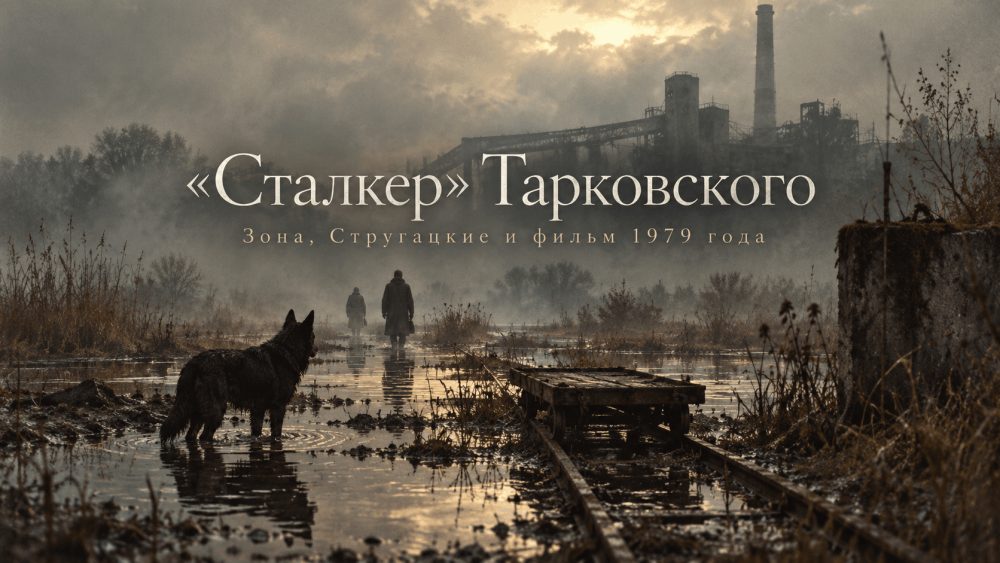
Andrei Tarkovsky's Stalker appeared in 1979. Its starting situation is straightforward: a guide takes a Writer and a Professor into a forbidden Zone, where a place is rumored to fulfill a person's deepest wishes. Gradually, the journey shifts attention from the dangerous route to the travelers themselves. What a person actually wants becomes harder to establish than where he intends to go.
The film draws on Roadside Picnic by Arkady and Boris Strugatsky. Shared words, images and later cultural associations can blur the differences between the book, the film and real historical events. Separating them is more useful than searching for one definitive solution to the Zone.
From Roadside Picnic to Stalker
The Strugatskys wrote Roadside Picnic in 1971; its first publication followed in the magazine Aurora in 1972. In the book, a stalker enters the Zone and brings out unusual objects. The activity involves earning a living, taking risks and breaking the law. The narrative follows different episodes in its protagonist's life.
Tarkovsky's film concentrates on a single journey involving three men. The Strugatsky brothers themselves wrote the screenplay, but the literary material was substantially reshaped. The screen Stalker is more than a supplier of valuable objects. His role as a guide is bound up with hope and a particular sense of responsibility toward other people.
Expecting an illustrated version of the book can therefore make the film harder to appreciate. Both works ask questions about dangerous knowledge and human desire, but they do so through different forms. Fiction can describe the workings of an extensive imagined society. Tarkovsky's cinema places unusual weight on the duration of a look, a pause, a sound or the physical distance between people.
Neither approach has to replace the other. Comparing them is most productive when the question is what the adaptation chooses to concentrate on, rather than how many incidents it has preserved.
The three travelers
Aleksandr Kaidanovsky plays the Stalker, Anatoly Solonitsyn the Writer, and Nikolai Grinko the Professor. Alisa Freindlich plays the Stalker's wife. The film credits include cinematographer Alexander Knyazhinsky and composer Eduard Artemyev.
The names Writer and Professor invite an initial distinction between creative and investigative ways of approaching the world. Yet reducing the men to fixed emblems of Art and Science misses their changing behavior. It is more revealing to follow the moments when certainty gives way to irritation, hesitation or dependence on someone else.
The Stalker is not an all-knowing tour leader who hands the audience a reliable manual. His conviction cannot give viewers a fully testable account of the Zone. His companions must make decisions without complete information about the place, the guide or their own reasons for going there. That problem can feel recognizable even when the setting does not.
Why the Room is unsettling
At first, the possibility of the Room seems to offer a reward: reach the destination and receive what you want. But a deepest wish is not necessarily the same as a request prepared in advance. People can give admirable explanations for their actions while remaining uncertain whether those explanations tell the whole story.
One way of reading the film's central tension is therefore to locate danger in self-knowledge as well as geography. What if reaching the goal exposed a motive that a traveler would rather not acknowledge? This is an interpretation, not an official set of instructions left by Tarkovsky. The film does not provide a verified rulebook that makes every scene unambiguous.
In his Criterion essay, critic Mark Le Fanu examines the film's spiritual concerns and the director's reflections during its development. Such criticism offers a way into the seriousness of its religious questions. It need not turn every image into a symbol with one compulsory translation.
The difference matters because an explanation can close off attention as easily as open it. If a viewer has already decided what every person and object represents, there is less room to notice uncertainty, contradiction and changes in tone.
Where the Zone was filmed
Important location sequences were shot in Estonia, in and around Tallinn. Patrick Gamble's exploration of the locations for the British Film Institute shows how actual industrial spaces became part of the imagined landscape. Water, vegetation and evidence of human work make it feel recognizable without making it reassuring.
The effect does not always require an unfamiliar machine or an elaborate spectacle. It can arise from changing the way the camera and the characters attend to an ordinary place. A passage becomes a trial; a pause becomes an event. Watching familiar objects acquire importance through attention is one useful way to approach the film's visual world.
Stalker belongs to the history of Soviet cinema and was produced during Leonid Brezhnev's leadership. Its landscapes should not be treated as a documentary inventory of the country. Recognizable features of everyday Soviet life are arranged for an artistic purpose, while the story's setting is not given an ordinary geographical address.
Why Stalker is not a film about Chernobyl
The film dates from 1979; the Chernobyl nuclear accident occurred in 1986. Stalker was not shot in the Chernobyl exclusion zone. The later association is understandable: restricted territory, abandoned structures and invisible danger can call up similar images. That resemblance does not change the production chronology.
Describing the film as prophetic can convey a viewer's impression. As history, it is more precise to say that later events changed how people understood an earlier work. New audiences bring experiences that the film's first viewers could not have possessed. Recognizing this process preserves both the chronology and the force of the association.
It also prevents a fictional landscape from becoming evidence about a real disaster. A film can help articulate a later fear without having documented its cause or circumstances.
Approaching a first viewing
There is no need to read every explanation of the ending in advance. Three questions can provide a useful starting point: who trusts whom at this moment, what makes a traveler hesitate, and how does the promise of the destination differ from the experience of the journey? They help follow the action without turning the screening into a test of symbolic knowledge.
This introduction leaves the ending unexplained. The film can leave a viewer uncertain, and the viewer can resist its tone or conclusions. Part of its interest lies in the fact that questions of hope, belief and responsibility cannot simply be answered on behalf of the people making the journey.
Frequently asked questions
Is Stalker a faithful scene-by-scene adaptation? No. It substantially reshapes Roadside Picnic, although the book's authors also wrote the screenplay.
Is the Zone in Chernobyl? No. That connection belongs to later reception. The film predates the accident by seven years, and its major location work took place in Estonia.
Does the film have one correct explanation? There are persuasive interpretations, but they should be distinguished from documented production facts and the director's own statements.