Road to Life: Sound, the 1931 Premiere and Venice Recognition
Explore Road to Life through its makers, premiere venue, Venice audience referendum, later soundtrack revision and digital restoration.
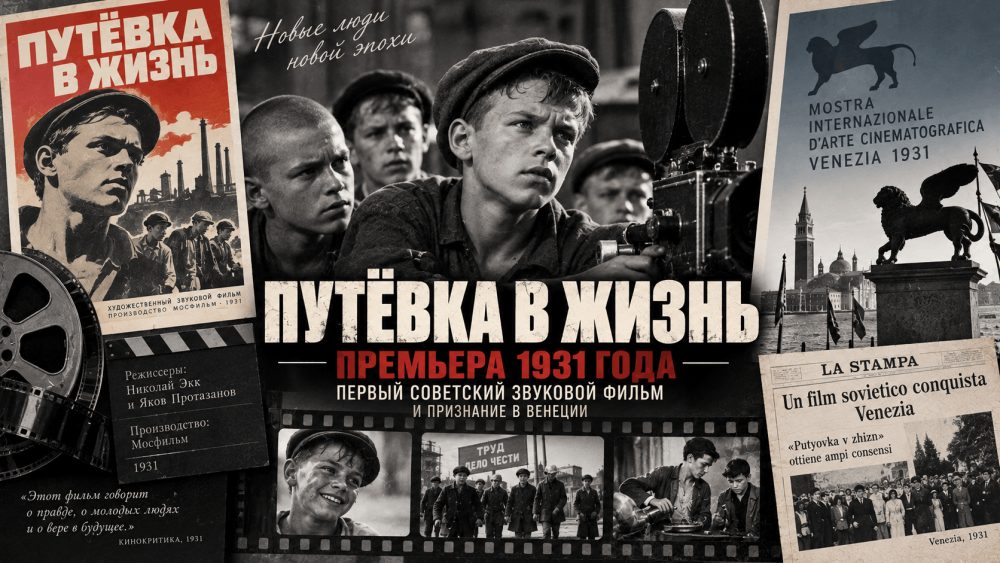
Nikolai Ekk's Road to Life appeared in 1931 and became known as the first Soviet feature-length sound fiction film. Its importance, however, is not exhausted by the presence of recorded speech. The film connects a new technical possibility with a story about homeless children offered a different life in a labour commune.
Its subsequent history is equally instructive: exhibition, international recognition, revision and restoration. Following those separate strands clarifies the premiere, the response in Venice and the difference between a work dated 1931 and a particular copy available today.
The filmmakers and their subject
Ekk directed the film for Mezhrabpomfilm. The Venice Biennale archive identifies Ekk, Aleksandr Stolper and Regina Yanushkevich as its screenwriters. The cast includes Nikolai Batalov, Yvan Kyrlya, Mikhail Dzhagofarov and Mikhail Zharov.
Gosfilmofond summarizes the story through Sergeyev, the head of a labour commune who takes homeless children into his care for re-education. This is a fictional account of the possibility of changing lives, not a statistical report on children's institutions.
That distinction matters in historical viewing. A character can embody a hope, a pedagogical idea or a political expectation. The character's fate does not establish what happened to every child living in comparable circumstances.
Where the premiere took place
In recollections published in Vechernyaya Moskva on 9 August 1958, Ekk dated the premiere to 1 June 1931. He named the Koloss cinema and explained that it operated in the Great Hall of the Moscow Conservatory. References to a cinema and to the conservatory can therefore describe the same screening.
This small detail illustrates a wider issue with historical addresses. An institution's name and the building it occupies need not be identical. Without an explanation, different descriptions of a venue can be mistaken for contradictory accounts.
Ekk also recalled location work at Kolomenskoye and Bolshevo. His text should be treated as a participant's retrospective testimony. Its value does not require presenting every remembered detail as a fact independently established by several sources.
What to listen for in a sound film
Within the history of Soviet cinema, recorded sound expanded the available expressive tools. Viewers can attend not only to dialogue but also to the relationship between voices, pauses, music and images. Asking what is audible can be followed by asking why it becomes audible at that moment.
This is a suggestion for attentive viewing, not a claim that silent cinema had no musical accompaniment or that sound automatically improved every film. A technical possibility and the artistic use made of it are different subjects.
The description of the film's priority should also retain its qualifications: Soviet, feature-length, sound and fiction. Reducing it to the first film with sound confuses countries, forms of cinema and earlier recording experiments. Precision makes its achievement clearer rather than smaller.
Venice in 1932: an audience referendum
The Venice Film Festival's official history states that no official awards were presented at its first edition in 1932. An audience referendum named Ekk best director for Road to Life. The festival archive separately records the film's participation in that inaugural exhibition.
Describing this simply as a directing prize can give the wrong impression of a modern competition with a jury and a settled award structure. Explaining the procedure preserves the recognition while avoiding institutions that did not yet exist in that form.
The recognition of The Cranes Are Flying at Cannes in 1958 belongs to a different festival history. The word victory can cover many kinds of success in everyday language. Historical discussion benefits from identifying the event and the mechanism by which recognition was given.
Why the version matters
In his 1958 article, Ekk discussed rerecording the soundtrack and undertaking a new directorial and literary revision. This testimony shows that the film's later life involved changes to its sound and textual organization. The original production year cannot tell us everything about each surviving edition.
On 30 March 2026, Gosfilmofond announced completion of a digital restoration. Its short notice does not specify every source element or restoration decision. Nor does it establish that any copy found online is necessarily that restoration.
Before viewing, it is useful to examine the credits, edition information and the supplying archive's description. Running time alone may not identify a version reliably. For early sound cinema, the histories of image and soundtrack can require separate explanations.
These checks need not turn a screening into a technical investigation. They simply establish what is being watched. A work's date, an edition's date and a restoration announcement answer different questions.
Approaching the historical drama
Three questions offer a productive starting point. How are the characters' lives organized into a story? How does sound contribute to its telling? What model of education and collective life does the film present? These questions encourage a more specific discussion than a list of technical firsts.
The broader setting can be explored through the literacy campaign and compulsory schooling in 1930. A labour commune, an ordinary school and adult literacy classes were not the same institution. Their coexistence within one historical period does not erase differences in purpose.
Road to Life can be approached both as a film and as evidence about the ideas of its time. Neither approach requires treating fiction as a complete social survey or inflating its festival distinctions. Identifying the work, its version and the questions brought to it provides a firmer foundation for discussion.
Sources
- Venice Biennale archive: Putyovka v zhizn: production year, studio, filmmakers and festival participation.
- History of the Venice Film Festival: the 1932 audience referendum and absence of official awards.
- Nikolai Ekk: recollections about the film and its makers: his 1958 account of the premiere and subsequent revision.
- Gosfilmofond's digital restoration announcement: the story outline and completion of restoration work in 2026.
The cover is an original diagram of two events, not a film frame or a historical poster.