Hedgehog in the Fog: Making Norstein’s 1975 Film
Norstein, Yarbusova and Zhukovsky, layered photography, Soyuzmultfilm production records and the recognition of Hedgehog in the Fog.
Hedgehog in the Fog is Yuri Norstein's 1975 short film, made at Soyuzmultfilm from a script by Sergei Kozlov. Its starting point is almost domestic: a small character is on his way to visit a friend. The familiar journey becomes an encounter with a world in which something visible may remain uncertain, and something uncertain is not necessarily hostile.
The film's effect depends less on the number of incidents than on how they are experienced. Objects emerge and disappear; sounds suggest a surrounding space; pauses allow expectation to develop. Looking at the construction of the image helps explain why this brief journey feels so substantial.
A collaboration behind the familiar name
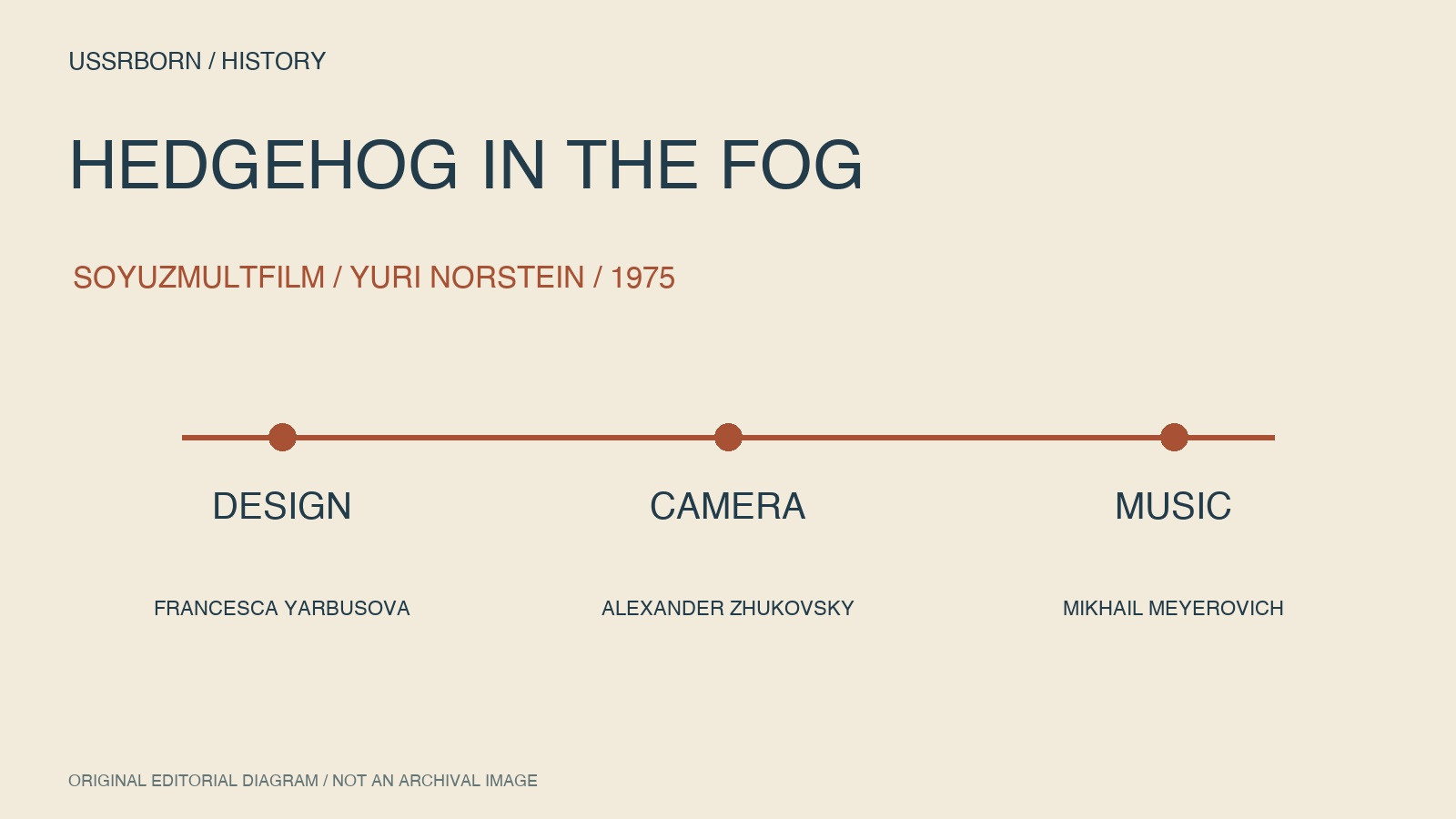
Animator.ru credits Francesca Yarbusova as production designer, Alexander Zhukovsky as cinematographer and Mikhail Meyerovich as composer. Norstein directed and animated the film. Maria Vinogradova voiced Hedgehog and Vyacheslav Nevinny voiced Bear Cub, with Alexei Batalov also contributing to the soundtrack.
Those different responsibilities are worth keeping in view. Design establishes a character and its surroundings. Animation gives that character behaviour. Photography determines how depth, transparency and visual texture appear on screen. Music helps shape the experience of tension and release. A celebrated director's name should not conceal the collaboration through which the film was made.
The database classifies the work as cutout animation and records a running time of 10 minutes and 29 seconds. In a film of that length, a pause or a small movement occupies a meaningful share of the whole. The brevity is not an absence of detail; it makes the timing of details especially consequential.
From an idea to a studio production
The Russian State Archive of Literature and Art, RGALI, preserves production material in the Soyuzmultfilm collection. Its published selection includes an order for the film dated 20 February 1975 and an art-council discussion of the visual treatment dated 20 March.
These records restore the practical process behind a seemingly self-contained artwork. An idea had to be developed, presented and made by a working crew. The date of a production order is not necessarily the date of the first inspiration, just as approval of drawings does not mean that the finished film already exists.
A later anniversary post from Soyuzmultfilm states that permission for distribution was received in December 1975. Production year, studio decisions and distribution authorization are different parts of a film's chronology. Treating one isolated date as if it described the entire process makes the history less clear.
Fog as an active part of the picture
RGALI describes the action as being organized between layers of glass. The layered arrangement helped create a whitening depth in which characters and environmental details could appear with different degrees of clarity.
For the viewer, that changes the act of looking. In a clear scene, an object can immediately have an identifiable outline and position. In fog, a patch or suggestion may come first, with recognition following later. The setting therefore participates in the action by controlling what can be distinguished and when.
In a recollection published by the studio, Yarbusova described combining filmed water with drawn leaves and treating the water image with drawn strokes to make the textures work together. The account suggests an experimental production process rather than a single magic trick that explains every shot.
This distinction is helpful when appreciating animation. The finished scene can feel unified even when different methods contributed to it. The viewer experiences one world; the artists have had to make its separate elements belong together.
How a short journey acquires emotional scale
The destination, a visit to Bear Cub, gives the story a familiar anchor. On the way, ordinary confidence in one's surroundings is disturbed. One possible reading is that curiosity and fear coexist when a person encounters something unknown, and that help need not come from a source that can be clearly identified.
That is an interpretation, not a compulsory decoding of the director's intentions. The film does not require a viewer to assign an abstract meaning to every creature or object. Following the rhythm of a scene, the distance between things and changes in the character's attention can be enough.
On another viewing, it is useful to notice when an image communicates more than speech, or when sound arrives before the situation becomes visually clear. The film can then be understood as arranging an experience rather than merely delivering information about one. We are not only told that the character is uncertain; for a moment, our own view is uncertain too.
Norstein's account of the character
In an interview for Culture.ru, Norstein recalled that the creators looked at Andrei Rublev's image of the Saviour while developing Hedgehog. He connected that reference with an ambition to give the character a universal quality in his gaze and movement.
This is an artist's testimony about a visual point of reference. It does not oblige us to treat the entire film as a literal retelling of a religious narrative. A painting can influence a face or an attitude without turning every detail of a new work into a coded symbol.
The distinction also leaves room for a child's response. Recognizing a source in art history is not a prerequisite for caring about the small traveller. Additional associations can enrich a viewing without becoming an examination the audience has to pass first.
What the awards do and do not mean
The film received the first prize for animation at the ninth All-Union Film Festival in Frunze in 1976. A much later distinction is often shortened to the claim that it is the best animated film of all time. Soyuzmultfilm connects that title with a 2003 poll of 140 critics and animators at Japan's Laputa festival.
The result has a particular setting and a particular group of respondents. It documents professional recognition, rather than establishing an objective ranking binding on every audience.
The work ultimately offers a more immediate way to assess its achievement: watching it. A small journey towards a friend becomes an experience of looking, listening and waiting. Knowledge of production technique and archival records explains some of the labour that made it possible, while leaving viewers free to respond to the result in their own way.