Circus (1936): Orlova, Music and the Soviet Promise
How Circus works: Marion Dixon’s story, Dunayevsky’s music, screenplay attribution and the difference between the 1936 release and later copies.
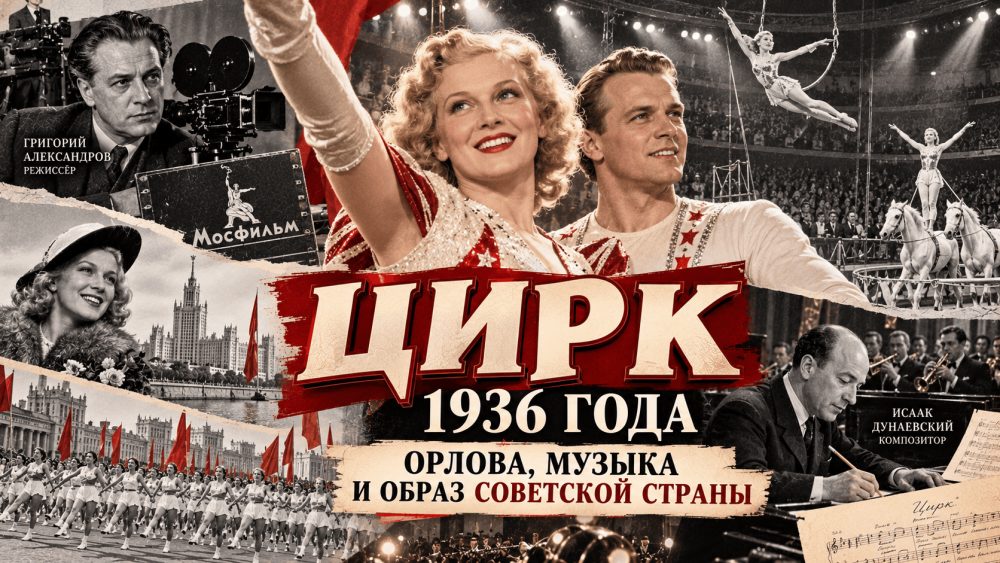
Grigory Alexandrov's Circus was released in 1936, with Lyubov Orlova as the American performer Marion Dixon. The musical comedy brings together a circus attraction, a romantic story and a political promise: the Soviet Union is presented as a place where its heroine can find safety and acceptance. The interaction between these elements matters as much as the songs that became associated with the film.
Circus rewards two kinds of attention. It can be watched as a musical, with its own dramatic rhythms, and examined as an image of the society its makers wanted to present. A convincing performance by the leading actress does not make the surrounding fictional world documentary evidence of everyday Soviet life.
The conflict beneath the circus spectacle
Mosfilm's synopsis describes Marion's arrival in the USSR with an American attraction called Flight to the Moon. Her manager, Kneishitz, exploits her vulnerability by threatening to reveal that she has a Black son. The support she finds in Moscow gives her a way out of his control. A story about entertainers therefore becomes a story about escaping racist blackmail.
The attraction's name does not make Circus a science-fiction film. It refers to a staged spectacle. The arena is a particularly useful dramatic setting because a performer stands before an audience: exposure can produce humiliation, but it can also produce public support. A fear experienced privately can be answered collectively.
There are two connected problems here. One concerns an individual's power over a performer. The other concerns a social prejudice that makes his threat effective. Ending the immediate threat is only part of the solution offered by the story. Marion also needs people who reject the prejudice on which that threat depends. That distinction helps explain why her surroundings matter so much to the film's argument.
Alexandrov and Orlova's musical comedies
Mosfilm's institutional history places Circus between Alexandrov's Jolly Fellows, released in 1934, and Volga-Volga, released in 1938. Orlova appeared in all three. Watching them in that order offers a way to follow the same creative partnership through different comic situations.
A musical cannot be understood entirely through a plot summary. Voice, movement, costume and the timing of a performance carry part of the story. Dialogue can tell us that a character is afraid. A staged number can reveal professional confidence while the surrounding scenes expose dependence on someone behind the curtain. Music and performance can therefore change our understanding of a character rather than merely interrupt the action.
This is a useful viewing question for Circus: what does a musical sequence make visible that a conversation would leave unexplained? It directs attention to the form of the film as well as to its explicit message.
Why the screenplay credits require care
The studio catalogue lists Alexandrov, Ilya Ilf, Yevgeny Petrov and Valentin Katayev as screenwriters. The Russian State Archive of Literature and Art, RGALI, identifies Under the Circus Dome as the literary basis and reports that the writers asked for their names to be removed from the credits after changes made during production.
A catalogue entry and the credits in a particular print can answer different questions. The first may record a work's literary origins; the second records the attribution used in that version. Research should distinguish the original authors, the adaptation process and the names actually displayed on screen. Treating these as separate pieces of evidence is more useful than assuming every discrepancy must be a mistake.
Music as part of the drama
Isaak Dunayevsky composed the film's music. RGALI's description of a surviving autograph score connects Song of the Motherland specifically to Circus and identifies Vasily Lebedev-Kumach as its lyricist. That documentary link places the song within the making of a sound film rather than in an undifferentiated collection of patriotic music.
In an Arzamas essay, musicologist Darya Cherkasova draws attention to the Entrance March. It accompanies the heroine's arrival in the arena and also returns in her romantic story. The same musical material can thus connect her public identity as an entertainer with her private emotional life. Cherkasova also discusses the film as a combination of spectacular cinematic methods and a propaganda purpose.
A practical way to watch again is to note each return of a recognisable musical idea. Who can hear it within the scene? Is it part of a performance, or does it guide the film audience's response? Does its confidence match the character's situation? These questions turn familiarity with a tune into attention to dramatic structure. No quotation of the lyrics is necessary to investigate how the music works.
The release date is not the date of every surviving copy
Mosfilm lists the film as a 1936 production, separately records a restoration in 1970 and gives a running time of 89 minutes. The Russian State Art Library describes a black-and-white videocassette with a duration of 87 minutes. These are catalogue descriptions of particular materials, not proof that there are two unrelated works with the same title.
The difference in duration alone cannot tell us which scenes, if any, were altered. Establishing that requires comparison of copies and documentation of their versions. A viewer discussing editing or sound should therefore identify the copy being used. Equally, the date of a restoration should not replace the year of the original film.
This distinction is particularly helpful when a remembered scene does not match a new viewing. Before constructing an explanation about censorship or authorial intention, the available copies need to be identified. A catalogue's number of minutes is a starting point for that investigation, not its conclusion.
Reading the political promise critically
The film's opposition to racist persecution coexists with its idealised image of the receiving society. It is possible to recognise the force of the personal story and still question the broader national picture built around it. The happy resolution tells us how Marion's story has been organised; evidence about the treatment of real people must come from elsewhere.
Circus is valuable as a work in which an individual predicament becomes a public statement. Its meaning is easier to examine through particular scenes, recurring music and identifiable versions than through a single label. Watching closely preserves both the achievement of the musical and the distance needed to assess its political claims.