Andrei Rublev: The 1966 Film, Cannes and Its Soviet Release
Why Andrei Rublev has several key dates: production, permissions, the FIPRESCI prize, Soviet distribution and the distinction between versions.
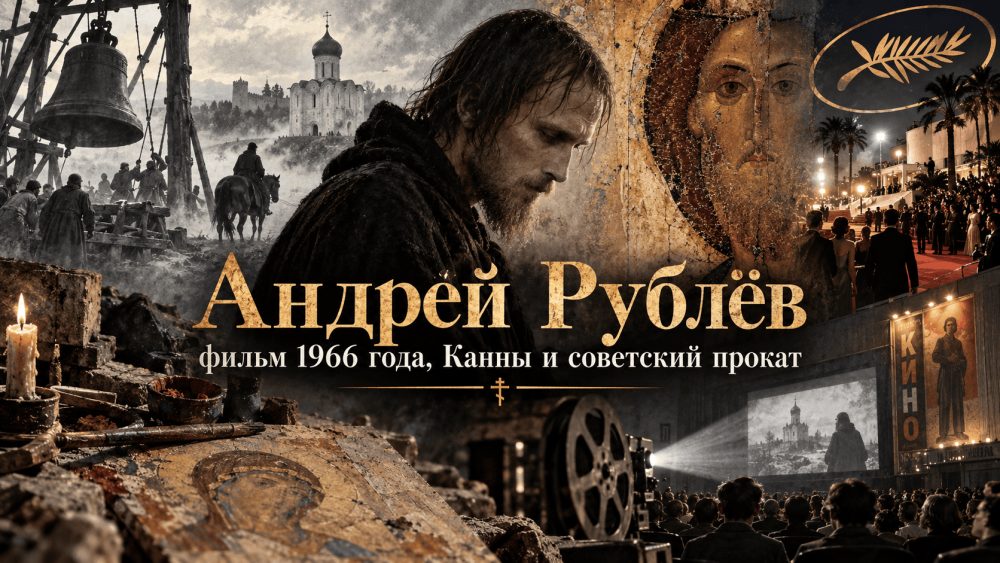
Andrei Rublev is a 1966 film by Andrei Tarkovsky that screened out of competition at Cannes in 1969 and reached Soviet cinemas in 1971. The three dates mark different stages in its history. A catalogue year, a festival appearance and a domestic release need not coincide.
Its subject is an artist living amid violence, conflict and loss. The historical protagonist is an icon painter, but the film is not an illustrated biography built around a chronological list of works. It asks how creative work remains possible when experience repeatedly undermines a person's confidence in its meaning.
The people and work behind the film
Andrei Tarkovsky and Andrei Mikhalkov-Konchalovsky wrote the screenplay. Vadim Yusov was the cinematographer and Vyacheslav Ovchinnikov the composer. The Mosfilm and Cannes records agree on these credits. The cast includes Anatoly Solonitsyn, Nikolai Grinko, Ivan Lapikov, Nikolai Burlyayev and Irma Raush.
A complicated production stood behind the director's name. Mosfilm's archival account places filming between October 1964 and July 1966 and describes crowd scenes, studio sets and extensive location work. The places named include Pskov, Izborsk, Pechory, Suzdal and Vladimir.
A location contributes to the image without certifying the documentary accuracy of every event staged there. An old building does not turn an invented conversation into historical evidence. A film can attend carefully to its material surroundings while constructing its own characters, encounters and dramatic relationships.
That is a useful starting point for this particular work. Its historical setting matters, but looking for a one-to-one correspondence between every episode and an established biographical fact is not the only way to understand it.
A narrative made from episodes
Mosfilm describes eight episodes that together present early fifteenth-century Rus'. This structure differs from a continuous chain in which one scene immediately causes the next. Recurring questions provide connections: what violence does to people, how doubt changes their choices, and why they continue to create.
The Cannes synopsis identifies a movement away from art and back towards it. This offers a useful viewing guide. The subject is not simply what the painter produces; it is also the condition in which making art becomes impossible, and the possibility of finding a reason to resume.
Such a reading does not require treating every image as a hidden code. More concrete relationships are available to follow: who speaks, who remains silent, who performs work and who controls its result. They make the historical setting an experience of human decisions rather than merely a background of period costumes.
These are interpretive questions, not claims that the film supplies a single answer. They leave room for viewers to disagree about particular scenes while attending to the way the narrative is organised.
Finishing production did not mean reaching cinemas
The studio's archival overview describes a December 1966 screening after revisions demanded by its artistic council and the state cinema authorities. Showing a completed film to a particular audience was not the same as placing it in ordinary theatrical distribution.
Part ten of Mosfilm's archival series records a further sequence: a completion report dated 16 February 1969, a screening at the Central House of Cinema on 17 February, and a distribution certificate issued on 6 March. Even that sequence did not produce an uninterrupted release. Exhibition was subsequently suspended.
Another authorisation followed revisions in 1971, when the film reached Soviet screens. Its route to viewers therefore involved successive decisions and alterations, rather than a simple story of one prohibition followed by one final permission.
The distinction helps avoid apparent contradictions in the documents. A certificate establishes that an administrative act occurred. A history of exhibition must also establish when audiences actually saw the film and which version they encountered.
The dates of production, permission and distribution answer related but different questions. Substituting one for all the others would flatten the history of the film's reception.
Cannes in 1969: naming the award correctly
The official Cannes record places Andrei Rublev in the festival's out-of-competition programme in 1969 and records the FIPRESCI international critics' prize. It was not the Palme d'Or or a victory in the main competition.
This distinction does not diminish the recognition. It identifies the award and the body responsible for it. Festival participation, a critics' decision and the main jury's prizes are separate entries in a film's record.
The studio's consolidated catalogue contains adjacent Cannes-related award entries assigned to different years. For the specific festival claim, the organiser's archive provides the clearer reference: 1969, out of competition, FIPRESCI. Copying every line of a cumulative list could accidentally create an additional award that the festival record does not support.
This is also why a festival year should not replace the film's production year. The Cannes appearance belongs to the history of a film already made, rather than establishing that it was first created in 1969.
Running time and different versions
The Mosfilm catalogue checked for this article lists a running time of 175 minutes and a restoration year of 2025. Those details describe the version presented in that record. They should not automatically be assigned to every edit that existed from the 1960s onwards.
Editorial revision and technical restoration are different processes. Cutting or re-editing can change the selection or sequence of material. Restoring picture and sound does not, by itself, mean that every scene removed at some earlier stage has been reinstated. The word “restored” needs a version attached to it.
Before comparing two viewings, it helps to identify the edition and running time of each copy. Otherwise, a discussion may concern two different assemblies of material carrying the same title.
Andrei Rublev belongs to several connected histories: Soviet film production, international recognition and the difficult passage to its audience. Keeping those histories distinct makes room for both the filmmakers' work and the circumstances in which viewers were able to encounter it.