The 1936 Soviet Constitution: Government, Elections and Rights
Read the original 1936 Soviet Constitution: the Supreme Soviet, 11 republics, electoral rights, the party and the gap between law and practice.
The Soviet Constitution of 1936 is often remembered for the rights it promised. It also reorganized the highest institutions of government, established electoral principles and described the Communist Party's place within the system. Understanding it requires three separate questions: what the original document said, how later amendments changed it, and how political power actually operated.
Adoption and the document's scope
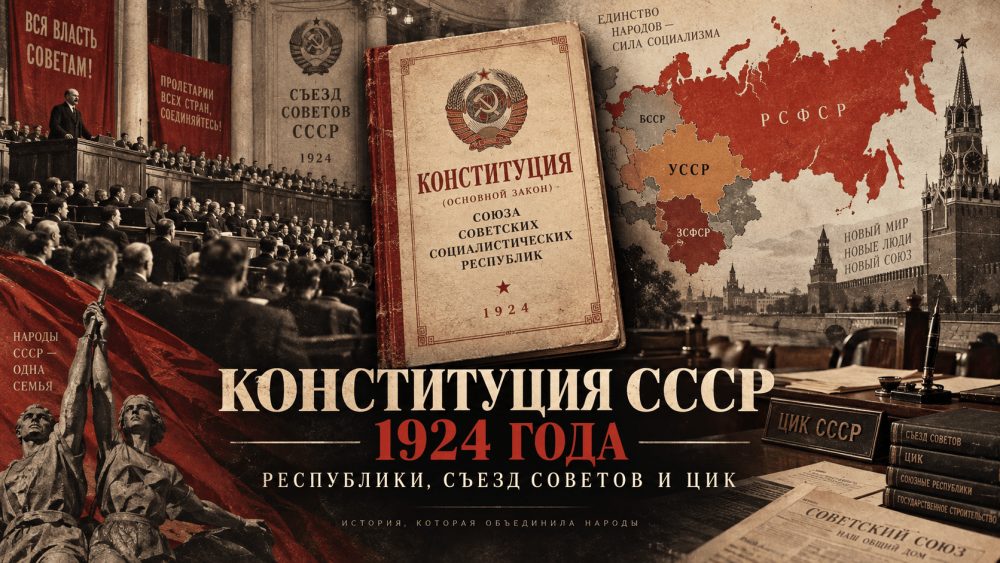
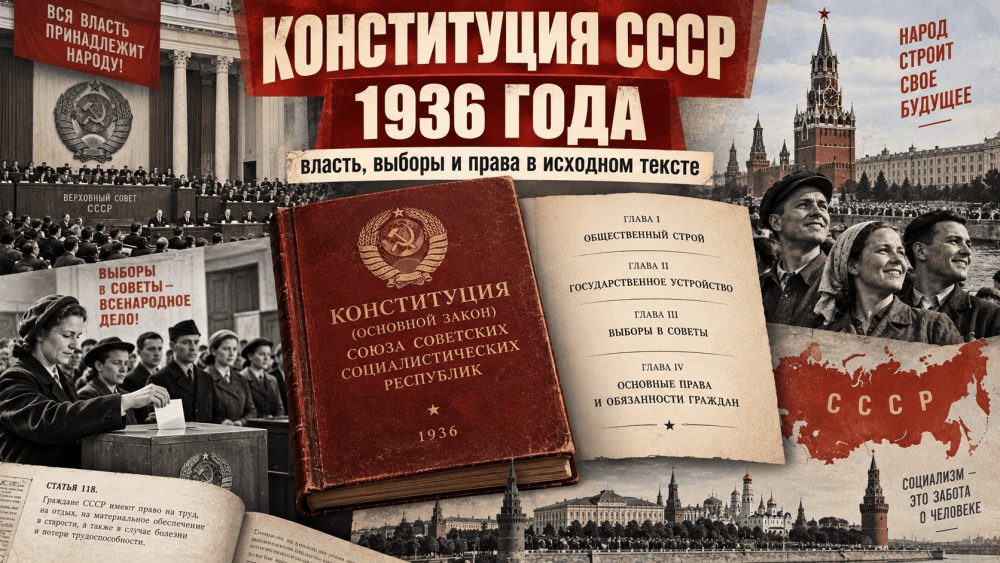
The Extraordinary Eighth Congress of Soviets approved the Constitution on 5 December 1936. It replaced the 1924 basic law. Whereas the earlier constitution concentrated on organizing the Union and allocating authority, the new document gave much more space to the social system and the position of individual citizens. The article on the 1924 Soviet Constitution explains the preceding arrangement.
The new text contained 13 chapters and 146 articles. Its familiar designation as the Stalin Constitution should not obscure its official identity as the Constitution, or Fundamental Law, of the USSR. When checking a quotation, an article number and an edition date are more useful than the popular label alone.
The drafting process left an extensive documentary record. The Presidential Library's inventory of the Constitutional Commission includes early drafts, proposed amendments, discussion materials and translations. It also identifies a transcript of the commission's meeting on 31 October 1936. This inventory tells researchers what survives. It cannot, by itself, establish how freely people discussed the draft or explain the fate of every proposed change.
The Supreme Soviet and its two chambers
Article 30 designated the Supreme Soviet of the USSR as the highest organ of state authority. Article 32 assigned legislative power to it. The Supreme Soviet consisted of the Soviet of the Union and the Soviet of Nationalities. Both chambers had equal rights, although their representation was organized differently.
The Soviet of the Union represented population. Article 34 provided for one deputy per 300,000 inhabitants. The Soviet of Nationalities represented republics and autonomous territories. The arrangement therefore combined two principles: representation of the Union's population and representation of its national-territorial structure.
Two chambers did not mean two rival political parties. They were components of a single institution. This distinction matters when comparing constitutional architecture with political competition: the number of parliamentary chambers does not establish how independently they acted.
The original Article 13 listed 11 union republics. The familiar late-Soviet total of 15 cannot be applied to December 1936. The overview of the Soviet republics provides a broader timeline. Changes in the Union's composition are one reason a later edition of the constitution can differ substantially from the document first adopted under that name.
What the electoral provisions meant
Article 134 specified universal, equal and direct suffrage with secret voting. Each word addressed a different feature of an election: eligibility, the weight of each person's vote, the route by which representatives were elected, and the privacy of the individual ballot.
Article 135 set the voting age at 18. It listed characteristics that were not to restrict electoral rights, including nationality, religion, education, residence, social origin, property status and past activity. It also contained exceptions, including people deprived of electoral rights by a court. The term universal should therefore be read with the actual provision, rather than treated as a claim that no exceptions existed.
An electoral procedure is not the same thing as political competition. A constitutional promise of secret voting does not establish whether independent opponents could organize, how candidates were selected or what happened to public dissenters. Those questions require evidence from electoral administration and political history as well as the constitution.
Social rights and civil guarantees
Chapter X brought together social rights, civil guarantees and duties. Its provisions covered work, rest, support in old age and when unable to work, and education. Separate articles addressed equality between women and men and equality regardless of nationality or race.
These commitments need to be read at the correct level. A constitutional right to education is not a history of school places, teaching or access to study. Similarly, a general commitment to support in old age does not demonstrate that every social group already had identical pension arrangements in 1936. The basic law provided a framework; other measures determined particular institutions and entitlements.
Article 125 listed freedom of speech, the press, assembly and demonstrations. It placed these freedoms within the interests of working people and the strengthening of the socialist system. That qualification was part of the provision. Leaving it out produces a broader promise than the text actually made.
Article 127 guaranteed personal inviolability and stated that arrest required a court decision or a prosecutor's authorization. Article 128 protected the home and the secrecy of correspondence. Such specific clauses make comparison with actual state conduct possible. They offer a more precise starting point than a general description of the constitution as either generous or restrictive.
The party's constitutional position
The Communist Party's special position appeared in Article 126. The document described the All-Union Communist Party (Bolsheviks) as the leading core of working people's public and state organizations. Its constitutional role therefore did not begin with the basic law adopted in 1977.
The article numbers should not be confused. The well-known Article 6 belongs to the 1977 Soviet Constitution. For the relevant passage in the 1936 text, the number is 126. Checking this small detail can expose a quotation or image caption that has combined material from different periods.
Law and the exercise of power
Adopting the constitution did not end Stalinist repression. The Library of Congress archival exhibition describes mass arrests, the show trials of 1936-1938 and the Great Terror's peak in 1937-1938. That context belongs alongside any account of the constitutional protection against arbitrary arrest. The separate article on the Gulag discusses the camp system.
The distinction works in both directions. A guarantee written into law does not prove that officials respected it. Violations of a guarantee do not make the document irrelevant as a historical source. The constitution records the lawful order the state claimed to establish; records of persecution reveal how authority operated. Reading both allows a sharper assessment than either celebrating the promises in isolation or dismissing the text without examining it.
Checking an online quotation
Start with the edition date. A webpage headed Constitution of the USSR, 1936 may reproduce a version incorporating much later amendments. Next, locate the article number and read the entire provision, including qualifications and exceptions. Finally, separate the rule itself from any claim that it was implemented.
Three useful checks for the original document are the 11 republics in Article 13, the Supreme Soviet in Article 30, and the party provision in Article 126. They help identify chronological mixing. This approach treats the constitution as a dated historical document with a specific structure, rather than as a collection of famous sentences detached from their setting.
The cover is an original editorial diagram, not an archival image.