The 1924 USSR Constitution: Republics, Congress and Central Government
Explore the first USSR Constitution: the 1923-1924 decisions, Union and republican powers, the Congress of Soviets and the two parts of the Central Executive Committee.
The first Constitution of the USSR received final approval from the Second Congress of Soviets on 31 January 1924. Its central task was to organise the union state: to identify the matters handled by the Union, the powers retained by its republics and the institutions through which common government would operate. Reading it as a shortened version of the 1977 Constitution would miss that purpose.
Why two adoption dates appear
The document published by Moscow State University's history faculty identifies two stages: adoption by the second session of the USSR Central Executive Committee on 6 July 1923, followed by final approval at the Congress on 31 January 1924. The Presidential Library also associates the July session with approval of the draft and the formation of the first Union government.
The USSR already existed. Its formation dates to December 1922. The three dates therefore describe successive stages of state organisation, not three separate foundations. Identifying which institution took which decision is more useful than choosing one date without explanation.
A declaration and a treaty
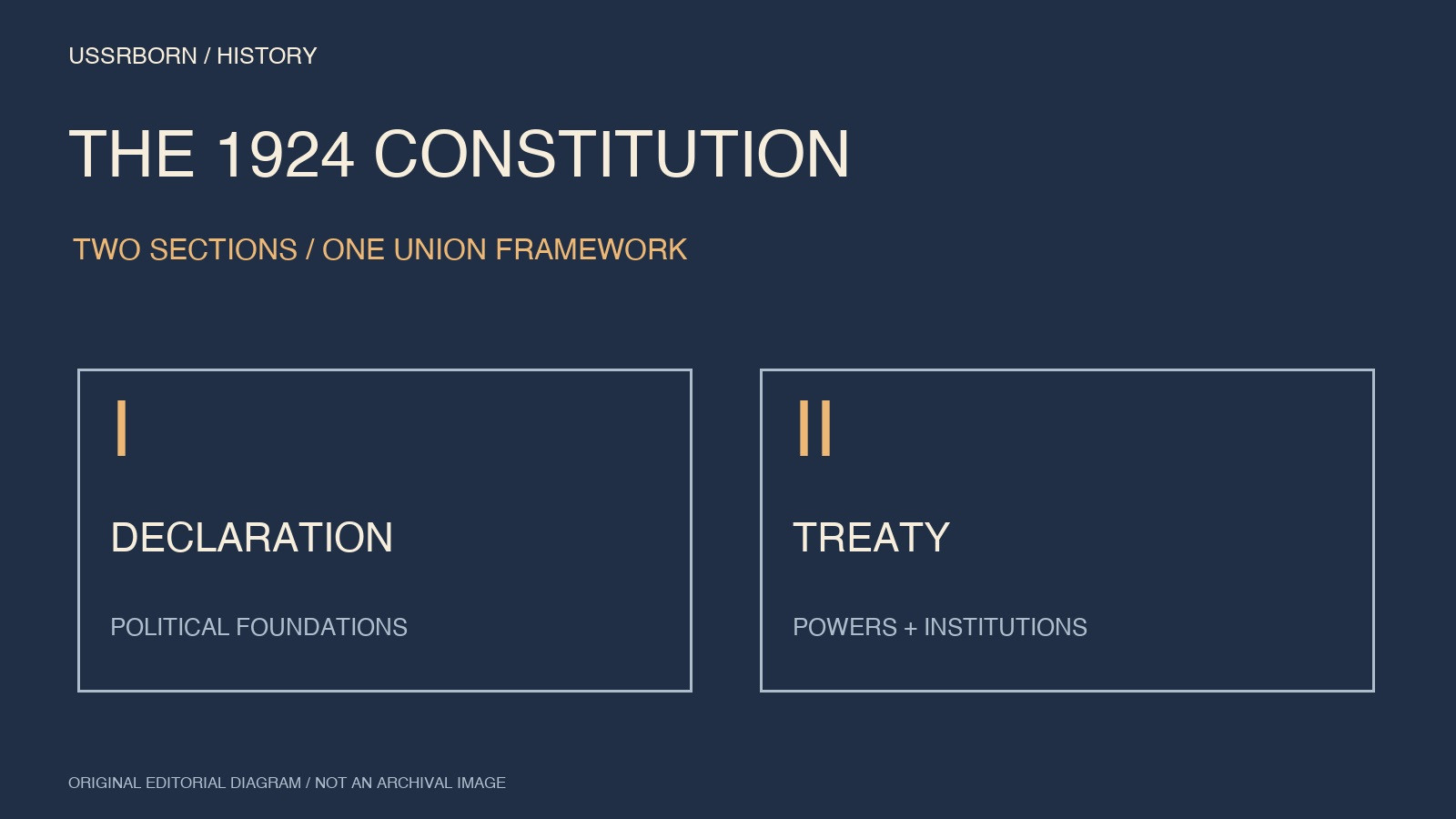
The constitution comprised two sections: the Declaration and the Treaty on the Formation of the USSR. The Declaration explained unification in the language of Soviet political ideology. The treaty section set out governmental powers and institutional arrangements. It contained eleven chapters and ended with Article 72.
This did not simply reproduce the short agreement of December 1922. Union government received a more detailed framework. Separate chapters addressed the government, Supreme Court, people's commissariats and the Joint State Political Directorate.
The document's assertions about equality and voluntary association also need to be read as statements within a particular kind of source. They establish how the authorities described the state legally and ideologically. Judging political practice requires other evidence as well. A constitutional declaration cannot, on its own, demonstrate that every declared principle was observed.
Union powers and republican authority
Article 1 assigned major responsibilities to the Union authorities, including foreign relations, war and peace, the armed forces, foreign trade and important areas of economic administration. These were substantial central powers, not merely the functions of an occasional coordinating conference.
Articles 3 through 7 simultaneously defined the position of the republics. Beyond the matters assigned to the Union, a republic exercised its own state authority. Article 4 retained a right to leave the Union. A republic's territory could not be changed without its consent, while changing or removing the secession provision required the agreement of all Union republics. The constitution also established common Union citizenship.
The right to leave was not accompanied in this text by a detailed sequence of procedural steps, deadlines and arrangements for settling disputes. The existence of a provision and the conditions for exercising it in practice are therefore different questions. Rules introduced decades later should not be projected backwards onto 1924.
At the formation of the Union, its constituent parties were the Russian SFSR, Ukrainian SSR, Byelorussian SSR and Transcaucasian federation. The familiar late Soviet list of fifteen republics describes a different historical configuration.
Congress, Central Executive Committee and two chambers
Article 8 designated the Congress of Soviets as the supreme authority. Between congresses, that position belonged to the Central Executive Committee, commonly abbreviated as TsIK. It consisted of the Soviet of the Union and the Soviet of Nationalities.
The two bodies embodied different principles of representation. The Soviet of the Union reflected the population of the republics, while the Soviet of Nationalities represented republics and autonomous formations according to specified allocations. A bill became law after approval by both bodies. Disagreements were to go through a conciliation procedure.
Between sessions of the Central Executive Committee, its Presidium exercised authority. The constitutional structure brought legislative, executive and administrative functions together. Describing it simply as a modern parliament with a familiar separation of powers would conceal important features of the system.
Nor was representation based on equal direct elections by all citizens to the Union institution. Articles 9 and 10 provided different representation ratios for urban soviets and provincial congresses; delegates were selected through congresses of soviets. The electoral arrangements of later constitutions cannot be substituted for these provisions.
This layered structure also explains why an institution's name is not enough to establish its role. A reader needs to ask what it could decide, when it met and which body acted between its meetings. Those questions distinguish formal rank from the continuing work of government.
What the text did not contain
The Presidential Library points out that there were no separate chapters setting out citizens' rights and duties, local government or electoral law. That does not mean there were no rules about representation anywhere in the document: the articles on the Congress clearly included them. The point is that these subjects were not given comprehensive Union-level treatment, and many matters remained within republican constitutions.
The final chapter addressed the emblem, flag and capital. Article 72 named Moscow. The history of the Soviet state flag offers another reason to pay attention to versions and dates even when examining familiar state symbols.
Comparing constitutions without merging them
A comparison with the 1977 Constitution should check institutional names, methods of selection and the organisation of the text separately. The shared label of constitution does not imply an unchanged governmental structure across the intervening decades.
The date of a law must also be distinguished from the publication date of a book. The Presidential Library catalogues a 1925 edition of the constitution with supplementary legislation. Its imprint does not establish the existence of a new Union constitution adopted in 1925.
The 1924 document primarily organised the Union and the distribution of authority within it. It provides evidence of the state's legal design. How officials used that design, and how formal provisions interacted with political power, are related historical questions requiring additional sources.
The cover is an original editorial diagram of the document's two sections. It does not reproduce an authentic historical edition.