The Soviet State Flag: Design, Proportions and Display Rules
Read the Soviet flag through its legal history: the 1924 design, 1:2 proportions, the 1955 regulation and later amendments, with worked dimensions.
The Soviet state flag is easy to recognize: a red field, a hammer and sickle, and a star. Its official identity, however, depended on more than a familiar collection of symbols. Written rules specified the shape of the cloth, the position of the devices and the circumstances in which the flag was displayed. Reading those rules makes historical photographs easier to interpret.
The design in the 1924 Constitution
Article 71 of the USSR Constitution adopted on 31 January 1924 described a red or scarlet flag with a gold hammer and sickle near the top of the hoist. Above them stood a red five-pointed star outlined in gold. The central elements of the familiar design were therefore established long before the postwar period. The wording can be consulted in this edition of the 1924 Constitution.
The arrangement matters. A hammer and sickle on a poster, badge or banner did not automatically make that object a state flag. Nor did a red background alone establish its identity. The official flag combined particular devices with a particular layout.
There is also a small trap in the early wording. The published Article 71 uses the terms length and width in an order different from the familiar modern description. For the measurements below, the later flag regulation supplies an unambiguous basis: width to length is 1:2. Distinguishing the documents avoids silently modernizing the language of an early text.
Why 1955 is a legal milestone, not the birth of the design
On 19 August 1955, the Presidium of the Supreme Soviet approved a regulation on the state flag. The approving decree records that legal event. It should not be mistaken for the invention of the red field or the hammer and sickle.
A symbol can already be recognizable before a later document sets out its use in greater detail. Saying that the Soviet flag first appeared in 1955 collapses those separate stages into one and obscures the earlier constitutional evidence.
The regulation also underwent subsequent amendments. The consolidated text incorporating changes through 1984 used here describes late Soviet rules. Its complete holiday calendar cannot be treated as a verbatim record of the original 1955 requirements.
The proportions explained
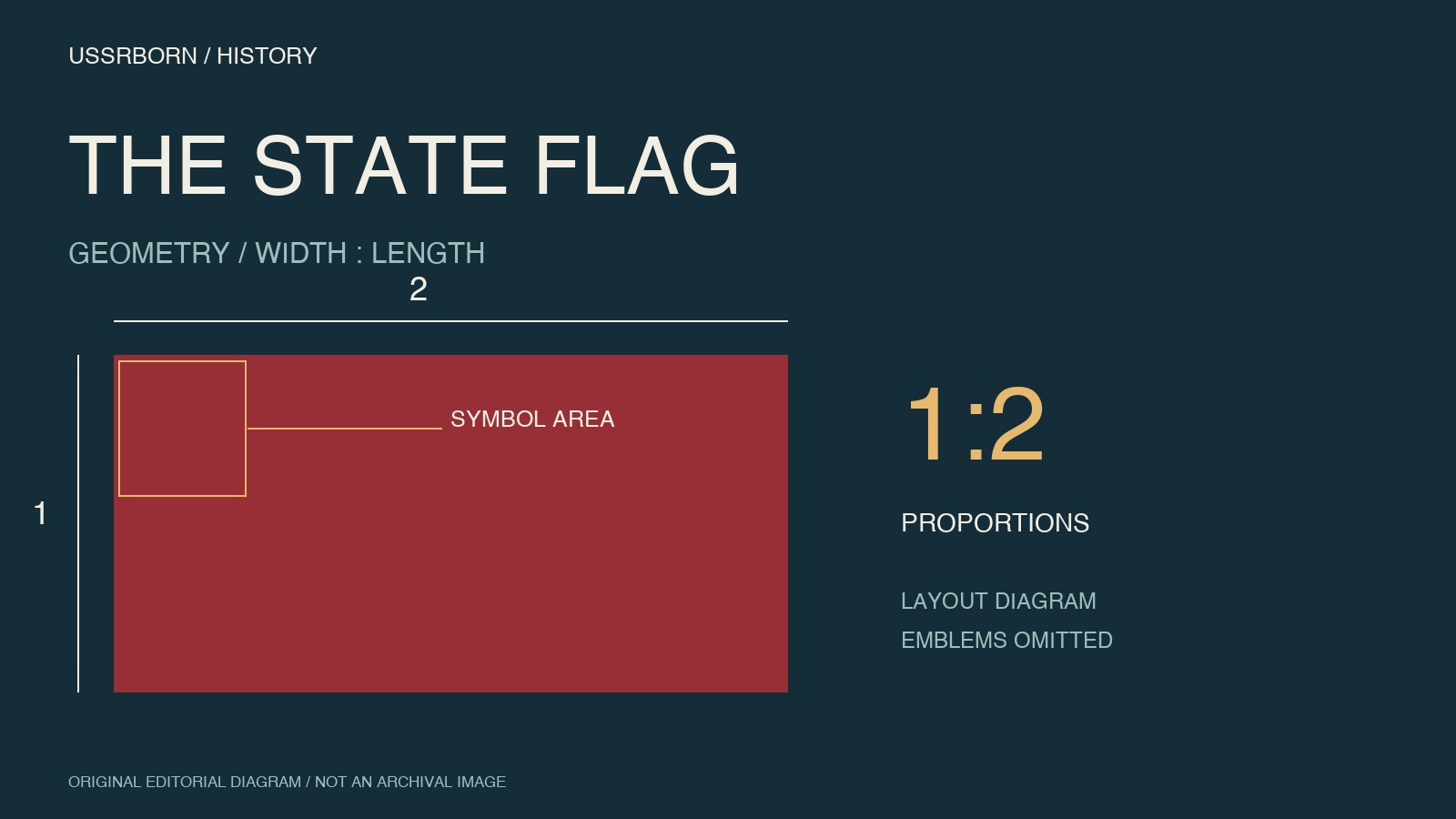
The horizontal length was twice the flag's vertical width. A flag one metre high would consequently be two metres long. The devices occupied the upper area next to the pole, leaving most of the red field clear.
The regulation expressed their dimensions as fractions of the flag's width. The hammer and sickle fitted within a square whose side measured one quarter of that width. The star fitted within a circle with a diameter of one eighth. The vertical axis of the devices stood one third of the flag's width from the hoist, while the star's centre lay one eighth of the width below the upper edge.
For a hypothetical flag 120 centimetres high, the calculations give:
- a horizontal length of 240 centimetres;
- a 30-centimetre square for the hammer and sickle;
- a 15-centimetre circle around the star;
- a distance of 40 centimetres from the hoist to the devices' axis;
- a distance of 15 centimetres from the top edge to the star's centre.
These are worked examples based on the regulation, not measurements of a surviving museum object. They explain why an oversized emblem in the middle of a red rectangle would produce a different composition, even if its individual shapes looked familiar.
The red star had many other uses in Soviet visual culture. On the state flag, its scale and position formed part of a defined design. Recognizing a symbol and identifying the object carrying it are two different tasks.
Permanent display and holiday display
The late regulation distinguished between buildings. The flag was displayed permanently on the buildings of the Presidium of the Supreme Soviet and the USSR Council of Ministers. At a building hosting a session of the Supreme Soviet, it was raised for the session. Many other institutions, enterprises and residential buildings followed a holiday calendar.
The 1984 version included, among other dates, 1 and 2 May, 9 May, 7 October, and 7 and 8 November. The October constitution observance belongs to the later constitutional setting discussed in our article on the 1977 Soviet Constitution. Its presence in an amended text is not evidence that it appeared in the original regulation decades earlier.
The Council of Ministers' implementing instruction No. 1975, in its later version, assigned responsibility for timely display on relevant buildings to organizational leaders and building managers. Maritime use followed additional rules. A photograph of a flag on a ship therefore needs a different setting from one showing a flag above an office entrance.
The Union flag and republican flags
The USSR flag represented the Union as a whole, while the constituent republics had their own state symbols. When a republican flag and the Union flag were raised together, the regulation stipulated that the Union flag could not be smaller. The relationship makes more sense alongside the political background of the Soviet republics.
A coat of arms was another distinct state symbol. Adding the complete Soviet arms to a late Soviet flag would not be justified simply because both belonged to the same state. Historical identification requires the actual design of the object, rather than a general impression that everything on it looks Soviet.
Reading a photograph with care
Begin with the hoist. If folds conceal that part of the cloth, the emblem may be hidden rather than absent. Next consider the proportions, allowing for perspective and movement. Finally check the date, location and occasion. A red banner carried in a procession could represent an organization instead of serving as the state flag.
A monochrome photograph cannot by itself settle the precise colour of an outline or the shade of a fabric. Regulations describe an official model; photographs record particular objects under particular conditions. Using both kinds of evidence helps separate what the law prescribed from what a surviving image actually proves.