USSR vs Russia: What Was the Difference?
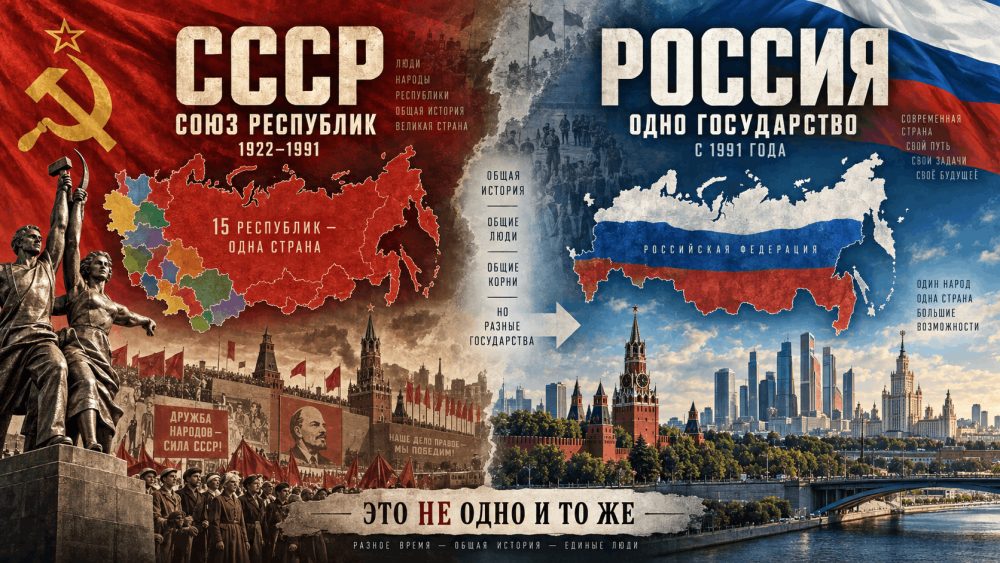
The USSR and Russia are often used as synonyms, but historically they were not the same. Russia was the largest of 15 Soviet republics, while the USSR was a separate multinational state that existed from 1922 to 1991.
Were the USSR and Russia the same thing?
No.
Russia was the largest republic inside the Soviet Union, but it was not the entire Soviet Union. In its final decades, the USSR contained 15 union republics, and the Russian Soviet Federative Socialist Republic, usually shortened to the Russian SFSR or RSFSR, was one of them.
The confusion is understandable. Moscow was the capital of both Russia and the USSR. Russian was the dominant language of central government, the military and much of public life. The Russian republic accounted for most of the Soviet Union's land and the largest share of its population and economy. In Western speech, "Russia" was often used as shorthand for the entire Soviet state.
But historically and legally, Russia and the USSR were not identical.
The simplest way to understand it
Think of it this way:
The USSR was the union.
The Russian SFSR was the Russian republic inside that union.
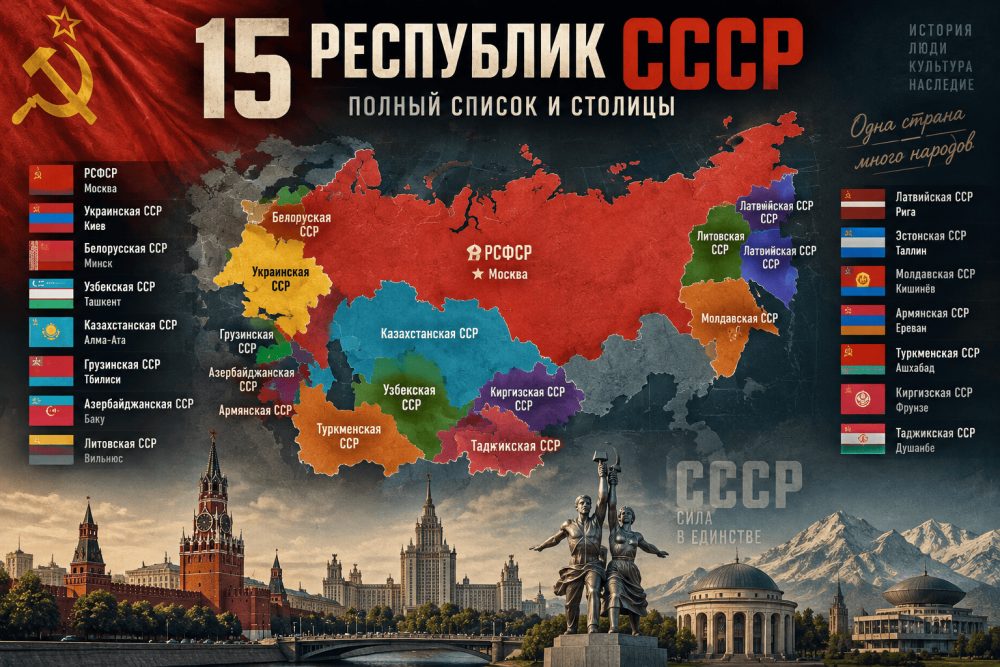
By the late Soviet period, the Union also included Ukraine, Belarus, Moldova, Estonia, Latvia, Lithuania, Georgia, Armenia, Azerbaijan, Kazakhstan, Kyrgyzstan, Uzbekistan, Turkmenistan and Tajikistan.
See the complete list: The 15 Soviet republics.
Which came first, Soviet Russia or the Soviet Union?
Soviet Russia came first.
After the revolutions of 1917 and the collapse of the old Russian Empire, the Bolsheviks established control over much of the former imperial territory. The Russian Soviet Federative Socialist Republic was formally organized in 1918.
The USSR did not appear until several years later.
On 30 December 1922, the Russian SFSR, Ukrainian SSR, Byelorussian SSR and Transcaucasian federation created the Union of Soviet Socialist Republics.
Russia therefore existed as a Soviet republic before the USSR and then became its largest constituent republic.
Read more: How the Soviet Union was formed in 1922.
Why did people call the Soviet Union "Russia"?
There were several reasons.
First was sheer size. The Russian SFSR covered roughly three quarters of Soviet territory and contained more than half of the USSR's population.
Second was the capital. Moscow was both the capital of the Russian republic and the capital of the entire Soviet Union.
Third was language. Russian became the main language of union-wide administration, the armed forces, much of higher education and communication between different republics.
Fourth was historical habit. Before 1917, the great Eurasian state centered on Moscow and St Petersburg had been the Russian Empire. To many foreign observers, Soviet power looked like a new political system occupying much of the same geopolitical space.
So newspapers, politicians and ordinary speakers in other countries often said "Russia" when they really meant "the Soviet Union."
It was convenient shorthand, but it erased important distinctions.
A Soviet citizen was not necessarily Russian
This is another common source of confusion.
The Soviet Union was home to Russians, Ukrainians, Belarusians, Kazakhs, Georgians, Armenians, Azerbaijanis, Uzbeks, Lithuanians, Latvians, Estonians and many dozens of other ethnic groups.
"Soviet" described citizenship and political belonging. "Russian" could describe ethnicity, language or connection to the Russian republic.
A citizen of the USSR might be Ukrainian, Kazakh, Jewish, Georgian or belong to another nationality.
Soviet internal passports even included an official nationality entry that was separate from citizenship.
Calling every Soviet citizen Russian is therefore historically inaccurate.
How was the Russian SFSR different from the other republics?
Constitutionally, the Russian SFSR was a union republic, like Ukraine, Kazakhstan or Georgia.
In practice, its scale made it unique. It contained Moscow, most of the Soviet landmass, much of the country's heavy industry, and the largest single population.
There was also a curious institutional imbalance. For much of Soviet history, Russia had fewer separate republican institutions than one might expect from the largest republic. A separate Communist Party of the Russian SFSR was not created until 1990. Before then, the all-Union Communist Party structures effectively filled that role.
Russia and the Soviet center were therefore deeply intertwined.
Was the USSR actually a federation?
Formally, yes.
Soviet constitutions described the USSR as a federation of union republics. Those republics had their own constitutions, legislatures, governments and, on paper, a right to leave the Union.
In practice, the system was strongly centralized for most of Soviet history.
The Communist Party leadership in Moscow controlled the main political decisions. The armed forces, foreign policy, security services, economic planning and much of heavy industry operated through union-wide institutions.
So the USSR was federal in constitutional structure but much more centralized in everyday political reality.
Read more about how the ruling system worked: The Soviet nomenklatura.
Russia and the USSR did not have the same borders
The Soviet Union was much larger than the Russian Federation that exists today.
It included the territories of all fifteen union republics. When the USSR broke apart, most internal republican borders became international borders.
Russia retained the territory of the former Russian SFSR, while Ukraine, Kazakhstan, Belarus, the Baltic states, the South Caucasus republics, Moldova and the Central Asian republics became separate countries.
A map of the USSR and a map of modern Russia are therefore not simply two versions of the same state at different dates.
Who led Russia while the USSR still existed?
For most of Soviet history, Russian republican institutions were politically overshadowed by the all-Union government and Communist Party.
That changed dramatically under perestroika.
In May 1990, Boris Yeltsin became chairman of the Russian republic's Supreme Soviet. On 12 June 1990, the Russian legislature adopted a Declaration of State Sovereignty.
In June 1991, Yeltsin was elected president of the Russian SFSR.
The result was an unusual political arrangement. Mikhail Gorbachev was President of the Soviet Union, while Boris Yeltsin was the elected president of the largest republic inside that union.
The Soviet center and the Russian leadership increasingly competed for authority.
Did Russia help dissolve the Soviet Union?
Yes, Russian leaders played a central role in the final phase, though the breakup had many causes and involved all the union republics.
On 8 December 1991, Boris Yeltsin of Russia, Leonid Kravchuk of Ukraine and Stanislav Shushkevich of Belarus signed the Belavezha agreements. They declared that the Soviet Union had ceased to exist and created the Commonwealth of Independent States framework.
Most former Soviet republics joined a broader agreement on 21 December.
Gorbachev resigned as Soviet president on 25 December. The remaining Soviet institutions formally recognized the end of the Union the following day.
Read more: Why the Soviet Union collapsed in 1991.
Did Russia simply become the USSR after 1991?
No, but there is an important legal distinction.
The Russian Federation was the state based on the former Russian SFSR. It did not inherit the territory of the other fourteen republics.
At the same time, Russia continued the Soviet Union's membership in the United Nations, including its permanent seat on the Security Council. On 24 December 1991, Boris Yeltsin informed the UN Secretary-General that the Russian Federation would continue the USSR's membership with the support of the Commonwealth of Independent States countries.
Russia also assumed major Soviet international responsibilities involving diplomatic property, debts, treaty commitments and strategic nuclear forces.
For that reason, Russia is often described in international practice as the continuator state of the USSR.
"Continuator," however, does not mean that the Russian Federation was identical to the Soviet Union. The USSR was a union of republics. Russia was one of those republics and became a separate state after the Union disappeared.
Russian Empire, USSR and Russian Federation: three different systems
They are connected historically, but they should not be collapsed into one label.
The Russian Empire existed until the revolutionary period of 1917.
Soviet Russia emerged after the Bolshevik takeover and became the core of the new Soviet Union in 1922.
The USSR lasted until 1991.
After its dissolution, the Russian SFSR was renamed the Russian Federation.
The state structures, borders, political systems and constitutional arrangements changed dramatically across those transitions.
Why the distinction still matters
Using the right terms makes twentieth-century history much easier to understand.
Saying "Russia joined the USSR" is incomplete without explaining that the Russian SFSR was one of the founding republics.
Saying "the USSR was Russia" erases fourteen other union republics by the end of the Soviet period.
Calling all Soviet citizens Russians also obscures the experiences of Ukrainians, Belarusians, Kazakhs, peoples of the Caucasus and Central Asia, the Baltic nations and many others.
The Soviet Union was heavily centered on Russia. That is not the same as saying it was only Russia.
Frequently asked questions
Was the USSR just old Russia?
No. Russia was the largest republic in the USSR, but the Union included fourteen other republics by 1991.
Was Russia part of the Soviet Union?
Yes. The Russian SFSR was the largest Soviet republic by territory and population.
Why did people call the USSR Russia?
Because of Russia's size, Moscow's role, the dominance of the Russian language and historical habit. It was common shorthand, but technically inaccurate.
When did Russia leave the USSR?
There is no single clean exit date. Russia declared sovereignty on 12 June 1990, took part in the Belavezha agreements on 8 December 1991, and the USSR ceased to exist at the end of December 1991.
Who took the Soviet Union's UN seat?
The Russian Federation continued the USSR's United Nations membership, including its permanent seat on the Security Council.
How many countries emerged from the USSR?
Fifteen independent states corresponding to the fifteen late Soviet union republics.
Related articles
- The 15 Soviet republics
- The formation of the USSR in 1922
- The dissolution of the Soviet Union
- Mikhail Gorbachev
Sources
- U.S. Department of State, Office of the Historian, *Union of Soviet Socialist Republics*: https://history.state.gov/countries/soviet-union
- U.S. Department of State, Office of the Historian, *Russia*: https://history.state.gov/countries/russia
- U.S. Department of State, Office of the Historian, *The Collapse of the Soviet Union*: https://history.state.gov/milestones/1989-1992/collapse-soviet-union
- United Nations, *Russian Federation*: https://www.un.org/en/node/122895
- Library of Congress, *Soviet Union: A Country Study*: https://www.loc.gov/item/90025756/