15 Republics of the Soviet Union: List, Capitals and What Happened After 1991
Which republics made up the Soviet Union, why were there 15 of them, and was that number always the same? A full list of the union republics, their capitals and what happened in 1991.
Which republics made up the Soviet Union?
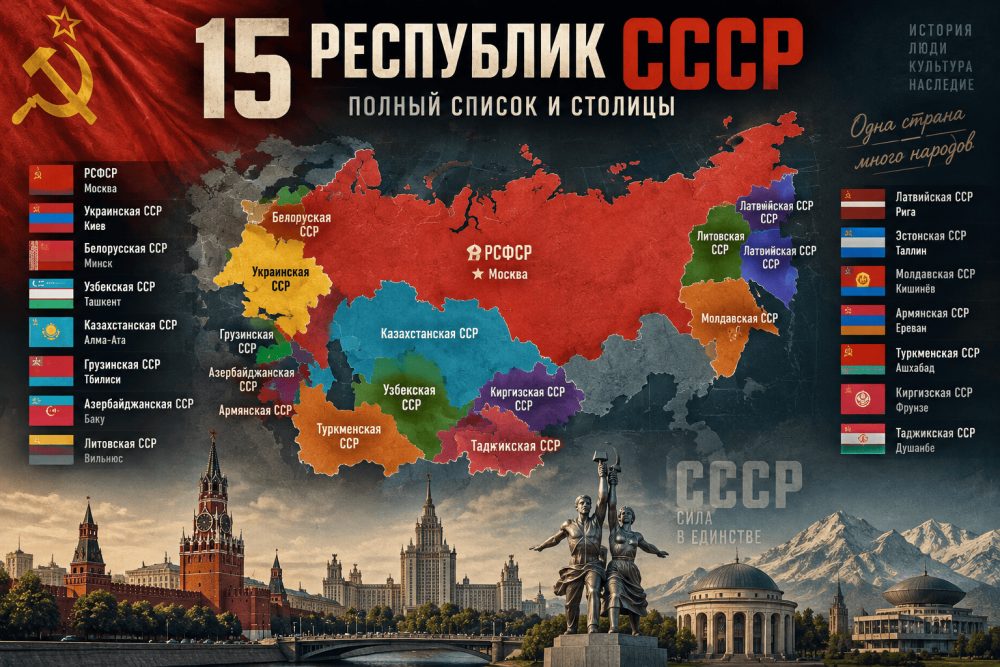
At the time of its collapse in 1991, the Soviet Union consisted of 15 union republics. Today they are 15 independent states, although their relationships with the Soviet past differ sharply.
The late Soviet map is familiar: Russia, Ukraine, Belarus, the three Baltic republics, the three South Caucasus republics, Moldova and five republics in Central Asia.
But "15 Soviet republics" was not a fixed formula for the entire life of the USSR. The Soviet Union began in 1922 with four constituent republics. The number changed several times, and the familiar total of 15 became permanent only in 1956.
The full list of the 15 Soviet republics
This was the composition of the USSR during its final decades:
| Soviet republic | Capital in the late Soviet period | Country today |
|---|---|---|
| Russian SFSR | Moscow | Russia |
| Ukrainian SSR | Kyiv | Ukraine |
| Byelorussian SSR | Minsk | Belarus |
| Uzbek SSR | Tashkent | Uzbekistan |
| Kazakh SSR | Alma-Ata | Kazakhstan |
| Georgian SSR | Tbilisi | Georgia |
| Azerbaijan SSR | Baku | Azerbaijan |
| Lithuanian SSR | Vilnius | Lithuania |
| Moldavian SSR | Kishinev | Moldova |
| Latvian SSR | Riga | Latvia |
| Kirghiz SSR | Frunze | Kyrgyzstan |
| Tajik SSR | Dushanbe | Tajikistan |
| Armenian SSR | Yerevan | Armenia |
| Turkmen SSR | Ashgabat | Turkmenistan |
| Estonian SSR | Tallinn | Estonia |
Several city names need a note. Alma-Ata is now called Almaty. Frunze was renamed Bishkek in 1991. Kishinev is the older English and Russian form associated with the Soviet period; the modern Moldovan capital is generally written Chișinău or Chisinau in English.
The USSR started with four republics, not fifteen
The Soviet Union was formally established on 30 December 1922.
Its four founding constituent units were:
- the Russian Soviet Federative Socialist Republic;
- the Ukrainian SSR;
- the Byelorussian SSR;
- the Transcaucasian Socialist Federative Soviet Republic.
The last of these united Armenia, Azerbaijan and Georgia in a single federal republic.
So there were no "15 Soviet republics" when the USSR was born. The political map was still being built.
Read more: The formation of the Soviet Union in 1922.
How the number of republics grew
During the 1920s and 1930s, Soviet authorities redrew internal borders, especially in Central Asia.
Uzbekistan and Turkmenistan became union republics in 1924. Tajikistan first existed as an autonomous republic within the Uzbek SSR and became a separate union republic in 1929.
The 1936 Soviet Constitution changed the structure again. The Transcaucasian federation was dissolved, making Armenia, Azerbaijan and Georgia separate union republics. Kazakhstan and Kirghizia also gained union-republic status.
By the end of the 1930s, the map was beginning to resemble the USSR remembered from the Cold War era.
Why did the USSR briefly have 16 republics?
In 1940, the total rose to sixteen.
After the Soviet-Finnish Winter War, the Karelo-Finnish SSR was created. It combined the former Karelian autonomous republic with some territory transferred from Finland.
The same year also brought major changes in the west. Lithuania, Latvia and Estonia were incorporated into the Soviet Union, while the Moldavian SSR was created.
The status of the Baltic states is an important historical and legal dispute. Soviet authorities described their incorporation as lawful accession. Many Western governments did not recognize the annexation, and the present-day governments of Estonia, Latvia and Lithuania describe 1940 to 1991 as a period of Soviet occupation.
In 1956 the Karelo-Finnish SSR was downgraded to an autonomous republic inside the Russian SFSR. The number of union republics returned to fifteen and remained there until 1991.
What did "union republic" actually mean?
On paper, the USSR was a federation.
Union republics had their own constitutions, legislatures, councils of ministers and other formal state institutions. Soviet constitutional law even recognized a right for a union republic to leave the USSR.
In practice, political power was highly centralized for most of Soviet history. The Communist Party, central ministries, the planned economy and security institutions tied the republics closely to Moscow.
That gap between the constitutional structure and day-to-day political reality matters when we reach the late 1980s.
As central authority weakened under Gorbachev, republican institutions that had long looked secondary suddenly became real centers of political power.
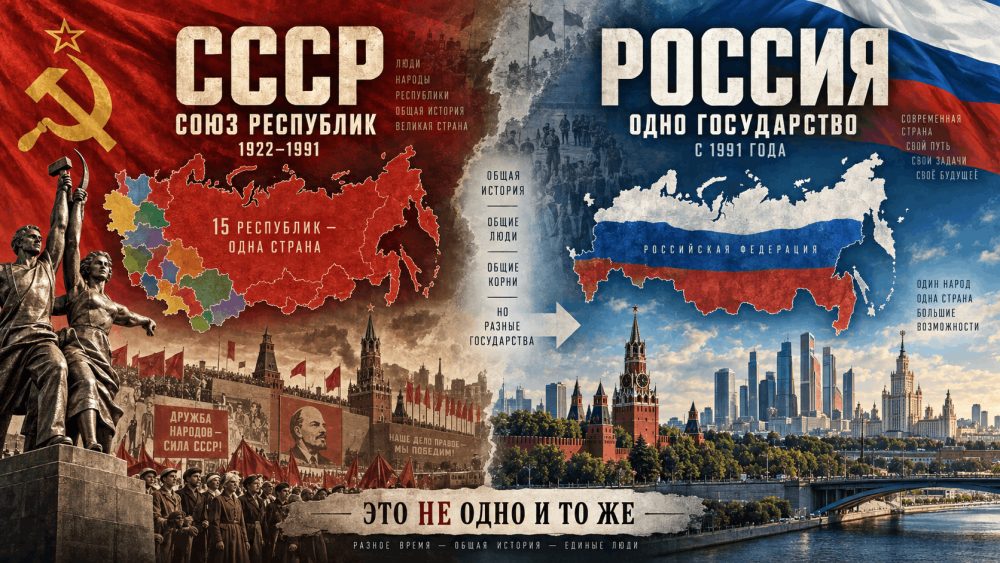
The Russian SFSR was Russia, but Russia was not the whole USSR
The Russian SFSR was by far the largest Soviet republic. It covered most of the Soviet Union's territory and contained more than half of its population.
Moscow served both as the capital of the Russian republic and as the capital of the USSR.
That is one reason foreign writers and speakers often used "Russia" as shorthand for the Soviet Union and called Soviet citizens "Russians." Technically, that was inaccurate. Ukraine, Georgia, Kazakhstan, Lithuania and the other union republics were not provinces of the Russian SFSR. They were constituent republics of the Soviet Union.
The distinction became impossible to ignore in 1991, when Russia itself asserted sovereignty and entered into a political struggle with the Soviet center.
Read more: USSR vs Russia: what was the difference?.
Why were Ukraine and Belarus already members of the United Nations?
Here is one of the stranger details of Soviet federalism.
When the United Nations was founded in 1945, the Soviet Union joined as a member, but the Ukrainian SSR and Byelorussian SSR also received separate UN seats.
They therefore sat in the General Assembly in their own names while still being constituent republics of the USSR.
The arrangement came from wartime negotiations among the Allied powers. Stalin had initially sought separate seats for all Soviet republics; the final compromise gave extra membership only to Ukraine and Belarus.
When the USSR disappeared, the two republics did not need to join the UN from scratch. They continued their existing memberships as independent states.
How the republics became independent
The late 1980s changed the political landscape with remarkable speed.
Glasnost and the weakening of Communist Party control made it possible to discuss national history, economic grievances and relations with Moscow much more openly. Mass political movements appeared in several republics.
The Baltic republics moved especially quickly. Lithuania declared the restoration of independence in March 1990. Estonia and Latvia also set out on paths to restore statehood.
During 1990 and 1991, sovereignty declarations spread across the USSR, including in the Russian SFSR itself.
The failed August 1991 coup accelerated the process. Republic after republic declared independence.
On 8 December 1991, the leaders of Russia, Ukraine and Belarus signed the Belavezha agreements and stated that the USSR had ceased to exist. On 21 December, most of the former union republics joined a broader Commonwealth of Independent States framework.
Mikhail Gorbachev resigned as Soviet president on 25 December. The USSR formally ceased to exist the following day.
Read more: The dissolution of the Soviet Union.
What happened to the fifteen republics after 1991?
All fifteen became independent states, but their paths soon diverged.
Estonia, Latvia and Lithuania oriented themselves toward Western institutions and later joined both the European Union and NATO.
Russia continued the Soviet Union's membership in the United Nations, including its permanent seat on the Security Council, and assumed a large share of the USSR's international obligations and assets.
Belarus, Kazakhstan, Armenia, Kyrgyzstan and several other former republics participated to varying degrees in post-Soviet integration projects involving Russia.
Ukraine, Moldova and the South Caucasus states went through their own political crises, reforms and conflicts. Several parts of the former USSR became sites of armed conflict involving borders, autonomy and disputed territories.
A single Soviet political structure had produced fifteen very different post-Soviet histories.
Union republics were not the same as autonomous republics
The Soviet Union also contained many autonomous republics, autonomous regions and districts.
Most were located inside larger union republics, especially the Russian SFSR.
The Tatar ASSR, Bashkir ASSR, Yakut ASSR and Chechen-Ingush ASSR, for example, were parts of the Russian republic. They were not separate union republics on the same constitutional level as Ukraine or Kazakhstan.
That distinction mattered enormously in 1991. The union republics became internationally recognized independent states. Most autonomous republics inside the Russian SFSR remained within the Russian Federation.
Frequently asked questions
How many republics were in the Soviet Union?
There were 15 during the USSR's final decades. The number changed over time: the Union began with four constituent republics, and there were 16 from 1940 to 1956.
What was the largest Soviet republic?
The Russian SFSR. It accounted for most of the Soviet Union's territory and more than half of its population.
What was the second most populous Soviet republic?
The Ukrainian SSR.
Were the Baltic states voluntary members of the USSR?
The interpretation is disputed. Soviet authorities described their 1940 incorporation as lawful accession. Many Western governments did not recognize it, and the modern Baltic states describe the Soviet period as an occupation.
Why did the number fall from 16 to 15?
In 1956, the Karelo-Finnish SSR was transformed into the Karelian Autonomous Soviet Socialist Republic inside the Russian SFSR.
Which 15 countries emerged from the USSR?
Russia, Ukraine, Belarus, Moldova, Estonia, Latvia, Lithuania, Georgia, Armenia, Azerbaijan, Kazakhstan, Kyrgyzstan, Uzbekistan, Turkmenistan and Tajikistan.
Related articles
Sources
- Library of Congress, *Republics of the Soviet Union* (1991 map): https://www.loc.gov/item/2005626536/
- Library of Congress, *Soviet Union: A Country Study*: https://www.loc.gov/item/90025756/
- Library of Congress, *Russia and its Empire in Eurasia: Cartographic Resources*: https://guides.loc.gov/russia-maps
- U.S. Department of State, Office of the Historian, *The Collapse of the Soviet Union*: https://history.state.gov/milestones/1989-1992/collapse-soviet-union
- United Nations, *Russian Federation*: https://www.un.org/en/node/122895