US Recognition of the Soviet Union in 1933: Letters and Undertakings
How Roosevelt and Litvinov established diplomatic relations in November 1933: letters, non-interference, debts and instructions to diplomats.
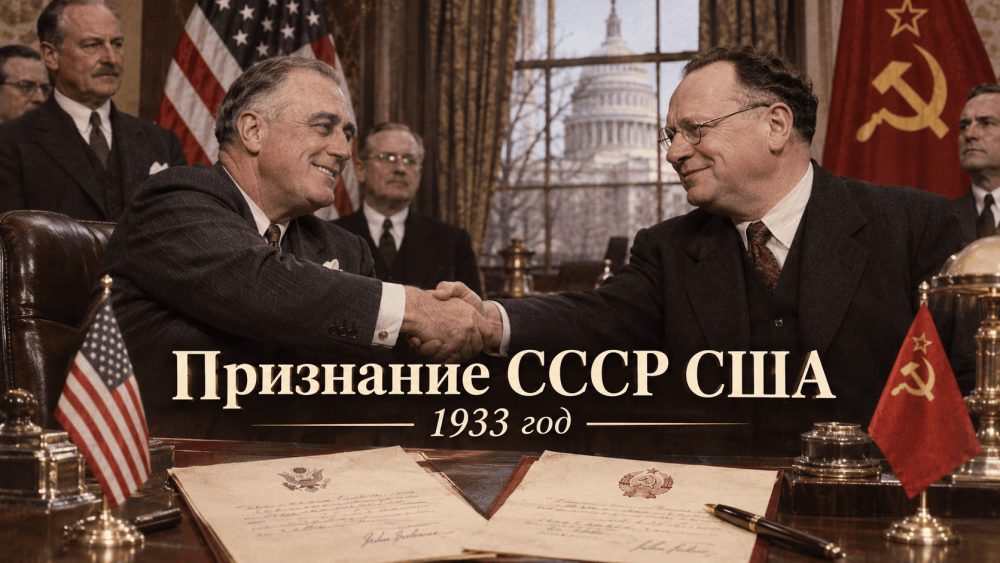
On 16 November 1933, the United States established diplomatic relations with the Soviet Union. President Franklin D. Roosevelt and Soviet Foreign Commissar Maxim Litvinov exchanged letters confirming normal diplomatic relations and an exchange of ambassadors.
The date marks a specific change in relations between governments. It does not mean that there had previously been no trade, contact or interest between the two countries. Nor did recognition create a military alliance. It established an official channel between governments that continued to disagree on major political questions.
Why recognition had been delayed
Washington did not recognise the Soviet government after the Bolsheviks came to power. Disputes concerned the debts of earlier Russian governments, nationalised property and commitments to foreign states. American officials also raised questions about revolutionary propaganda and the treatment of US citizens in Soviet territory.
Commercial connections nevertheless existed during the 1920s. Recognition should therefore not be pictured as the sudden opening of a door that had previously been completely sealed. Trade and diplomatic recognition are different forms of interaction: businesses can make agreements before governments exchange ambassadors.
There is also a chronological distinction. The USSR was formed in December 1922. The earlier period of American non-recognition concerned Soviet rule in Russia, rather than a union already bearing its later name.
Roosevelt’s reasons for changing policy
The US Department of State’s historical account identifies several considerations behind the new administration’s approach. Roosevelt hoped to expand commercial opportunities during the Great Depression and saw a strategic interest in limiting Japanese expansion in Asia. By this point, the United States was the only major power still withholding formal recognition.
Preparations for direct negotiations developed in autumn 1933. Litvinov travelled to Washington in November. The discussions addressed specific disputes as well as the broad formula for establishing relations.
This explains the structure of the surviving documentary record. Brief letters announcing recognition sit alongside separate assurances and discussions of outstanding claims. The political outcome fits into a short sentence, but reaching it required negotiation over several different subjects.
The exchange of letters on 16 November
Roosevelt’s letter informed Litvinov that the United States had decided to establish normal diplomatic relations with the government of the USSR and exchange ambassadors. The president also expressed hope for friendly cooperation and the preservation of peace.
Litvinov’s response, dated the same day, confirmed the Soviet government’s willingness to establish those relations and exchange ambassadors. He echoed the hope that the relationship would remain friendly and serve both countries.
It is useful to distinguish the operative decision from the expression of hope. An exchange of ambassadors was an agreed action. Lasting friendship was an aspiration, not evidence that every dispute had been resolved. Neither letter promised military assistance or automatic support for the other government’s foreign policy.
The brevity of these documents is part of their significance. They did not attempt to recount the entire history of disagreement. They recorded that the two governments had reached a decision about how they would deal with one another from that point onward.
The non-interference undertaking
A separate letter from Litvinov on 16 November addressed American internal affairs in greater detail. It committed the Soviet government to respect the United States’ right to organise its own affairs within its jurisdiction and to refrain from interference.
The undertaking extended to people in government service and organisations under direct or indirect government control, including those receiving financial assistance. It addressed support for armed struggle and activity aimed at bringing about a forcible change in the American political or social order.
This was more precise than a general promise that ideological differences would disappear. It identified kinds of conduct and organisational support. Evaluating later allegations therefore requires comparing specific actions with the language of the undertaking, rather than substituting the broad idea of friendship for its terms.
Debt questions were not completely settled on recognition day either. Further negotiations were envisaged. Establishing diplomatic relations did not itself amount to payment of all outstanding financial claims or agreement on every disputed amount.
What diplomats were told the following day
On 17 November, Acting Secretary of State William Phillips sent a circular telegram to American diplomatic missions abroad. It announced the previous day’s decision and instructed representatives to enter into appropriate official and social relations with their Soviet counterparts according to the established practice at their posts.
The telegram also dealt with a practical matter: Soviet passports were henceforth to receive the same treatment as those issued by other recognised governments. Consuls were to be informed.
Such instructions reveal the administrative meaning of recognition. The event changed more than newspaper language. It affected how officials abroad dealt with colleagues and documents. William C. Bullitt, appointed the first US ambassador to the Soviet Union, became a central representative of the new diplomatic relationship.
The sequence is clear: political agreement on 16 November, instructions to overseas missions on 17 November, and the work of representation that followed. Treating all these stages as one ceremony would hide how a diplomatic decision became institutional practice.
What recognition achieved
The immediate result was a normal diplomatic relationship and an agreed exchange of ambassadors. Recognised representatives and embassies provided a framework for discussing disputes. Financial claims and disagreements over non-interference continued to cause difficulty, as the American historical account acknowledges.
Recognition is consequently best understood as creating a means of negotiation, rather than completing a reconciliation. Different documents reveal different parts of the change. The leaders’ letters record the decision; additional notes set out undertakings; the circular telegram explains their administrative consequences. Reading them together gives the anniversary a more exact meaning than either a story of sudden friendship or a claim that nothing changed at all.
Related articles
- The Treaty of Rapallo
- The formation of the USSR
- The New Economic Policy
- The USSR and the founding of the UN