The USSR and the Founding of the UN: Charter, Ratification and Membership
How the USSR helped found the UN in 1945: San Francisco, Charter ratification, Ukrainian and Byelorussian membership, and the Soviet Security Council seat.
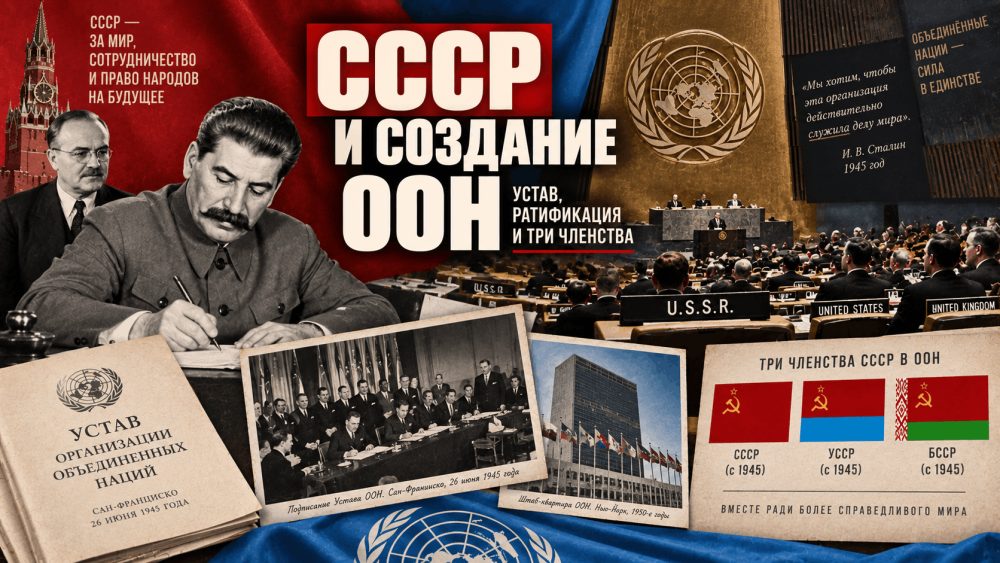
The Soviet Union helped establish the United Nations and became one of its original members. The signing of the Charter on 26 June 1945, however, was not the same event as the organization's legal birth. The UN came into existence on 24 October, once the conditions for ratification had been met. Another distinctive feature was that the Ukrainian and Byelorussian Soviet republics became original members alongside the USSR.
These details explain why accounts of the founding use different dates and membership totals. They refer to separate diplomatic steps, rather than competing versions of a single event.
From wartime cooperation to a permanent organization
The United Nations was established during the final stage of the Second World War. Its founders sought a continuing framework for international cooperation and the maintenance of peace. The USSR participated as one of the leading powers in the wartime coalition against Nazi Germany.
The history of the Great Patriotic War provides the Soviet context. Yet a permanent international organization could not simply operate as an extension of the Allies' wartime command arrangements. It needed organs, defined powers and procedures that could function after the fighting ended.
The San Francisco discussions therefore concerned more than a statement of shared hopes. The Charter had to specify membership, organizational structure and the responsibilities of participating states. This institutional work distinguishes the founding of the UN from a single meeting of national leaders.
The San Francisco Conference
The conference ran from 25 April to 26 June 1945 and brought together delegations from 50 countries. Committees and commissions worked beneath the plenary sessions to settle the document's provisions. The participants were not simply gathering to sign an already complete statement.
The UN's official conference history identifies Vyacheslav Molotov among the heads of the sponsoring powers' delegations who took turns chairing plenary meetings. Andrei Gromyko deputized for him at later meetings. Soviet participation consequently cannot be reduced to the appearance of one diplomat in a photograph or a single speech.
The Charter was adopted on 25 June and signed the following day. These were successive actions: agreement on the document's text, followed by the representatives' signatures. Neither should be confused with the later date on which the Charter entered into force.
Why the organization began in October
Article 110 required signatory states to ratify the Charter through their respective constitutional procedures. For the document to enter into force, ratifications had to be deposited by five specified powers and a majority of the other signatories.
Those five were China, France, the Soviet Union, the United Kingdom and the United States. Soviet ratification was therefore a necessary condition for the organization's establishment. The delegates' signatures in June did not by themselves complete the process.
Three dates summarize the sequence:
- 25 June 1945: adoption of the Charter's text;
- 26 June: signature;
- 24 October: entry into force and the establishment of the United Nations.
The distinction is between reaching a diplomatic agreement and completing the procedure that brought the agreement into operation. It explains why the UN's anniversary falls in October even though the famous founding conference ended in the summer.
Fifty delegations, fifty-one original members
Poland was absent from the conference because the sponsoring powers had not settled the recognition of its government in time. It subsequently signed and ratified the Charter in 1945 and became an original member.
Article 3 did not define original membership solely by physical attendance at San Francisco. It also allowed for participation in the 1942 Declaration by United Nations, provided that the Charter was subsequently signed and ratified.
The numbers 50 and 51 thus answer different questions. Fifty identifies the conference participants; fifty-one identifies the original membership. A number becomes meaningful only when the category being counted is clear.
This also illustrates why joining at the founding and admission as a later member are not necessarily the same procedural story. The Charter distinguished original members from the process used to admit others.
The USSR and two Soviet republics
The conference itself invited the Ukrainian and Byelorussian Soviet republics. They became separate original members while remaining constituent republics of the Soviet Union. The UN library explicitly explains that some founding participants did not then possess the ordinary degree of independent statehood associated with international membership.
This arrangement did not give every Soviet republic a separate UN seat. Nor did it provide the USSR with three permanent places on the Security Council. Membership of the organization and membership of a particular organ are different parts of its structure.
Article 18 assigns one vote to each member of the General Assembly. Separate republican membership therefore mattered for representation in that body. The USSR itself, however, was the permanent Security Council member; its constituent republics did not each acquire that status.
Separating these institutional levels prevents a misleading shorthand from replacing the actual arrangement. “Three memberships” does not mean “three permanent Security Council seats.”
What a permanent Security Council seat meant
The Charter assigned the Security Council primary responsibility for maintaining international peace and security. The Soviet Union belonged to the group of permanent members given a special position in the decision-making structure.
Security Council voting should not be confused with General Assembly voting. The organs have different functions and procedures. The Council's numerical composition in today's consolidated Charter should also not be transferred uncritically to 1945: it was enlarged later.
Founding a common organization did not eliminate disagreements between its members. The history of the Cold War shows how serious those disagreements became. Their existence, however, did not erase the forum, its procedures or the documents to which governments could refer.
An institution can remain a site of argument without embodying agreement on every issue. That is a more precise way to understand the postwar UN than to assume that its creation promised continuing harmony among the wartime allies.
Placing the founding in context
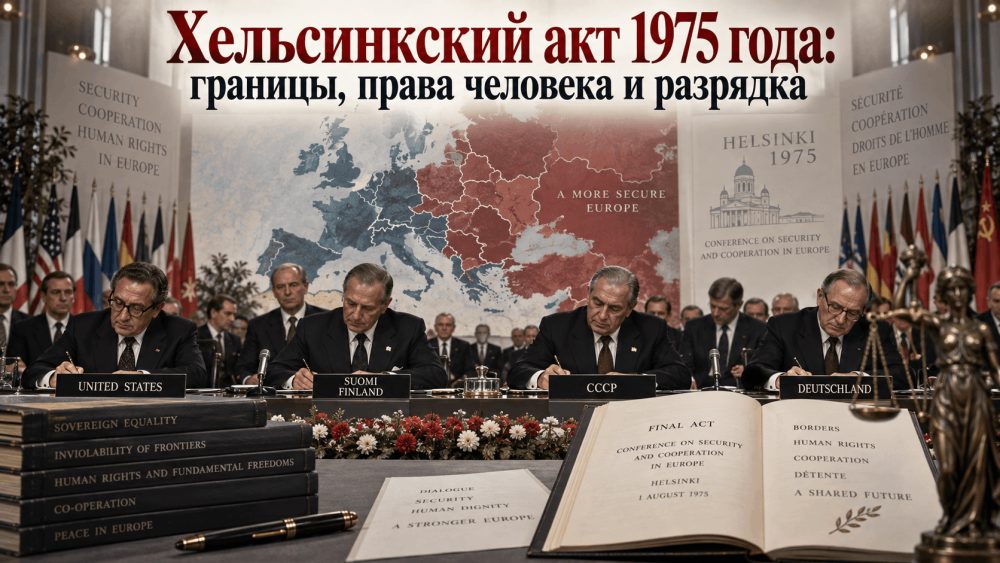
The UN was one framework for postwar international relations, not the only one. The Helsinki Final Act of 1975, for example, belongs to a different diplomatic process. Organizations, conferences and the documents they produce need to be distinguished even when many of the same states participate.
The Soviet contribution to the UN's founding is most clearly followed through concrete actions: work on the Charter, signature, ratification, original membership and a permanent Security Council seat. This sequence is more informative than a general statement that the great powers created the UN, and it leaves room for the contributions of the other participants.
Sources
- United Nations. History of the United Nations.
- United Nations. The San Francisco Conference.
- Dag Hammarskjöld Library. Information about the UN's founding members.
- United Nations. Charter, full text: Articles 3, 18, 23-24 and 110.