The 1977 Soviet Constitution: Rights, Republics and Article 6
Explore the 1977 Soviet Constitution, its social rights, the CPSU’s role and the republics. Learn how the original wording differed from the 1990 amendments.
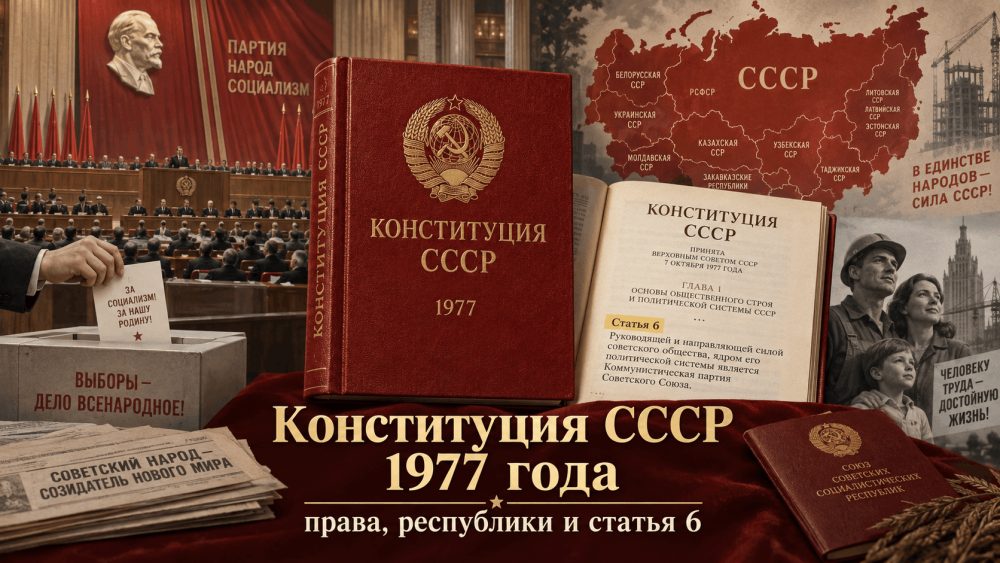
The 1977 Soviet Constitution is often remembered through a single provision: Article 6, which established the Communist Party's leading role. Yet the same document contained a right to housing, freedoms of speech and assembly, the republics' right to leave the Union and a detailed account of government institutions. Understanding how these provisions fitted together is more useful than reading any one of them in isolation.
The Constitution was adopted on 7 October 1977. It is often called the Brezhnev Constitution, referring to the political period rather than establishing personal authorship. It was a statement of the state's official arrangements for society, public authority and the citizen.
Adoption and the importance of the edition
The extraordinary seventh session of the ninth Supreme Soviet adopted the document. The Presidential Library catalogues both a 1977 edition of the Constitution and the stenographic record of the session held from 4 to 7 October. These serve different purposes: the constitutional text contains the adopted rules, while the proceedings provide a route into the process and speeches surrounding them.
The biography of Leonid Brezhnev helps place the document in its period. The Constitution nevertheless describes a much wider structure than the career of one leader. Its subjects include councils, government, republics, enterprises, public organisations and citizens' obligations.
The edition is crucial. A document headed Constitution of 1977 may incorporate amendments made in the late 1980s or in 1990. The year in the title identifies its origin; it does not guarantee that every provision reproduces the wording adopted that October.
For that reason, this article distinguishes the original text from the changes made in March 1990. Without this distinction, an account can accidentally place later institutions into an earlier political setting.
What an all-people's state meant in the document
The preamble declared that a developed socialist society had been built. Article 1 described the USSR as a socialist state of the whole people, representing workers, peasants and the intelligentsia. These were official political descriptions, rather than independent findings about the extent of public agreement.
Article 2 located the exercise of state authority in the Soviets of People's Deputies. Article 3 explained democratic centralism through election, accountability and the binding force of decisions made by higher bodies upon lower ones. The reference to elections therefore needs to be read alongside the rest of the institutional design.
The Constitution tells us how public authority was supposed to be arranged under its own rules. Establishing how a particular decision was actually reached requires additional evidence, such as minutes, correspondence and records of institutional activity.
This distinction does not deprive the text of value. It identifies the kind of evidence it provides. A constitution is an especially important source for the formal language and structure of power, while other records reveal the operation of that structure.
The significance of Article 6
In its original form, Article 6 established the Communist Party's leading position in society and the political system. It assigned the party a role in determining the general direction of development and the lines of domestic and foreign policy. It also stated that party organisations operated within the Constitution.
This helps explain the relationship between party and state. Listing formal state institutions alone does not reveal the entire arrangement of leadership, because the Constitution itself specified a special position for the CPSU alongside them.
That does not mean that every office or institution was formally identical. The Supreme Soviet, the Council of Ministers and party bodies had distinct functions. Those distinctions remain necessary even in an interpretation that emphasises the party's political predominance.
The social rights it recognised
The text established rights to work, rest, health protection, material support, housing and education. The articles generally went on to identify mechanisms intended to secure them: public institutions, construction, payments, training or the development of services.
Article 44 on housing is particularly instructive. It connected provision with construction and the allocation of living space as the housing programme proceeded. It did not promise that every citizen would immediately receive a separate apartment on the day the Constitution was adopted.
A right, the means intended to support it and the time at which an individual obtained a particular benefit are different questions. Treating them as interchangeable can produce misleading claims even when the article number is correctly cited.
Likewise, a constitutional provision on education sets out a system of guarantees; it is not evidence that every individual received the same educational experience. Research into everyday life in the USSR needs to compare formal provision with access, location and personal circumstances.
Freedoms and their qualifications
Article 50 listed freedoms of speech, the press, meetings, rallies, marches and demonstrations. Its wording connected these freedoms with the interests of the people and the strengthening of the socialist system. Removing that introductory condition changes what the provision says.
Article 39 stated that exercising rights should not damage the interests of society or the state, or the rights of other citizens. Article 59 linked the exercise of rights with the fulfilment of obligations. Guarantees and requirements were therefore presented as connected parts of the citizen's position.
The existence of a written freedom does not establish that its exercise was unlimited in practice. Conversely, investigating restrictions does not require pretending that the constitutional wording never existed. The more productive question concerns the procedures and institutions that shaped a person's actual ability to use the stated right.
An individual experience and a constitutional article can consequently illuminate different aspects of the same history. Neither should automatically be treated as a substitute for the other.
Republics and Union authority
Article 71 listed the Union republics. Article 72 retained each republic's right to secede freely from the USSR. Alongside them, Article 73 assigned extensive responsibilities to the Union, and Article 74 gave an all-Union law precedence when it conflicted with a republican law.
Reading the secession provision without the surrounding articles loses much of the federal arrangement. The reverse mistake is to refer to centralisation as though the republics had no constitutional status of their own. Our guide to the Soviet republics helps distinguish these levels of government.
The short wording of Article 72 did not itself set out a detailed procedure for departure. Its existence alone therefore cannot explain the entire sequence of events in 1991. Such an account also requires later legislation, republican decisions and the political circumstances in which they occurred.
A constitutional possibility and the actual dissolution of a state are not the same historical event. Keeping them separate allows more precise questions about how formal rules interacted with political choices.
The change made in March 1990
Law No. 1360-I of 14 March 1990 established the office of President of the USSR and amended a series of constitutional provisions. Article 6 was rewritten to refer to other political parties alongside the CPSU, as well as forms of participation by public organisations and movements.
The familiar phrase abolition of Article 6 conveys the political significance of the change. Textually, however, its content was replaced: the article number remained, while the earlier formulation of the party's exclusive leading position changed.
The same distinction prevents the presidency from being projected backwards into the original 1977 arrangement. When studying perestroika, it is necessary to follow changes in institutions and the rules governing offices, not simply changes in the names of leaders.
The later amended Constitution is therefore valuable in its own right. It answers questions about a different stage of Soviet political development. The problem arises only when an edition from that later stage is presented as though nothing had changed since 1977.
Reading it as a historical source
Begin with the revision date, then read the whole provision and the articles connected with it. For a social right, examine the proposed means of implementation. For republican powers, look at the allocation of responsibilities. For an institution, establish its relationship with the others.
Next, ask a separate question about practice. The Constitution can establish that a guarantee or obligation was declared. It cannot, by itself, tell us how consistently that guarantee was upheld or what happened whenever it was violated. Those questions call for another layer of evidence.
This approach avoids two equally limited readings: treating the Constitution as a literal description of every day of Soviet life, or assuming its text tells us nothing about the period. Its importance lies in the official framework it set out, against which political practice and subsequent institutional change can be examined.
Sources
- The 1977 Soviet Constitution in its original wording, including Articles 1-6, 39-59 and 70-76.
- Presidential Library: the 1977 edition, confirming the date and session of adoption.
- Presidential Library: proceedings of the session of 4-7 October 1977, a catalogue record for studying the adoption process.
- USSR Law No. 1360-I of 14 March 1990, establishing the presidency and replacing the wording of Article 6.
The cover is an original diagram of constitutional subjects, not a reproduction of a historical edition.