The Helsinki Final Act of 1975: Borders, Rights and Detente
What did the 1975 Helsinki Final Act mean for the USSR? Explore its three baskets, borders, human rights and political commitments through primary documents.
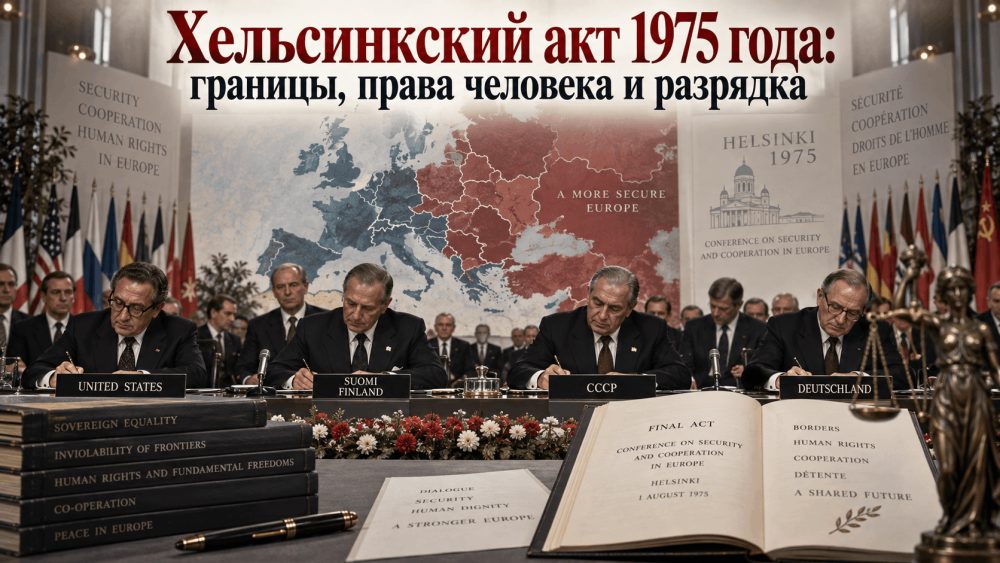
On 1 August 1975, representatives of 35 states signed the Helsinki Final Act of the Conference on Security and Co-operation in Europe. Soviet leaders regarded the summit as an important achievement of detente. Yet its scope extended well beyond a declaration about peaceful borders. Security, human rights, family contacts and the circulation of information appeared within the same negotiated framework.
The document did not end the Cold War or reconcile the political systems of its participants. Its importance lay in establishing public commitments that governments could subsequently be asked to explain. Understanding Helsinki means distinguishing those commitments from both the ambitions of the signatories and the uneven results of implementation.
How the negotiations became possible
The Soviet Union had long sought a European security conference. Western governments initially feared that such a meeting would consolidate Soviet influence in Eastern Europe. Detente in the early 1970s created room for negotiations linking territorial questions to economic cooperation and humanitarian issues. The wider history of the Cold War explains why cooperation and rivalry could develop at the same time.
Preparatory consultations began in 1972. The CSCE formally opened in Helsinki in July 1973, and detailed negotiations then moved to Geneva. European states other than Albania signed the resulting act, alongside the United States and Canada. This was therefore a multilateral undertaking, not simply a bargain between Moscow and Washington or an agreement confined to members of a European economic organization.
For Leonid Brezhnev, Helsinki was a prominent foreign-policy occasion. But a shared signature did not mean a shared hierarchy of priorities. Some governments emphasized stability and the postwar territorial order; others valued opportunities for exchanges and the humanitarian provisions. Bringing those interests into a single document helped make agreement possible without requiring political convergence.
Three baskets, with a separate follow-up process
The substantive agenda is commonly explained through three baskets:
- Political and military security, including principles governing relations between states and confidence-building measures.
- Economic, scientific, technological and environmental cooperation.
- Humanitarian matters, including personal contacts, information, culture and education.
The act also provided for subsequent meetings. Some historical accounts count this follow-up machinery as a fourth basket. The difference reflects how the document is grouped, rather than the existence of competing versions of the agreement.
One distinction is especially important. Human rights were not confined to the third basket. Respect for human rights and fundamental freedoms was one of the ten principles in the opening declaration on relations between participating states. The later humanitarian provisions gave more specific expression to parts of that wider commitment.
This arrangement matters because it prevents a misleading division between supposedly serious security questions and supposedly optional human concerns. The text placed both within the same diplomatic undertaking, even though its different provisions varied in their detail and practical application.
Inviolable borders did not mean permanently unchangeable borders
The ten principles covered sovereign equality, non-use of force, frontier inviolability, territorial integrity, peaceful settlement of disputes and non-intervention. They also addressed human rights, the equal rights and self-determination of peoples, cooperation, and good-faith performance of obligations under international law.
Reading frontier inviolability in isolation can produce the mistaken conclusion that Helsinki froze the map of Europe forever. The first principle expressly allowed frontiers to change peacefully, by agreement and in accordance with international law. Prohibiting territorial seizure and allowing an agreed alteration are different propositions, and the document contained both.
Nor did the act give any power ownership of another state's political future. Its language affirmed the participating states' sovereign rights, including their ability to determine their international relationships. The political hopes attached to a document should therefore be separated from what the document actually says.
A useful way to read the declaration is to ask two questions together: what conduct does it rule out, and what peaceful procedures does it leave available? That approach is more faithful to the text than selecting one principle and treating all the others as qualifications that can be ignored.
Why family visits belonged in a security agreement
The humanitarian section moves from broad international principles to recognizable personal problems. It addresses visits to relatives, family reunification, marriages between citizens of different states, travel, youth exchanges and the working conditions of journalists.
For family reunification, the participants committed themselves to a positive and humanitarian approach, attention to urgent cases, moderate fees and reconsideration of rejected applications. Submitting an application was not supposed to alter the rights and obligations of the applicant or family members. Such provisions did not automatically turn a request into permission to leave. They did provide standards against which administrative conduct could be discussed.
Consider the difference between a declaration that families matter and a provision addressing repeated applications after a refusal. The latter identifies a concrete procedure. It gives a diplomat or advocate a more precise question to ask: was a rejected request reconsidered within a reasonable period, and was the family penalized merely for applying?
The information provisions worked in a comparable way. They encouraged wider access to publications from other participating states, cultural exchanges and improved conditions for foreign journalists. They did not instantly abolish censorship or eliminate restrictions on travel. Rather, they established a publicly endorsed direction of change. The history of the Iron Curtain helps explain why visas, newspapers and family contacts carried such political significance.
A political commitment rather than a new court system
The Final Act was politically binding, not a legally binding international treaty. Its closing language specified that it was not eligible for registration under Article 102 of the United Nations Charter. That distinction did not remove the force of existing international obligations to which the document referred.
Political commitment should not be confused with an inconsequential expression of goodwill. Governments had publicly endorsed standards that other participants could invoke in diplomacy and at review meetings. Failing to meet them could carry reputational and political consequences. Nevertheless, Helsinki did not create a new court through which every individual could immediately obtain a judgment against a government.
The distinction is practical. A family seeking reunification did not receive a directly enforceable international travel permit on 1 August 1975. But a refusal could now be raised in relation to an agreed international text, rather than discussed only as an internal administrative decision. A common vocabulary made some disagreements more specific and harder to dismiss as misunderstandings.
It is therefore useful to distinguish three things: the wording of a commitment, the means available to press for compliance, and actual changes in people's lives. Evidence for one does not automatically establish the other two. The signature is evidence of acceptance; subsequent records are needed to assess implementation.
What happened after the ceremony
An American memorandum offers an early illustration. On 17 September 1975, Assistant Secretary of State Arthur Hartman proposed an approach to the Soviet government concerning humanitarian matters, including family issues and conditions for journalists. The memorandum connected existing bilateral problems to the new CSCE provisions.
Its significance is not that it proves all those problems were solved. It shows officials translating broad conference language into a proposed diplomatic agenda. A plan for an approach, the approach itself and a successful outcome are separate stages; historians need different evidence for each.
The memorandum also discussed coordination with allies alongside bilateral initiatives. That combination helps explain how a multilateral declaration could be used in ordinary diplomacy. Participants did not have to wait for another summit to raise a particular visa case or discuss an exchange program.
Helsinki monitoring groups later drew attention to discrepancies between official commitments and human-rights practices. The biography of Andrei Sakharov provides related context for rights advocacy in Soviet society. The act acquired significance through the people and organizations that used its language, as well as through government negotiations.
Why follow-up mattered
The act envisaged a subsequent meeting in Belgrade in 1977 to continue the process. The underlying idea was that governments would return to implementation rather than regard the summit photograph as the final result. Discussion could continue through unilateral action, bilateral negotiations and multilateral meetings.
This was a different kind of achievement from resolving every dispute at the initial conference. It preserved an agreed reference point even when governments disagreed about their behavior. An ongoing process could expose the distance between a commitment and a practice, although it could not guarantee that the distance would disappear.
Helsinki should not be described as the single cause of the Cold War's end. Equally, calling it an empty declaration overlooks the uses to which its provisions were put. It connected European security to the treatment of individuals and left a shared text that diplomats and activists could invoke. Its historical importance lies partly in the prolonged argument over what fulfilling that text required.
Sources
- OSCE: full Helsinki Final Act, PDF, the primary text for principles, humanitarian provisions and follow-up arrangements.
- OSCE: Helsinki Summit 1975, participants and negotiating stages.
- Office of the Historian: Helsinki Final Act, 1975, historical background and the subsequent Helsinki process.
- FRUS: Hartman's memorandum of 17 September 1975, a contemporary document on proposed implementation of humanitarian provisions.
The cover is an original editorial diagram of the act's three substantive areas, not an archival image.