The Iron Curtain: the border that split Europe for 45 years
A metaphor from a single speech that became a real border of concrete, barbed wire and minefields. What the Iron Curtain was, where the phrase came from — and how the curtain collapsed in one summer of 1989.
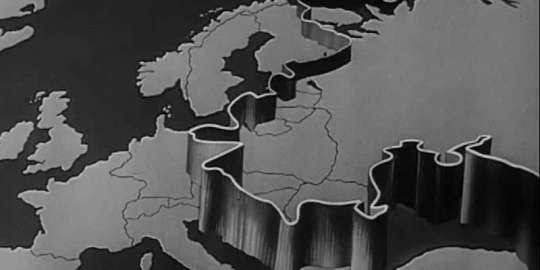
What the Iron Curtain was
The Iron Curtain is the name given to the border that divided Europe after the Second World War into the Soviet sphere of influence and the West. The term has two layers. The first is a metaphor: the political, military and ideological barrier with which the USSR fenced off itself and its client states of Eastern Europe from the Western world. The second is entirely material: thousands of kilometers of real fences, watchtowers, raked control strips and minefields running from the Baltic to the Adriatic — with the Berlin Wall as its most famous section.
The Iron Curtain stood from the late 1940s until 1989 and became the defining image of the Cold War — the line along which the world was divided into "us" and "them."
The Fulton speech: where the phrase came from
On March 5, 1946, Winston Churchill spoke at Westminster College in the small town of Fulton, Missouri. Churchill was no longer prime minister — British voters had unexpectedly turned his party out of office in the summer of 1945 — and he came to the United States as a private citizen; he was introduced on stage by President Truman himself, a Missouri native. The speech was titled "The Sinews of Peace," but history remembers another phrase: Churchill declared that "an iron curtain has descended across the Continent" — from Stettin on the Baltic to Trieste on the Adriatic — and that behind it lay Warsaw, Berlin, Prague, Budapest, Bucharest and Sofia, all subject to an ever-tightening degree of control from Moscow.
Curious details: the iron-curtain passage was absent from the text distributed to the press in advance — Churchill delivered it beyond his prepared script, and reporters had to reconstruct the wording from their notes. And the expression itself is older than the speech: the image of an iron curtain — the fireproof screen in theaters that seals the stage off from the hall — had been used by politicians before; in 1945 even Nazi propaganda had employed it. But it was Fulton that made the phrase immortal.
The reaction was immediate. The Western press initially criticized Churchill for warmongering; within days Stalin replied in Pravda, accusing him of inciting war and comparing his talk of English-speaking leadership to racial theories. Many historians — Russian ones included — date the Cold War from the Fulton speech.
A curtain of metal and concrete
The metaphor quickly grew iron flesh. By the early 1950s the socialist bloc's borders with the West had become the most fortified frontiers on Earth — and, like the Berlin Wall, these fortifications faced mostly inward: their chief task was not to stop an invasion but to keep their own citizens from leaving.
The inner German border — nearly 1,400 kilometers through forests and villages — consisted of metal fencing, alarm systems, plowed control strips, automatic spring guns and, on some stretches, minefields. Similar lines ran along the borders of Czechoslovakia, Hungary and Bulgaria. Villages in the border zone were forcibly resettled; trains crossed the frontier with their windows welded shut. Those killed attempting to cross numbered in the hundreds. Behind the curtain lay Poland, East Germany, Czechoslovakia, Hungary, Romania, Bulgaria, Albania and the USSR itself; Tito's Yugoslavia, after its break with Stalin in 1948, fell out of the Soviet bloc while remaining socialist.
Inside the USSR the curtain was doubled by an invisible layer: exit visas and vetting commissions, KGB checks, the jamming of Western radio stations, the censorship of mail. For most Soviet citizens the outside world was unreachable both physically and informationally — and it was this totality that distinguished the Iron Curtain from any ordinary border.
Life on both sides
The official Soviet interpretation mirrored the Western one in reverse: it is not we who have fenced ourselves off — the West is waging subversion, and the border protects socialism from spies and "ideological sabotage." In this logic the curtain was presented as forced self-defense. We state that position, because half of Europe lived by it — and we state what the people of the East said themselves: the hundreds of thousands who fled through Berlin before 1961, those who died on the wire and the mines, the lines outside embassies all voted with their choice. A curtain that shoots its own citizens is hard to call defensive.
Nor was the curtain ever absolutely sealed, and it changed with time: after Stalin's death came tourist exchanges, festivals and touring companies; Western radio voices, jamming notwithstanding, were heard by millions. As the decades passed, the curtain was losing the contest not to armies but to jeans, music and tape recordings.
How the curtain fell
The end came at astonishing speed. Gorbachev renounced the doctrine of controlling Eastern Europe by force — and the system lost its foundation. In May 1989 Hungary began dismantling the fence on its border with Austria — the first physical breach in the curtain. On August 19, 1989, near the town of Sopron, the Pan-European Picnic was held: a border crossing was symbolically opened for a few hours, and hundreds of East German citizens walked through it to the West — the largest mass escape since the Berlin Wall was built. In September Hungary opened the border officially, and East Germans drove west through Budapest by the thousands.
On November 9, 1989, the Berlin Wall — the heart of the curtain — fell. Within weeks the regimes of Czechoslovakia, Bulgaria and Romania collapsed behind it. Two years later the USSR itself was gone. A curtain that had taken decades to build vanished faster than it had risen.
What remains of the curtain
Today the former line of the curtain is traced by the European Green Belt — a ribbon of wild nature thousands of kilometers long: half a century as a closed border zone inadvertently created a nature reserve. Along it stand museums, preserved fragments of the fortifications and the Iron Curtain Trail cycling route through some twenty countries. Fulton hosts America's National Churchill Museum, and the metaphor itself lives on: whenever a new wall or a new system of isolation rises anywhere in the world, the first comparison reached for is the Iron Curtain. In that sense the curtain's chief lesson is simple: borders built to lock people in do not outlive their builders.
Frequently asked questions
What does the term "Iron Curtain" mean? The barrier — political, ideological and physical — that separated the USSR and its Eastern European client states from the West from the late 1940s until 1989. The term was made famous by Churchill's Fulton speech.
Who coined the term "Iron Curtain"? Churchill made it immortal on March 5, 1946, but the expression (from the fireproof safety curtain in theaters) had been used earlier — including by Nazi propaganda in 1945.
Which countries were behind the Iron Curtain? The USSR, Poland, East Germany, Czechoslovakia, Hungary, Romania, Bulgaria and Albania. Yugoslavia stood apart after 1948: socialist, but outside the Soviet bloc.
Was the Iron Curtain a real wall? In places, yes: the inner German border and the frontiers of Czechoslovakia and Hungary were fortified with fencing, watchtowers, alarm systems and in places minefields — and in Berlin there stood an actual wall.
When and how did the Iron Curtain fall? In 1989: in May Hungary began removing the fence on its Austrian border, on August 19 hundreds of East Germans crossed to the West during the Pan-European Picnic, and on November 9 the Berlin Wall fell.
How is the Iron Curtain different from the Berlin Wall? The Wall was the curtain's most famous section — the ring around West Berlin. The curtain was the entire system of borders between the blocs, thousands of kilometers long, from the Baltic to the Adriatic.
Related
- The Cold War: half a century of confrontation — the conflict whose border the curtain was.
- The Berlin Wall — the curtain's most famous section.
- The KGB: sword and shield of Soviet power — the curtain's invisible inner layer.
- Mikhail Gorbachev — the leader under whom the curtain opened.
- The dissolution of the USSR (1991) — the finale of divided Europe.
- The Warsaw Pact — the troops arrayed along the curtain.
Sources
The facts in this article can be verified against authoritative sources:
- Encyclopaedia Britannica, "Iron Curtain speech (1946)": https://www.britannica.com/topic/Iron-Curtain-Speech
- Wikipedia, "Iron Curtain": https://en.wikipedia.org/wiki/Iron_Curtain
- The National WWII Museum (New Orleans), "Winston Churchill's Iron Curtain Speech — March 5, 1946": https://www.nationalww2museum.org/war/articles/winston-churchills-iron-curtain-speech-march-5-1946
- America's National Churchill Museum, full text of "The Sinews of Peace": https://www.nationalchurchillmuseum.org/sinews-of-peace-iron-curtain-speech.html
- HISTORY, "Churchill delivers Iron Curtain speech": https://www.history.com/this-day-in-history/march-5/churchill-delivers-iron-curtain-speech
Where interpretations diverge (defense of socialism or a prison wall), we present both positions and the arguments behind each.