Treaty of Rapallo 1922: Six Articles and the November Supplement
What Soviet Russia and Germany agreed at Rapallo: mutual claims, diplomatic relations, economic provisions and the extension of the treaty in November 1922.
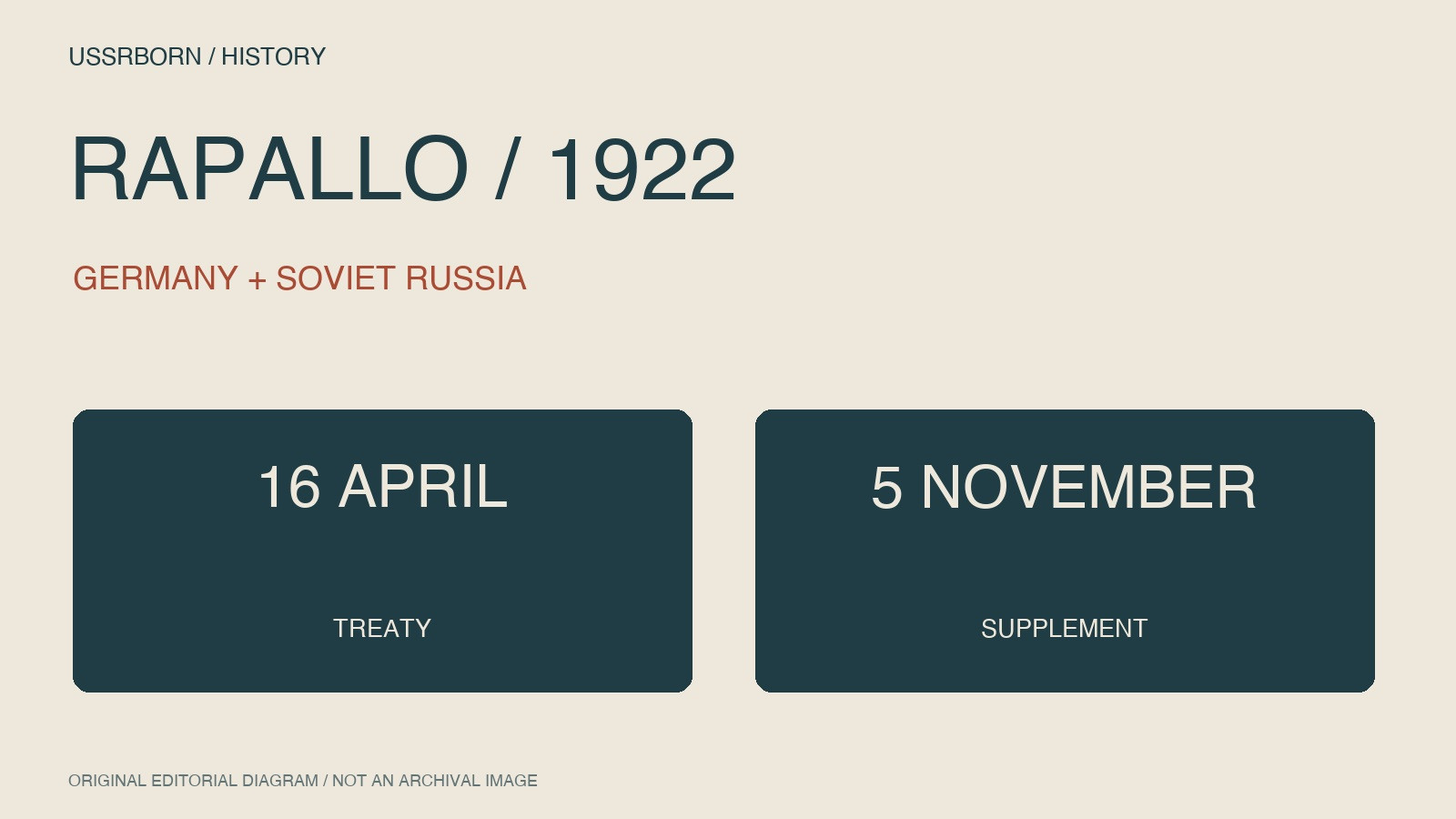
On 16 April 1922, representatives of Germany and Soviet Russia signed the Treaty of Rapallo in Italy. It restored diplomatic relations and settled important categories of outstanding claims. Describing it simply as an agreement between two isolated states misses much of its substance. Its six short articles addressed the consequences of war, property claims, diplomatic representation and the framework for economic relations.
Which states signed at Rapallo?
Walther Rathenau signed for the German government and Georgy Chicherin for the Russian Soviet republic. Germany was the German Reich of the Weimar period. In this document, the name does not refer to Nazi Germany: the agreement dates from 1922.
The other party was the RSFSR, not yet the Soviet Union. The USSR was formed on 30 December 1922, several months later. Rapallo belongs to the history of Soviet diplomacy, but calling its April signatory the USSR obscures the chronology. The distinction between the USSR and Russia is particularly useful when reading documents produced during this transition.
The negotiations took place against the background of the Genoa Conference on postwar European affairs. Germany's Federal Agency for Civic Education describes an agreement that expanded diplomatic and economic possibilities while also worsening relations with the Western powers. Improving one bilateral relationship did not remove the other conflicts confronting either government.
The claims that were waived
Article 1 provided for a reciprocal waiver of claims for war expenditure and damage caused by military action. It separately addressed the costs of prisoners of war and interned Red Army personnel, as well as certain consequences of exceptional wartime measures. These were identified categories of claims. The article was not a universal declaration cancelling every conceivable debt or obligation.
It also distinguished public and private legal relations arising from the state of war, including questions concerning merchant vessels. Those matters were to be settled on the basis of reciprocity. Even within the opening article, therefore, the treaty performed different tasks: it waived some claims and established a principle for resolving other issues.
Article 2 concerned German claims arising from Soviet laws and measures affecting German nationals and their rights. Its crucial qualification was that the Russian government should not satisfy comparable compensation claims made by a third party. Omitting that condition turns a qualified settlement into an apparently unconditional concession. A reliable summary needs to preserve the condition as well as the waiver.
The distinction is practical. A statement that a government renounced specified demands does not automatically establish what it would accept if another claimant received different treatment. The treaty's wording expressly connected those questions rather than leaving them entirely separate.
Diplomatic relations and an economic framework
Article 3 restored diplomatic and consular relations immediately. The conditions under which consuls would be admitted were to be set out in a separate agreement. Political normalisation and the detailed arrangements for its operation were thus related, but not identical, decisions.
Article 4 adopted most-favoured-nation treatment for the legal position of each party's nationals and the general regulation of commercial and economic relations. It included an exception for advantages that the RSFSR might grant to a Soviet republic or to a state formerly within the Russian Empire. The clause cannot accurately be paraphrased as a promise that Germany would receive every advantage offered to every possible partner.
Article 5 called for cooperation in meeting economic needs and recorded German willingness to support proposed agreements involving private firms. It did not set mandatory quantities of goods, identify a complete programme of industrial construction or create a common economic plan. Individual business arrangements still needed their own terms.
On the Soviet side, this was the period of the New Economic Policy. The domestic economic programme helps locate the treaty in time, but it should not be confused with the treaty itself. One concerned the organisation of economic life within the country; the other established obligations between governments.
Did every provision take effect immediately?
No. Article 6 stated that Article 1(b) and Article 4 would take effect on ratification. The remaining provisions were to operate immediately. Signing one agreement could therefore trigger different obligations at different stages. This is easy to lose when a chronology reduces the whole document to a single date.
The published six articles also contain no undertaking to wage war together or automatically defend the other party if it was attacked. Calling this text a military alliance would assign it provisions it does not contain. Any account of wider cooperation requires additional evidence; it cannot be inferred from clauses absent from the agreement.
What the cabinet discussion adds
The German cabinet meeting of 18 April, published by German History in Documents and Images, reveals the immediate diplomatic repercussions. Participants discussed Britain's response and the prospect that Germany would be excluded from negotiations about Russia. Rathenau's account justified the move towards Soviet Russia by referring to fears that other powers might reach an agreement without Germany.
These were participants' arguments recorded from the German side. They illuminate how the government defended its decision, rather than providing a neutral record of every government's intentions. The treaty tells us what the parties agreed. The cabinet minutes show how one government discussed the consequences. Reading the two together is more informative than treating either as a substitute for the other.
Why there was a November supplement
A supplementary agreement dated 5 November 1922 extended the Rapallo arrangements, with the necessary adaptations, to Germany's relations with the Ukrainian, Belarusian, Georgian, Azerbaijani and Armenian Soviet republics and the Far Eastern Republic. These names refer to the political entities listed in the contemporary document. They should not be silently replaced by a later map of the USSR.
The supplement also contained provisions of its own concerning personal protection, trade offices and contracts. For example, it permitted arbitration clauses in the agreements it discussed. It was consequently more than a second set of signatures beneath the April treaty: it addressed how a wider group of states would participate in the developing framework.
The subsequent union structure, later expressed in the 1924 Soviet Constitution, should not be projected backwards onto April. Keeping the sequence clear, from Rapallo to the November supplement and then the formation of the USSR, reveals that the governmental framework of Soviet foreign relations was itself changing during the year.