The 1959 Antarctic Treaty: Peaceful Purposes, Science and Inspections
How the Antarctic Treaty restricted military activity, preserved positions on territorial claims and provided for scientific exchange and inspections.
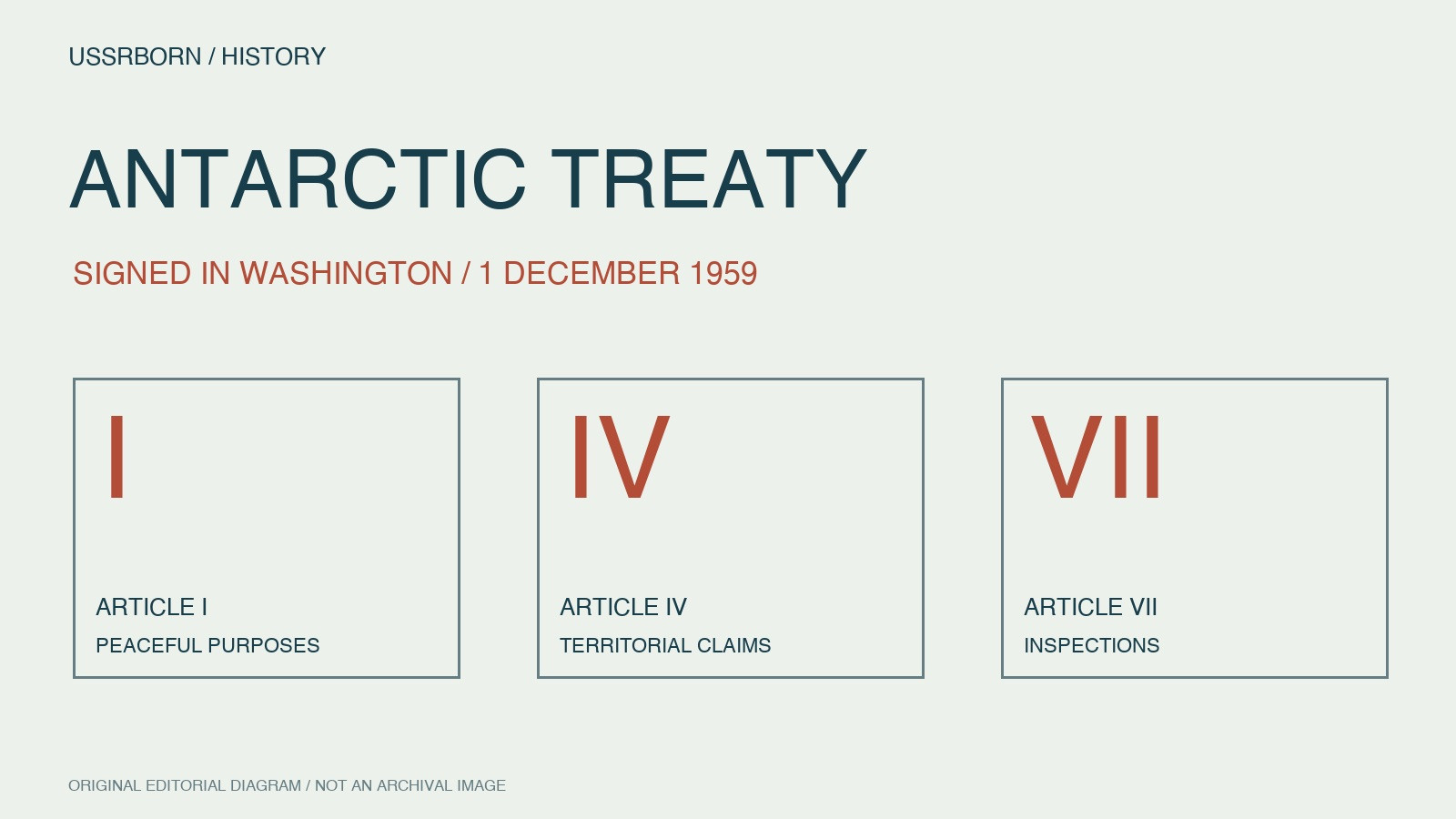
On 1 December 1959, the Soviet Union and eleven other states signed the Antarctic Treaty in Washington. At the height of the Cold War, they agreed to restrict military activity across a defined region, preserve scientific freedom and allow mutual inspections. They did not finally settle the competing claims to Antarctic territory. Instead, they created a way to cooperate without first resolving every disagreement over sovereignty.
The scientific and diplomatic setting
The immediate scientific context was the International Geophysical Year of 1957-1958. Research demonstrated the value of coordinating Antarctic observations, while continued work required a durable international framework. The Australian Antarctic Program also places the negotiations against fears that territorial rivalry might develop into conflict or become entangled in the confrontation between the United States and the Soviet Union.
The original signatories were Argentina, Australia, Belgium, Chile, France, Japan, New Zealand, Norway, the Union of South Africa, the USSR, the United Kingdom and the United States. The treaty entered into force in 1961. It was consequently a multilateral agreement, not simply a bilateral bargain between Moscow and Washington.
Its importance within the Cold War lies partly in the limited scope of the agreement. The participants did not abandon all their differences. They established rules for a particular area and set of activities where cooperation offered advantages to rivals and to the other states involved.
A geographic boundary, not just a continent
Article VI applied the treaty to the area south of 60 degrees south latitude, including ice shelves. “The Antarctic continent alone” is therefore an incomplete description: latitude defined the scope. The article also preserved the rights of states under international law concerning the high seas within that area.
This structure has practical significance. Before applying an obligation, it is necessary to establish whether an activity falls within the treaty's geographic area. A polar climate, an expedition's name or a vessel's nationality cannot substitute for that test. At the same time, the provision did not turn the surrounding sea into the territory of a single state.
Peaceful purposes and military equipment
Article I prohibited measures of a military nature, including bases, fortifications, maneuvers and weapons testing. It expressly allowed military personnel or equipment to be used for scientific research or other peaceful purposes. The purpose of an activity mattered, not merely the organization employing the people or owning the transport.
The claim that no military person could ever be present in Antarctica is thus inconsistent with the text. A military aircraft supporting peaceful scientific logistics and a weapons test are different cases under this distinction. This illustrates the article's structure; it is not a claim about a particular historical operation.
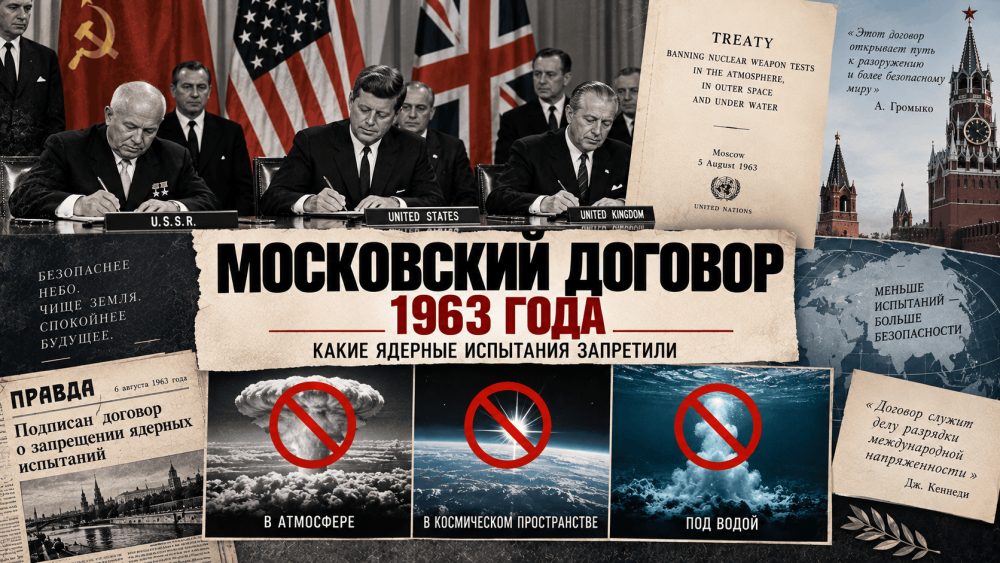
Article V separately prohibited nuclear explosions and the disposal of radioactive waste. Its wording should not be expanded into a blanket prohibition on every technology described as nuclear. It named specific activities. The later 1963 Moscow Partial Test Ban Treaty provides a useful comparison with a different agreement regulating nuclear explosions in a different scope.
Territorial claims were preserved, not settled
Article IV protected the parties' respective positions. Joining the treaty did not require renouncing an existing claim or accepting another country's claim. It also prevented new claims or the enlargement of existing ones while the treaty remained in force.
Activities undertaken during that period could not create rights of sovereignty or serve as a basis for asserting, supporting or denying territorial claims. A simple equation between building a station and acquiring territory would therefore contradict this arrangement.
It is equally misleading to say the agreement definitively made Antarctica “ownerless.” The treaty did not adjudicate every claim. It created a framework within which work could continue despite incompatible legal positions. Regulating conduct and resolving ownership are different tasks, and the document's achievement depended on keeping them distinct.
This helps explain why a map of national research stations is not automatically a map of recognized national borders. The presence of infrastructure and the legal status of a territorial claim answer different questions. Article IV prevented activity during the treaty period from becoming a shortcut around that distinction.
Research and the exchange of information
Articles II and III provided for scientific freedom and cooperation. The parties agreed, to the greatest feasible and practicable extent, to exchange information about research plans, scientific personnel, observations and results. Scientific cooperation was therefore more than permission for each country to operate a separate station.
The qualifications in the wording matter. The text set out commitments to cooperation without describing a single international institution that would conduct every experiment. National programs could remain distinct while sharing information and personnel under the agreed framework.
How inspections supported the rules
Article VII allowed parties entitled to participate in consultative meetings to appoint observers. Stations, installations and equipment were open to inspection. Ships and aircraft were included at points where cargo or personnel were loaded or unloaded. Aerial observation was also permitted.
The parties had to provide advance notice of the expeditions, stations and military personnel or equipment for peaceful purposes specified in the article. These information duties complemented access to facilities: understanding an activity required both notice of its existence and the ability to examine it.
This was not an unrestricted inspection entitlement for any visitor. It belonged to observers appointed through the procedure established by the treaty. The difference is essential when describing the agreement as opening Antarctica to inspection.
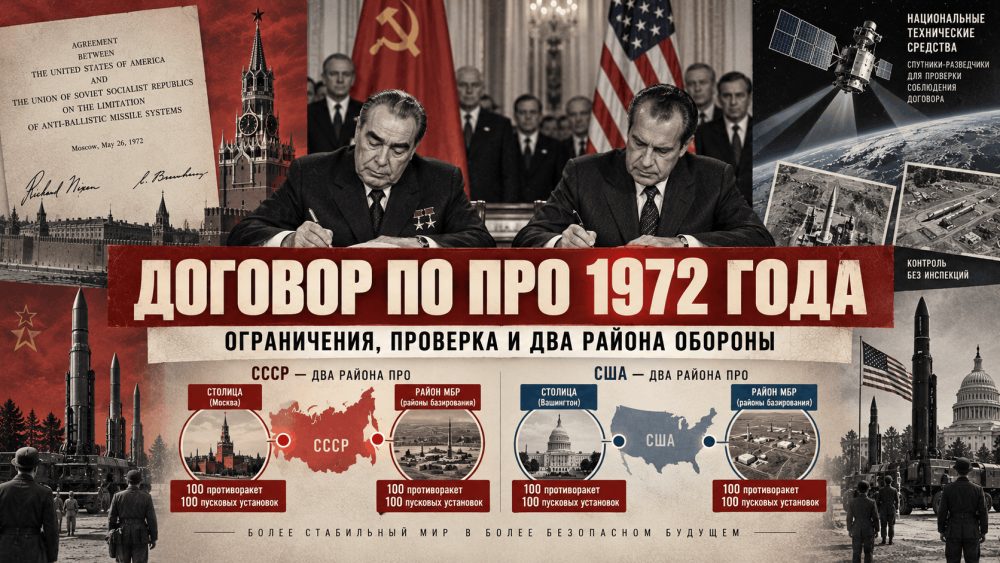
For comparison, the 1972 ABM Treaty addressed a very different subject and employed different verification arrangements. Both examples nevertheless show why a list of prohibitions is only part of a treaty's design. Information, observation and procedures help explain how the parties expected commitments to work.
The original treaty and later agreements
The wider Antarctic Treaty System developed beyond the 1959 text. The Madrid Protocol on Environmental Protection, for example, was signed in 1991 and entered into force in 1998. Its environmental provisions must not simply be read backward into the original agreement.
The treaty also did not establish a new state. It imposed obligations on participating governments and created a framework for consultation. References to the United Nations Charter and registration of the treaty did not transfer ownership of Antarctica to the UN. The broader institutional background is discussed in the article on the USSR and the founding of the United Nations.
The historical result was specific and substantial: governments with conflicting interests agreed on inspectable rules for peaceful activity without eliminating their wider political disagreements first. That is a more accurate description of the treaty's achievement than either declaring every Antarctic dispute resolved or dismissing cooperation because disputes remained.