The 1972 ABM Treaty: Limits, Verification and Two Defense Areas
Why the USSR and US limited missile defense: two areas under the original treaty, the 1974 change, verification and US withdrawal in 2002.
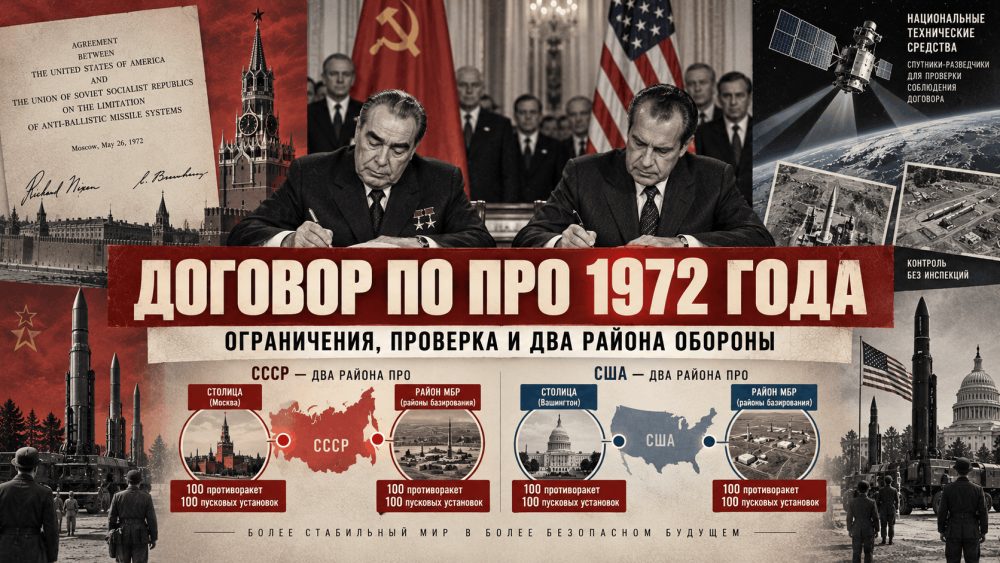
Leonid Brezhnev and Richard Nixon signed the Anti-Ballistic Missile Treaty in Moscow on 26 May 1972. It entered into force on 3 October that year. The Soviet Union and the United States agreed to restrict systems intended to intercept strategic ballistic missiles, retaining only carefully defined defensive deployments. The treaty was a central result of the first Strategic Arms Limitation Talks, known as SALT I.
It should be distinguished from the interim agreement on offensive weapons signed at the same summit. One document concerned defenses against missile attack; the other addressed specified categories of the forces that could conduct such an attack. Their relationship mattered, but they were not interchangeable texts.
Why negotiate limits on defenses?
The treaty's preamble connected defensive deployments with the competition in offensive arms. If one state expected to withstand retaliation, its opponent had an additional reason to expand or improve the forces capable of penetrating that defense. Limiting ABM systems was intended to reduce that pressure and the risk of nuclear war.
The underlying argument was not that civilian protection lacked value. It was that, in a confrontation involving enormous nuclear arsenals, confidence in escaping retaliation could itself be destabilizing. The agreement sought to regulate that dangerous relationship. It did not remove the threat of catastrophic destruction.
This was a departure from the everyday assumption that adding a defensive instrument must always improve security. Whether a particular deployment made the strategic balance safer depended on how both sides expected it to affect their choices. That helps explain why missile defense became a diplomatic subject alongside offensive missiles.
Two deployment areas in the original treaty
Article III initially allowed each party two ABM deployment areas. One could be centered on the national capital. The other could contain intercontinental ballistic missile silo launchers. Each area had a radius limited to 150 kilometres.
At each area, a party could deploy no more than 100 ABM launchers and no more than 100 interceptor missiles at launch sites. The original ceiling was therefore 200 launchers and 200 deployed interceptors per side. These were permitted maxima, not requirements to build every authorized installation.
The geographical measurement also needs care. A deployment area's radius was a treaty boundary. It was not automatically the interceptor's flight range, nor a promise that every point within a circle enjoyed equal protection. Legal limits on where a system could be stationed and the performance of that system were different questions.
Radar installations were restricted as well. The treaty treated an ABM system as a combination of interceptor missiles, launchers and ABM radars. Limiting missiles alone while leaving the supporting infrastructure unrestricted would not have imposed the same constraint on a larger defensive network.
What the treaty prohibited
Article I ruled out a defense of the country's entire territory and a base for such a defense. Article V prohibited the development, testing and deployment of sea-based, air-based, space-based and mobile land-based ABM systems and their components. Modernization and replacement of permitted systems remained possible within the treaty's provisions.
These restrictions were not a general ban on scientific inquiry. The distinctions between research, development, testing and deployment later became contentious. American documents from 1985 record debate over competing interpretations as new technologies and the Strategic Defense Initiative raised fresh questions.
Those records reveal a discussion within the US administration. They should not be read as proof that Moscow accepted every American interpretation, or that either side's preferred reading was an uncontested account of the agreement. The existence of detailed language did not make technological change politically simple.
Verification and consultation
Article XII provided for national technical means of verification. Each party undertook not to interfere with the other party's lawful verification means and not to use deliberate concealment measures that impeded verification of compliance. This was a different arrangement from routine reciprocal inspections at every installation.
The treaty also called for a Standing Consultative Commission. Its functions included considering compliance questions, ambiguous situations and changes affecting the agreement. It provided a place to address difficulties rather than leaving the parties with numerical restrictions alone.
A consultation mechanism could not guarantee trust. Its practical importance was procedural: a government could raise an issue, seek an explanation and discuss what should happen next within an agreed framework. In an arms-control relationship, the method for handling uncertainty is part of the agreement's substance.
The later reduction to one area
At the 1974 Moscow summit, the parties agreed to reduce the permitted number of ABM deployment areas from two to one each. The protocol was signed on 3 July. A published memorandum of the summit discussion records Nixon addressing the single-area limit and the possibility of changing the selected area later.
This sequence explains a common shorthand. Saying that the 1972 treaty allowed one ABM area describes the arrangement after its subsequent modification, not the original text. The difference matters when comparing contemporary plans or reading a document written before the additional restriction.
The limit also remained a ceiling. Permission for a site did not compel a government to maintain a particular installation indefinitely. Treaty entitlement, construction, operational service and later decisions about a system should be kept distinct.
Withdrawal in 2002
The treaty had unlimited duration, but Article XV allowed withdrawal after six months' notice if extraordinary events connected with its subject jeopardized a party's supreme interests. The US withdrawal took effect on 13 June 2002. President George W. Bush's statement that day explicitly recorded the effective date.
Bush justified the decision by describing a changed threat environment after the Cold War. That was the administration's stated position, rather than an assessment shared by everyone involved in the debate. Explaining the legal mechanism and date does not require treating the political case for withdrawal as settled.
The treaty's historical importance lies in its effort to connect defensive capabilities, offensive competition and verifiable rules. It neither abolished nuclear weapons nor ended the Cold War. It nevertheless established a framework that shaped a particularly sensitive part of strategic competition for decades.