The Moscow Test Ban Treaty of 1963: What Was Prohibited?
What the 1963 Moscow treaty prohibited: three environments, the underground-testing condition, key dates and the distinction from complete disarmament.
On 5 August 1963, the Soviet Union, the United States and the United Kingdom signed a nuclear test ban treaty in Moscow. It entered into force on 10 October. The two dates mark separate stages: signing an agreement and bringing its obligations into operation were not the same event.
Usually called the Partial or Limited Test Ban Treaty, the agreement prohibited nuclear explosions in the atmosphere, beyond it and underwater. Its significance becomes clearer when its five short articles are read alongside its familiar title. They reveal both the reach of the prohibition and the limits of the compromise.
Negotiations began before the Cuban crisis
The Cuban Missile Crisis of 1962 made the danger of direct confrontation starkly visible. Test ban negotiations, however, had begun earlier. The US Department of State's historical account describes talks in 1958, a temporary testing moratorium and the subsequent resumption of explosions. Verification remained a central obstacle: how could a suspected underground test be distinguished from natural seismic activity, and would foreign inspectors be admitted?
An American memorandum of Dean Rusk's conversation with Soviet Foreign Minister Andrei Gromyko on 25 September 1962 already discussed a ban in three environments. This was before the October crisis. Saying that the crisis encouraged agreement is therefore different from saying that it created the proposal.
According to that memorandum, Rusk believed a limited treaty could work without a special inspection mechanism. Gromyko sought to combine a ban in three environments with a suspension of underground testing while negotiations continued. The record preserves disagreement over the relationship between a limited agreement and a comprehensive one. It is an American account of the discussion, not a transcript jointly endorsed by both delegations.
Signatures, ratification and registration
The signatories for the three governments were Andrei Gromyko, Dean Rusk and Lord Home. Nikita Khrushchev and John F. Kennedy were the political leaders most closely associated with the Soviet and American sides, but they should not be substituted for the officials whose signatures appear on the treaty.
Article III required ratification by all three original parties and the deposit of their instruments of ratification before entry into force. That condition was fulfilled on 10 October 1963. The United Nations treaty record also gives 15 October as the registration date. Signing, entry into force and registration answer three different questions about the same instrument.
The three governments became depositaries. Their responsibilities included receiving documents and communicating information about signatures, ratifications and accessions. Being a depositary did not make a government part of a standing international inspection team. The role belonged to the administration of the agreement.
The prohibition in Article I
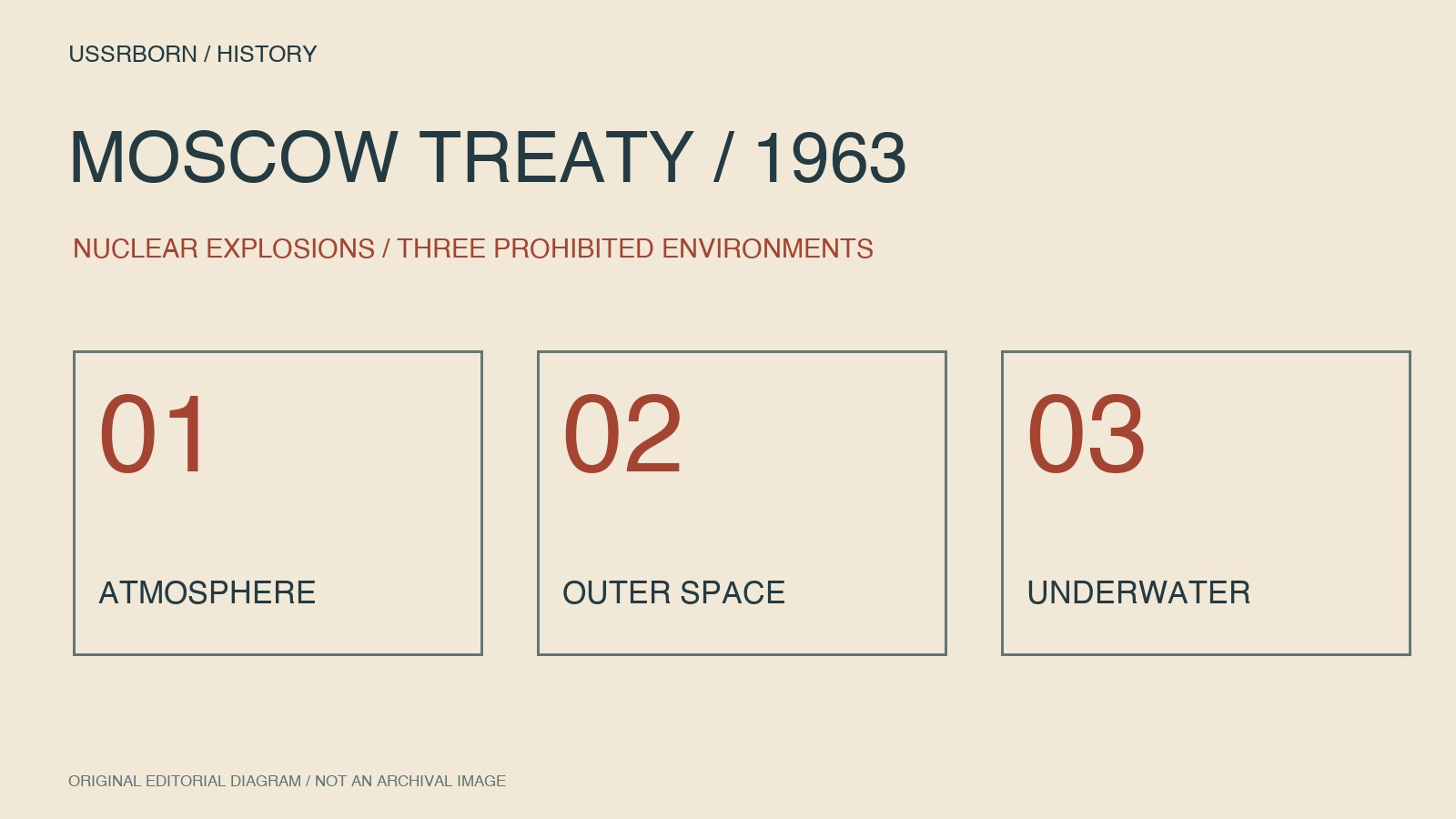
Each party undertook to prohibit, prevent and refrain from conducting covered nuclear explosions at places under its jurisdiction or control. Three environments were expressly identified:
- the atmosphere;
- the area beyond the atmosphere, including outer space;
- underwater locations, including territorial waters and the high seas.
The wording covered a nuclear weapon test explosion and any other nuclear explosion in these circumstances. Describing an explosion as peaceful would therefore not, by itself, place it outside the agreement. The operative distinction concerned the event and its environment, not simply the purpose announced by the state conducting it.
The article also required parties to refrain from causing, encouraging or participating in covered explosions elsewhere. This matters because the obligation was broader than a promise not to detonate a device within one's own borders. A short summary that mentions only domestic testing misses that additional undertaking.
Underground testing was not unrestricted
The treaty did not establish a general prohibition on underground nuclear tests. This is why its standard English names include the words partial or limited. Yet saying that anything underground was permitted would also misrepresent its wording.
Article I, paragraph 1(b), prohibited an explosion in any other environment if it caused radioactive debris to be present beyond the territorial limits of the state under whose jurisdiction or control the explosion occurred. An underground location alone was therefore not the entire legal test. The consequences beyond the state's territory also mattered.
This creates an important distinction between a prohibition based on the environment and one based on a specified cross-border effect. Consider two statements: a device was detonated underground; radioactive debris from it subsequently appeared outside the country. The first statement alone does not establish a breach of this treaty. The second raises the condition expressly addressed by paragraph 1(b). Assessing an actual event would require evidence about the explosion and its effects.
The text also preserved the objective of reaching a permanent ban on all nuclear test explosions, explicitly including underground ones. The limits of the 1963 settlement were acknowledged within the agreement itself, rather than hidden behind its public presentation.
Arms control was not the elimination of arsenals
The preamble expressed an ambition to achieve general and complete disarmament and end nuclear test explosions. Those aims should be distinguished from the specific duties in the operative articles. The treaty did not order the destruction of existing warheads, set a numerical ceiling on missiles or prohibit possession of nuclear weapons.
In the September 1962 memorandum, Gromyko also distinguished a test ban from disarmament itself. That distinction helps explain how an agreement could constrain particular activities while leaving wider strategic competition unresolved. It did not bring the Cold War to an end.
A careful assessment therefore avoids measuring the treaty against a promise it did not make. Its practical scope must be identified first. Only then can its contribution to limiting nuclear dangers be considered alongside the continuing existence of arsenals and the unresolved issue of a comprehensive test ban.
An agreement open to other states
Although negotiated by three original parties, the treaty was open to all states for signature. States that had not signed before it entered into force could subsequently accede. Its design was therefore multilateral, rather than a permanently closed arrangement among its three authors.
Article IV specified unlimited duration. It also allowed withdrawal if a party decided that extraordinary events connected with the treaty's subject had jeopardized its supreme interests. Notice had to be given to all other parties three months in advance. An agreement with no fixed expiry date is not necessarily an agreement with no withdrawal procedure.
The English and Russian texts were equally authentic. Readers comparing historical descriptions can use the treaty itself to check whether a short label has obscured a qualification, especially the clause concerning radioactive debris beyond territorial limits.
Why the Moscow treaty remains a useful historical example
The agreement demonstrated a form of diplomacy in which adversaries could accept a defined restriction without first resolving every dispute between them. Its terms drew a boundary around particular conduct while leaving other questions for further negotiation. That is a more precise account of its achievement than either calling it complete disarmament or dismissing it because disarmament remained incomplete.
The later Helsinki Final Act of 1975 addressed different subjects and had a different documentary character. Comparing such instruments is useful when those differences are retained. Diplomatic history consists of agreements with particular provisions, participants and procedures, not one interchangeable sequence of declarations about peace.
Sources
- Moscow treaty text in the United Nations Treaty Series: Articles I-V, signatures and the entry-into-force note.
- United Nations record for treaty No. 6964: dates, depositaries and authentic languages.
- Office of the Historian: Limited Test Ban Treaty: negotiations and the verification problem.
- Rusk-Gromyko conversation, 25 September 1962: the American record of positions before the Cuban crisis.
The cover is an original editorial diagram of the three prohibited environments, not an archival poster.