The Nuclear Non-Proliferation Treaty: From 1968 to 1970
How the Nuclear Non-Proliferation Treaty works: signature in 1968, entry into force in 1970, IAEA safeguards and the obligations of its parties.
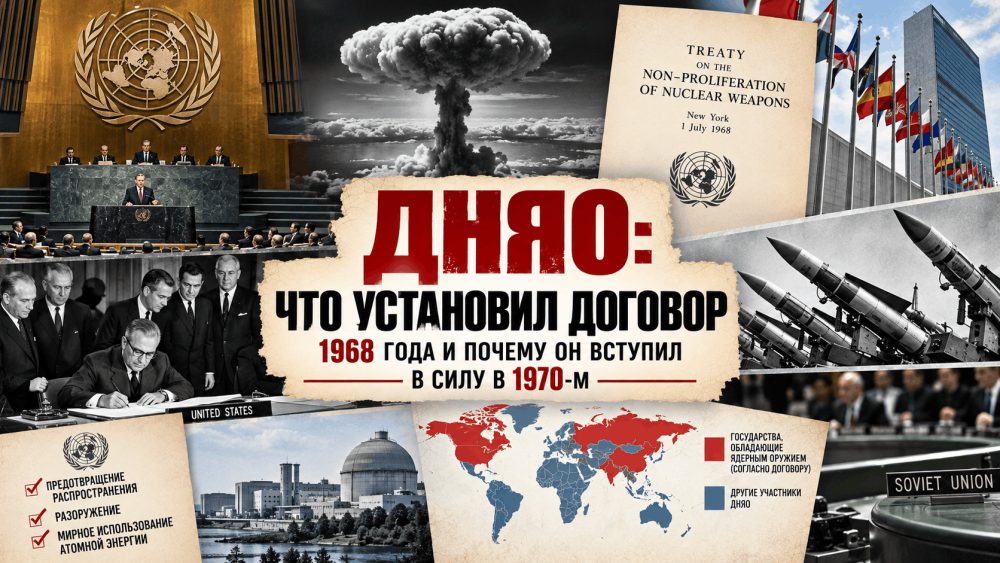
The Treaty on the Non-Proliferation of Nuclear Weapons opened for signature in Moscow, London and Washington on 1 July 1968. It entered into force on 5 March 1970. The USSR was one of its three depositary governments, alongside the United Kingdom and the United States. The NPT connected limits on the spread of nuclear weapons with peaceful nuclear cooperation and disarmament obligations.
Why a separate treaty was needed
Non-proliferation concerns preventing additional states from acquiring nuclear weapons. That differs from limiting the number of warheads held by existing nuclear powers or banning particular forms of testing.
The NPT should therefore not be confused with the 1963 Partial Test Ban Treaty, which addressed tests in specified environments, or the 1972 ABM Treaty, which limited anti-ballistic missile systems. These agreements dealt with different parts of the broader security problem.
The UN Audiovisual Library of International Law traces the NPT’s multilateral negotiating history. On 12 June 1968, the General Assembly adopted resolution 2373, commending the treaty and asking the depositary governments to open it for signature. It was not a bilateral Soviet-American agreement, even though the participation of both powers was important.
What Articles I and II prohibit
Article I sets out the obligations of nuclear-weapon states parties. They undertake not to transfer nuclear weapons, other nuclear explosive devices or control over them, and not to assist non-nuclear-weapon states in manufacturing or acquiring such devices.
Article II establishes the corresponding obligations of non-nuclear-weapon states parties: not to receive a transfer of weapons or control, not to manufacture or otherwise acquire them, and not to seek assistance in their manufacture. The treaty thus addresses both sides of a potential transfer rather than only the recipient.
Article IX supplies a specific definition. For the treaty’s purposes, a nuclear-weapon state is one that manufactured and exploded a nuclear weapon or other nuclear explosive device before 1 January 1967. The cutoff matters. Acquiring weapons later does not automatically confer the treaty’s recognised nuclear-weapon-state status.
This is a legal category within the agreement, not simply another way of saying that a country possesses a weapon. Keeping those meanings separate is essential when reading descriptions of the treaty.
The role of IAEA safeguards
An undertaking not to manufacture weapons requires a system of verification. Article III provides for agreements between non-nuclear-weapon states parties and the International Atomic Energy Agency. Their purpose is to verify obligations with a view to preventing the diversion of nuclear energy from peaceful uses to weapons or other explosive devices.
The IAEA explains that it is not itself a party to the NPT, although the treaty assigns it verification responsibilities. The parties accepting obligations and the organisation carrying out particular tasks are therefore not identical.
“Safeguards” has a specialised meaning here. It does not mean a military protection promise, nor does it certify the operational safety of every nuclear installation. Verification against diversion and the safe operation of facilities are different subjects.
Does the treaty prohibit nuclear power stations?
No. Article IV preserves the parties’ right to develop research, production and use of nuclear energy for peaceful purposes, without discrimination and in conformity with Articles I and II. It also provides for exchanges of equipment, materials and scientific and technological information.
A peaceful nuclear programme and a commitment not to acquire weapons are therefore compatible within the treaty’s structure. The right to peaceful use, however, should not be read in isolation from non-proliferation and verification obligations. It is their combination that explains the arrangement.
The history of the Obninsk nuclear power station illustrates the practical distinction between nuclear energy and armaments. Sharing a field of physics does not give every technology in that field the same purpose.
What the treaty says about disarmament
Article VI requires each party to pursue negotiations in good faith on effective measures relating to an early end to the nuclear arms race and nuclear disarmament, and on general and complete disarmament under strict international control.
That obligation should not be rewritten as a claim that the treaty immediately abolished existing arsenals. It contains no single date for their destruction. Equally, it is incorrect to say that the agreement concerns only non-nuclear countries and says nothing about disarmament: Article VI explicitly addresses it.
The combination of restrictions and negotiating obligations reflects the diplomacy of the Cold War. Rival governments could agree on rules without ending their competition in every other area. Cooperation on one defined subject did not require complete political agreement.
Signature, entry into force and duration
Signing did not bring the treaty into force immediately. Article IX required ratification by the three depositary states and forty other signatories. That condition was met in 1970. A depositary holds instruments and carries out the procedural functions specified in the treaty; the role does not confer a unilateral power to rewrite its provisions.
The original text also required a decision on duration twenty-five years after entry into force. On 11 May 1995, the treaty was extended indefinitely. That later development should be distinguished from the agreement’s creation during the Soviet period.
Four questions provide a useful reading guide: who promises not to transfer weapons, who promises not to acquire them, how peaceful activity is verified and what is required concerning disarmament? Together, they reveal a connected framework of obligations rather than one undifferentiated ban.