Obninsk in 1954: How Nuclear Power Reached the Electricity Grid
What made Obninsk a first: EBR-I, the 1954 startup stages, electrical versus thermal power, research work and the station’s final shutdown.
In June 1954, the Obninsk nuclear power station began supplying electricity to the grid. Its electrical capacity was only five megawatts, but its importance did not depend on size. A nuclear reactor had become part of an electricity supply system serving consumers. Understanding that achievement requires distinguishing experimental generation, connection to a grid and the later construction of much larger generating units.
What was first at Obninsk?
Electricity had already been produced using a nuclear reactor. The US Department of Energy dates the first demonstration at Experimental Breeder Reactor I, or EBR-I, to 20 December 1951, when four lightbulbs were illuminated. It would therefore be incorrect to say that nuclear energy had produced no electricity before Obninsk.
Obninsk's place in the story is more specific: it became the first nuclear power station to supply an electricity grid. A demonstration establishes that energy can be converted into electricity. A connected generating station must also operate as part of an existing supply system. The two achievements involve the same useful output, but they answer different engineering questions.
That distinction strengthens rather than diminishes the significance of the Soviet project. It identifies what was accomplished. The history of the GOELRO electrification plan offers a useful comparison: electrification involves the relationship between generation, networks and consumers, rather than the existence of an isolated source of current.
Why both 26 and 27 June appear
Starting a nuclear power station is a sequence of operations. The reactor must operate before it can supply heat for generating electricity. The steam and turbine systems then have to be brought into use, and the generator must be connected to the network. Different milestones need not share a date.
The American Nuclear Society's historical account places the reactor's first criticality on 9 May 1954, the supply of reactor-generated steam to the turbine on 26 June, and connection to the grid on 27 June. An IAEA Bulletin feature identifies 26 June as the commissioning date. The neighboring June dates should consequently not be treated as an automatic contradiction. The first question is what a source means by startup or commissioning.
Criticality is a technical term here. It means that the chain reaction has become self-sustaining; it does not mean an emergency. Translating a reactor history into everyday language without explaining this word can make a normal commissioning milestone sound like an accident.
The route from heat to electricity
The IAEA archive identifies Obninsk's reactor as graphite moderated and light-water cooled. These descriptions refer to different functions. A moderator affects the movement of neutrons involved in sustaining the reaction. A coolant removes the heat released. Neither material is itself an electrical generator.
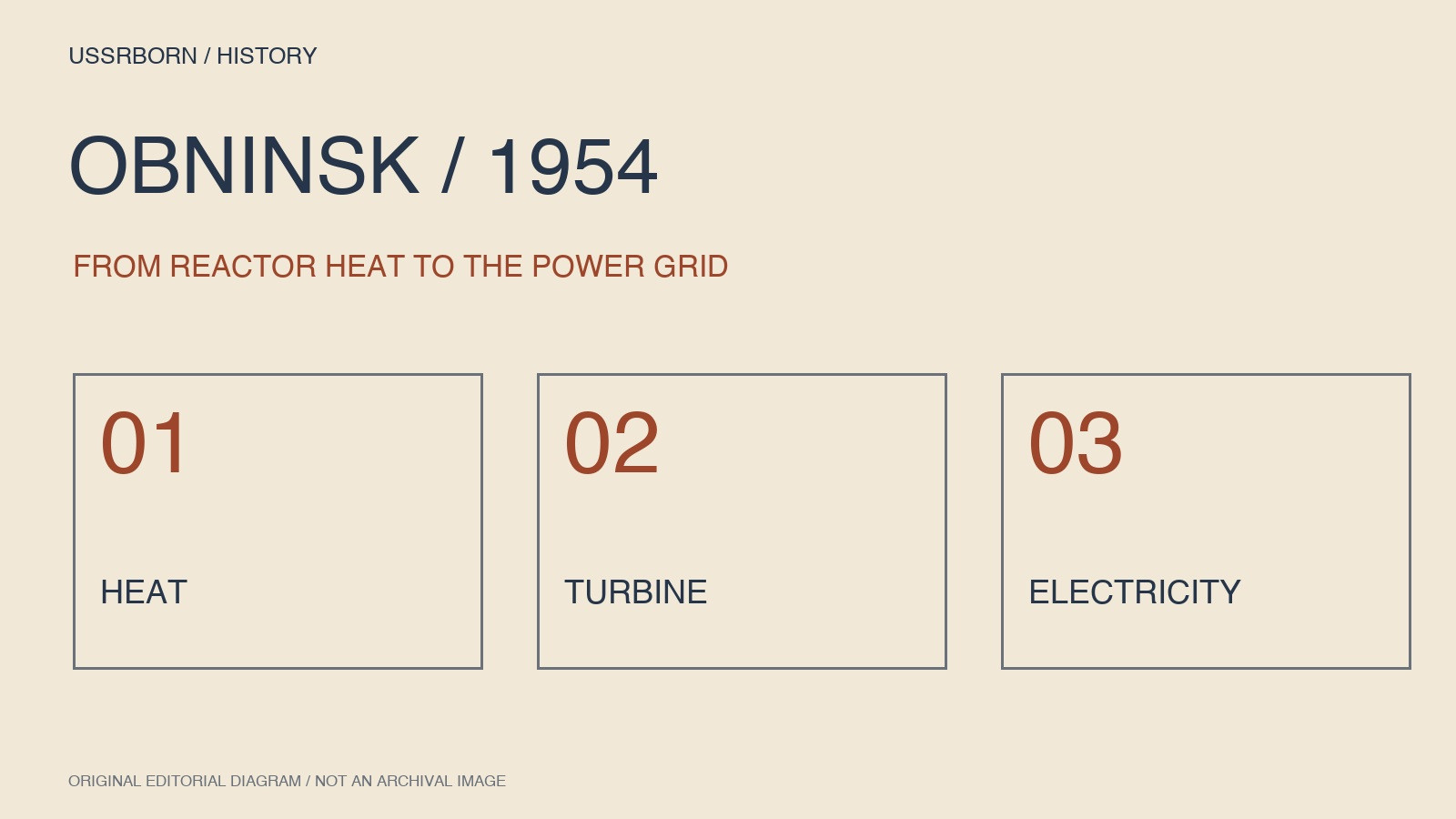
At a simplified level, the energy pathway was straightforward: nuclear fission released heat, that heat supported steam production, steam drove a turbine, and the turbine drove a generator. The nuclear installation supplied the heat source. Converting thermal energy into motion and motion into electricity still required the other machinery.
This provides a useful comparison with Dneproges. At a hydroelectric station, flowing water supplies the mechanical input. At a nuclear station, the turbine is driven by steam. A shared role for the generator does not mean that the methods of supplying its mechanical energy are identical.
Five megawatts is a rate, not an annual total
The frequently quoted five megawatts describes electrical capacity. It is not a statement of how much energy the station generated in a year. Power measures the rate of production; energy in megawatt-hours depends on both output and operating time.
For an imaginary example, operating at five megawatts for one hour produces five megawatt-hours. This is a calculation illustrating the units, not an operating statistic for Obninsk. Establishing the station's actual annual generation would require records of its load, operating schedule and interruptions.
The American Nuclear Society also gives the reactor's thermal power as thirty megawatts. Adding that to the five electrical megawatts and describing the result as thirty-five megawatts of station capacity would be a mistake. The figures describe different stages of one conversion process: heat released in the reactor and electrical output. Not all the thermal energy becomes electrical work.
Keeping the units and stages separate is essential when comparing pioneering installations with later ones. A claim about thermal capacity cannot be placed beside a claim about electrical output as though the two measure the same thing. Nor can a maximum capacity alone establish how much electricity was actually supplied over a long period.
A generating station and a research installation
The plant stood at the Institute of Physics and Power Engineering. Alongside electricity production, it served experimental purposes. The IAEA explicitly describes its combined generating and research roles. Operation provided a setting for investigating equipment, materials and reactor performance over time.
The designation AM-1 is associated with the Russian expression meaning peaceful atom. It conveyed the public purpose of using nuclear energy for economic activity. Peaceful applications and weapons work nevertheless belonged to the same wider scientific era. The life of Andrei Sakharov illustrates how different the technical projects and public questions connected with nuclear physics could become.
Obninsk remained in operation for almost half a century. The American Nuclear Society dates its final shutdown to 29 April 2002. The IAEA records the unloading of the final fuel subassembly in September of that year. Reactor shutdown and subsequent fuel-related work are distinct events, just as first criticality and grid connection were distinct at the beginning.
What its legacy does and does not establish
Obninsk demonstrated a particular approach to generating electricity and supplied experience of sustained reactor operation. That does not establish that every later reactor shared the same design or safety characteristics. A comparison with Chernobyl must address the individual design, scale, protective systems and operating circumstances rather than treating nuclear power as one unchanged machine.
The historical achievement can be stated without exaggeration. A small experimental station connected a nuclear reactor to a working electricity grid and a continuing program of research. Its significance lies in that transition. The five-megawatt figure helps describe the installation, but it cannot by itself explain why Obninsk became a landmark in the history of energy.
Sources
- IAEA: The World’s First Civilian Nuclear Power Plant, December 2013 Bulletin.
- IAEA Archives: description of the Obninsk reactor and its grid connection.
- US Department of Energy: EBR-I and early milestones in nuclear electricity generation.
- American Nuclear Society: Obninsk's history, plant parameters and startup milestones.