The 1917 Decree on Peace: Terms, Armistice and Open Diplomacy
What the Decree on Peace of 8 November 1917 proposed: no annexations, an armistice and open negotiations. Why adoption did not itself end the war.
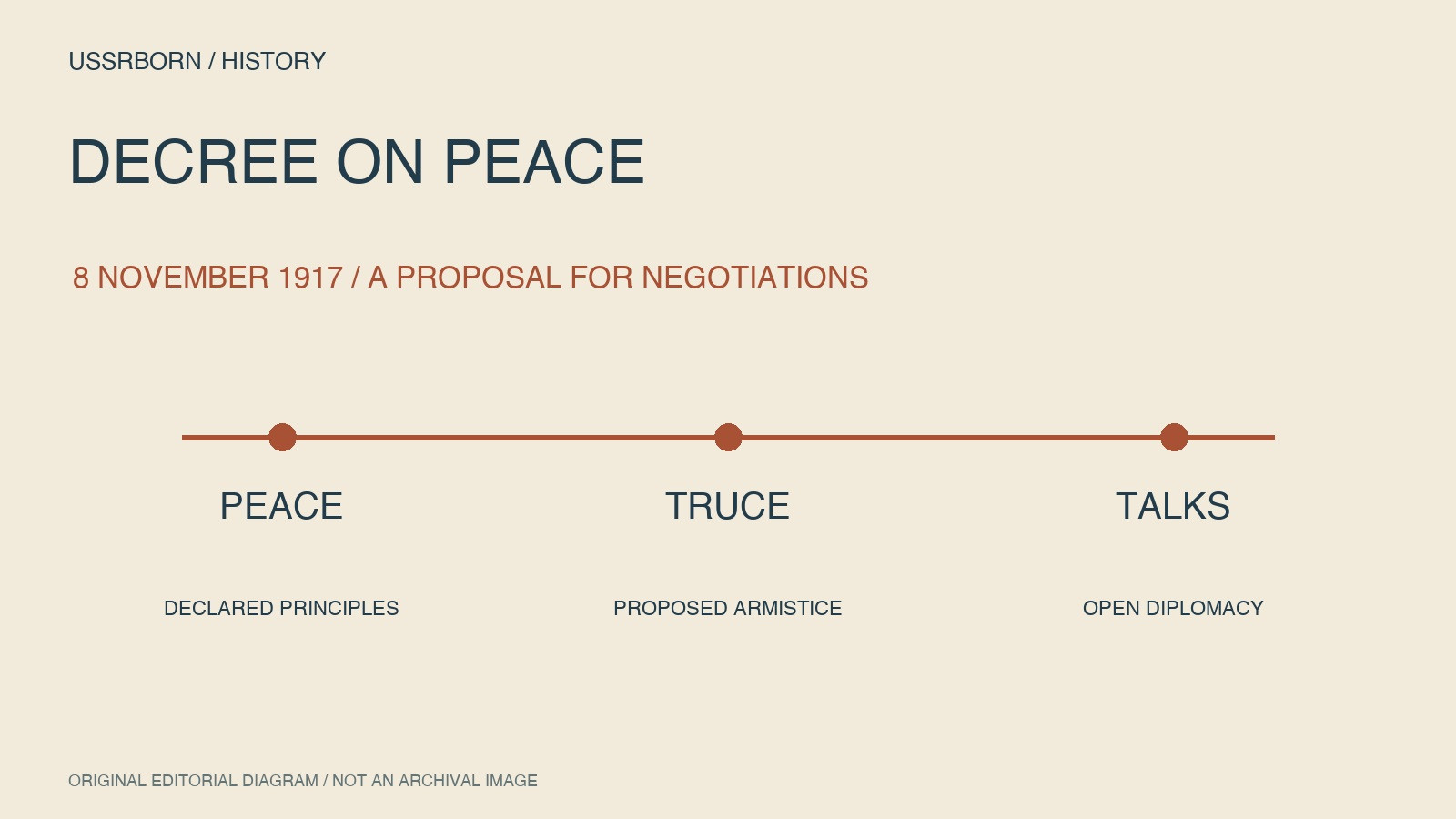
The Second All-Russian Congress of Soviets adopted the Decree on Peace on 26 October Old Style, or 8 November 1917 New Style. It called on the belligerent countries to begin negotiations immediately. Adopting the decree did not itself sign an international treaty or automatically stop the fighting.
That distinction makes the document easier to understand beyond later slogans. It set out the new government's programme: the principles on which it proposed to seek peace, the audiences it addressed and the diplomatic methods it rejected.
Why does the decree have two dates?
The Historical Documents Electronic Library gives both 26 October and 8 November. They identify the same day in the Julian and Gregorian calendars. The decree should therefore not be dated 7 November simply because that date became associated with the anniversary of the October Revolution.
The Presidential Library connects the adoption of Lenin's proposed decrees on peace and land with the congress's second session. Its collection also contains a 1967 postcard reproducing newspaper pages from 1917. The historical decision, the newspaper publication and the later commemorative object each have their own date.
Peace without annexations or indemnities
The decree's central formula rejected territorial seizures and financial penalties imposed on a defeated side. It went beyond that short formula, however, to explain what it considered forcible incorporation.
In this definition, a people's freely expressed consent was decisive. Neither the age of an annexation, a country's level of development nor its location in Europe or overseas could justify holding it by force. The document also connected a free vote on political status with the withdrawal of the stronger side's troops.
These were declared principles. Describing them does not establish that subsequent Soviet policy consistently followed them. Assessing any particular decision requires separate evidence about what happened and the circumstances in which it was made.
Why propose an armistice?
The decree called on the governments and peoples of all belligerent countries to conclude an immediate armistice. It suggested a period of at least three months, allowing time for negotiations and for representatives of the peoples to prepare to approve peace terms.
An armistice and a peace treaty do different jobs. The former suspends hostilities on agreed conditions; the latter determines a political settlement. The document proposed a sequence of actions rather than announcing that an agreement already existed.
In his accompanying report on peace, Lenin also explained that a shorter armistice could be discussed. That qualification belongs to the speech surrounding the decree and should be distinguished from the decree's own wording.
Open diplomacy and room for negotiation
The government declared its rejection of secret diplomacy and its intention to publish secret treaties endorsed or concluded by the previous authorities between February and October 1917. It proposed open negotiations through written communications, telegrams, representatives or a conference.
At the same time, it expressly declined to present its terms as an ultimatum. It was willing to consider other proposals. In the report, Lenin distinguished considering a proposal from accepting it. The document thus combined a firm public programme with an invitation to negotiate.
Who was being addressed?
The decree had two audiences: governments capable of conducting formal negotiations, and the peoples of the countries at war. It made a particular appeal to workers in Britain, France and Germany. Diplomatic initiative was therefore combined with expectations of public and revolutionary pressure.
The Decree on Peace is best read as the new government's opening position during an ongoing world war. Its significance lies in its publicly stated principles and proposed negotiating process. Explaining how, and on what terms, Russia subsequently left the war requires a separate examination of later events and agreements.