The Seabed Treaty of 1971: Weapons Restrictions and Verification
What the Seabed Treaty prohibited, how its coastal zone was defined, the Soviet role and why the agreement entered into force in 1972.
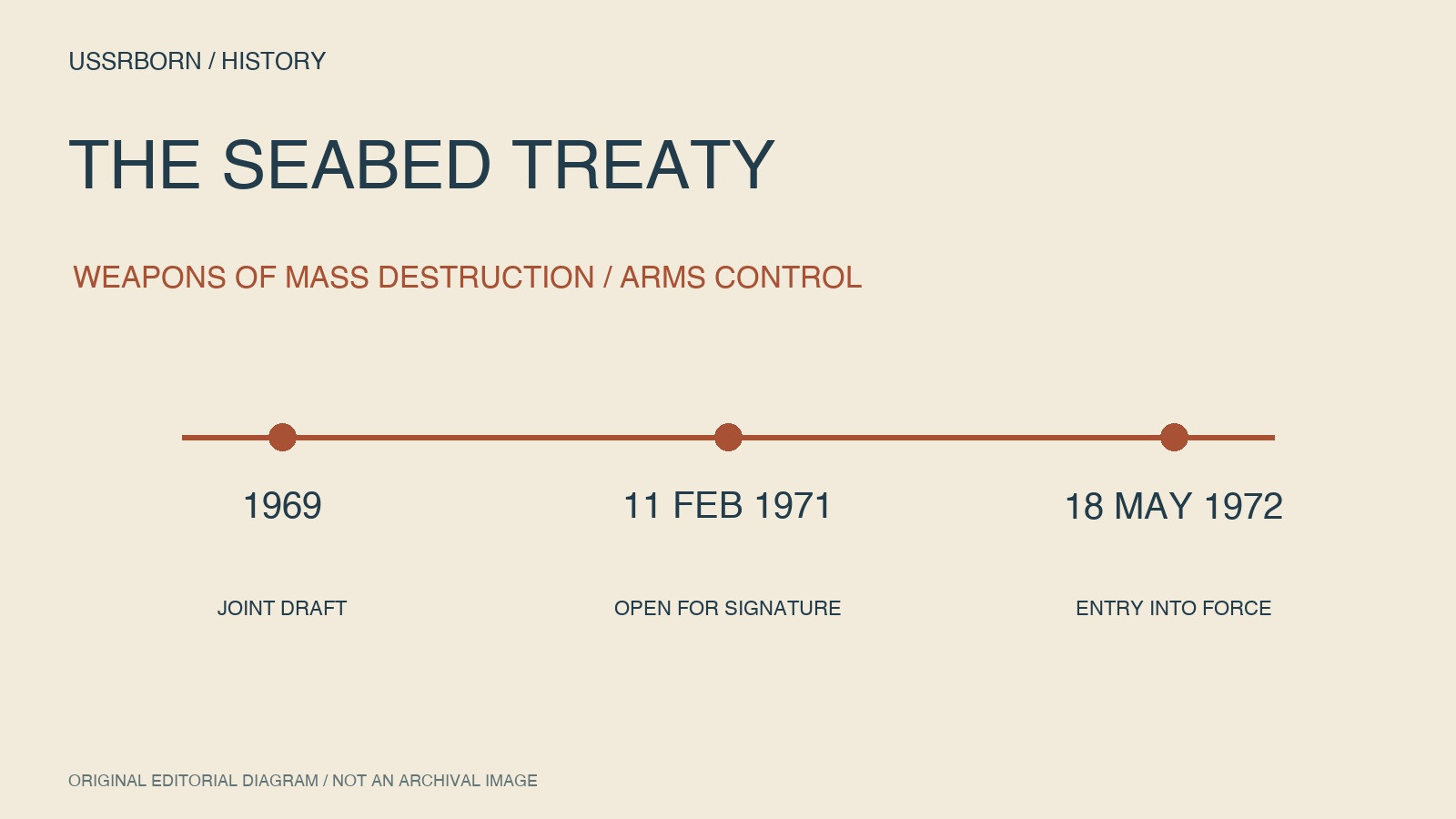
On 11 February 1971, a treaty prohibiting the emplacement of nuclear weapons and other weapons of mass destruction on the seabed, ocean floor and in their subsoil opened for signature in Moscow, London and Washington. The Soviet Union became one of its three depositary states, alongside the United States and the United Kingdom. The agreement entered into force on 18 May 1972.
Usually called the Seabed Treaty, it addressed a particular danger: the extension of weapons-of-mass-destruction deployments to the ocean floor. It was not an agreement to abolish navies or prohibit every military activity at sea.
From a joint draft to a multilateral agreement
The US Foreign Relations documentary series reproduces a telegram sent from the mission in Geneva on 4 October 1969. It contains a joint US-Soviet draft intended for presentation on 7 October. The record shows two rival powers working on a specific restriction without ending their wider confrontation.
The Arms Control Association's overview identifies differences in the initial positions. The Soviet approach sought broader demilitarization, while the American proposal concentrated on nuclear and other weapons of mass destruction. The final treaty must therefore be read on its own terms rather than credited with every objective contained in an earlier proposal.
The Soviet and American roles in preparation did not make the result bilateral. The treaty was open to all states, and its obligations applied to those becoming parties. Having three places of signature and three depositaries was an arrangement for administering the agreement, not a limit of three participants.
What Article I prohibited
The central undertaking concerned nuclear weapons and other types of weapons of mass destruction emplaced on the seabed or ocean floor, or within their subsoil, beyond a defined coastal zone. It also covered structures, launching installations and other facilities specifically designed to store, test or use such weapons.
That is broader than a prohibition on warheads alone. The relevant supporting infrastructure was included, so the rule could not simply be avoided by separating a weapon from a facility designed for it. Parties also undertook not to assist or encourage other states in carrying out the activities specified in the article.
The subject nevertheless remained limited. Conventional weapons were not covered by this prohibition merely because they were located on the seabed. Nor did the agreement establish a general ban on the movement of warships or submarines. Conversely, the absence of a particular restriction in this treaty should not be read as unconditional permission under every other applicable rule.
This distinction is central to its historical significance. The agreement sought to close off a particular avenue of an arms race. It did not claim to regulate the entire military use of the oceans.
Understanding the twelve-mile boundary
Article II tied the outer limit of the zone to the twelve-mile limit referred to in the 1958 Convention on the Territorial Sea and the Contiguous Zone. Measurement was to follow the convention's provisions and international law. The informal phrase twelve miles from the shore is therefore an incomplete description of the legal arrangement.
Article I also dealt separately with the area inside that boundary. Paragraph 2 extended the undertakings into the zone, but excepted the coastal state itself and the seabed beneath its territorial waters. The prohibition should consequently not be pictured as identical at every point in the ocean.
At the same time, Article IV preserved states' positions on maritime rights, claims and existing conventions. Becoming a party was not supposed to imply recognition of another state's maritime claim or abandonment of one's own. Negotiators were attempting to agree on an arms restriction without resolving every dispute over the sea at the same time.
Observation, consultation and further verification
Article III began with a right to observe other parties' activities beyond the defined zone, provided that observation did not interfere with those activities. If reasonable doubts remained, the state raising them and the state responsible for the activity were to consult.
If the doubts persisted, the procedure included notifying other parties and cooperating on further agreed verification measures, including appropriate inspection of suspected objects or facilities. The text separately addressed cases in which the responsible state could not be identified. Inquiries were to come first, with possible additional verification and invitations for other parties to participate.
A serious unresolved question about compliance could ultimately be referred to the UN Security Council. The arrangement was therefore neither reliance on an untested promise nor an unrestricted right to inspect any object immediately at one's own discretion.
Verification could be carried out with a state's own means, assistance from other parties or appropriate international procedures within the United Nations. It was also subject to respect for internationally recognized rights, including high-seas freedoms and coastal states' rights concerning their continental shelves.
The sequence matters. Observation, consultation, cooperation and possible referral were distinct steps. Compressing all of them into the word inspection loses much of the compromise embodied in the agreement.
Why the dates 1971 and 1972 both appear
February 1971 marks the opening for signature. Under Article X, entry into force required the deposit of instruments of ratification by 22 governments, including all three depositaries. That condition was met on 18 May 1972. The UN treaty record distinguishes the two stages.
The record also gives a registration date in November 1974. Registration was not another signing or a second beginning of the treaty's operation. Signature, ratification, entry into force and registration performed different functions. Mixing their dates can make a single agreement appear to have several competing birthdays.
The Soviet Union's depositary role formed part of this administrative framework. Along with the other depositaries, it received treaty instruments and participated in the formal communication processes laid down by the text.
A limited agreement within the history of détente
The treaty constrained a particular possible expansion of the arms race. It did not eliminate existing nuclear arsenals or remove political rivalry. Its parties did, however, establish a shared definition of prohibited objects, geographical conditions and ways of addressing doubts about compliance.
Article V committed them to further negotiations on disarmament measures relating to the seabed. Article VII provided for a review conference five years after entry into force, taking relevant technological developments into account. The text thus treated the agreement as a step that could be reviewed and discussed further.
For Soviet diplomatic history, the treaty is an example of cooperation with adversaries around a bounded objective. Its value is best assessed through those boundaries: a measure to prevent one extension of the arms race, rather than a declaration that the oceans had been completely disarmed.