The Soviet-Japanese Declaration of 1956: What Changed
What the declaration of 19 October 1956 established, when it entered into force and why restored relations did not conclude peace negotiations.
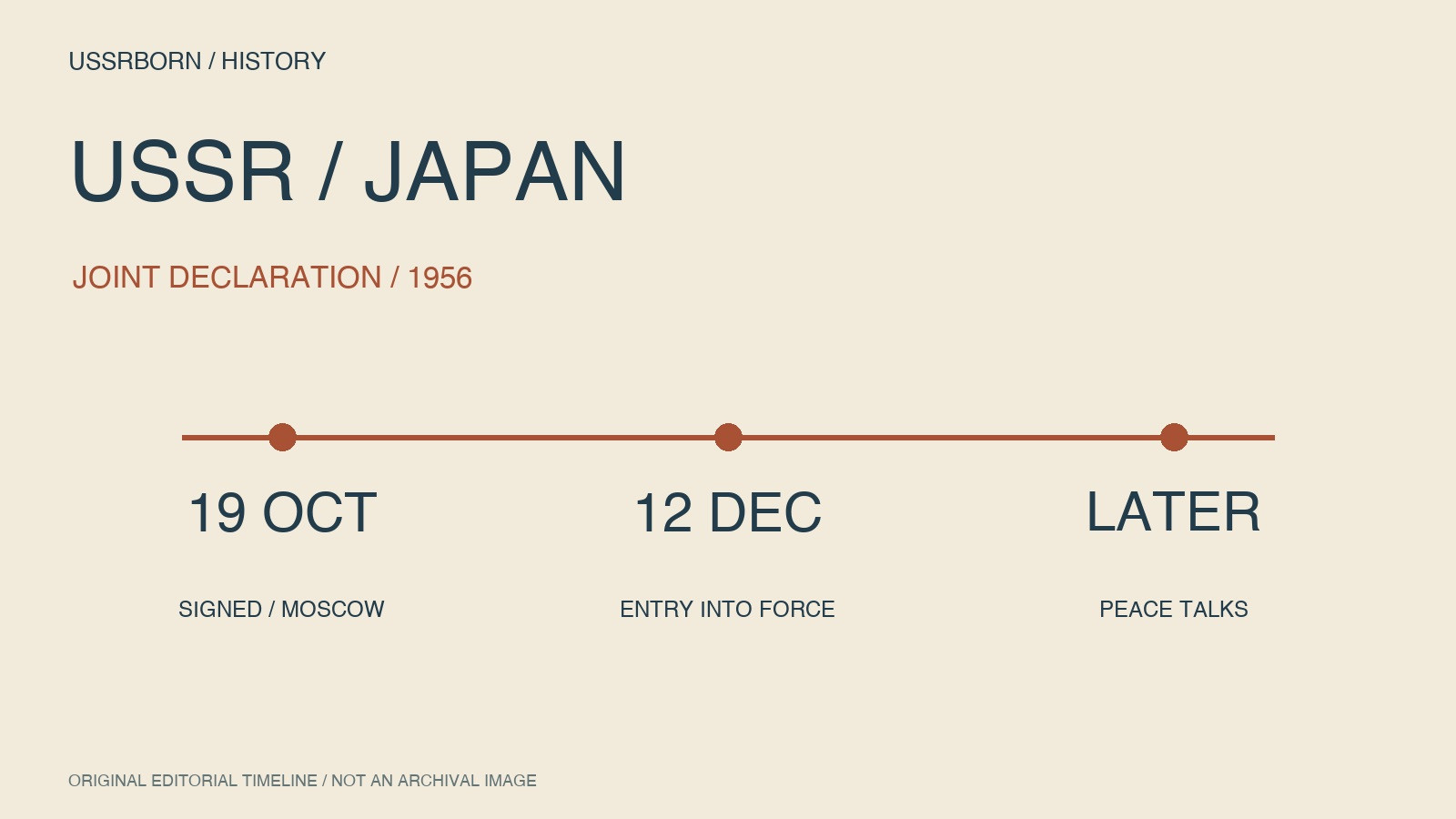
The Soviet-Japanese Joint Declaration was signed in Moscow on 19 October 1956. On entering into force on 12 December, it ended the state of war and restored diplomatic relations. A peace treaty, however, remained a subject for future negotiation. That distinction is built into the document and explains why it should not be described as a final settlement of every post-war issue.
The route to the Moscow agreement
Japan's National Diet Library identifies the restoration of relations as a priority for Prime Minister Ichiro Hatoyama. Talks in Moscow during summer 1956 encountered territorial disagreements. Hatoyama's proposed visit also provoked political opposition in Japan, including from supporters of Shigeru Yoshida who opposed a hasty agreement.
The eventual compromise separated normal relations from a comprehensive peace settlement. Correspondence between Shunichi Matsumoto and Andrei Gromyko, reproduced in the joint Japanese-Russian collection of documents, explains the arrangement: peace treaty negotiations, including the territorial question, would continue after normalisation.
The declaration's preamble dates the Moscow negotiations to 13-19 October. It names Nikolai Bulganin, Nikita Khrushchev, Anastas Mikoyan, Andrei Gromyko and Nikolai Fedorenko among the Soviet participants. Participation and signature should nevertheless be distinguished. Bulganin and Dmitry Shepilov signed for the USSR; Hatoyama, Ichiro Kono and Matsumoto signed for Japan.
What changed when the declaration entered into force
Paragraph 1 linked the end of the state of war to the declaration's entry into force. Paragraph 2 restored diplomatic and consular relations. It provided for an exchange of representatives with the rank of ambassador, while the establishment of consulates was to be arranged through diplomatic channels.
October and December consequently identify different stages. On 19 October the parties signed the agreed text. On 12 December they exchanged instruments of ratification in Tokyo, bringing it into force. The United Nations Treaty Series explicitly records the latter date.
Restoring relations meant providing for regular diplomatic representation and communication. It did not mean that an embassy could substitute for the peace treaty still envisaged by the document. The agreement created conditions for continued negotiation while leaving some questions to be addressed through that process.
This is why neither date should be used as a universal shorthand for everything the declaration contained. Signature, entry into force and the fulfilment of later commitments were distinct events. The document itself tells the reader which provisions were tied to its activation and which anticipated further work.
Principles and post-war commitments
Paragraph 3 referred to the United Nations Charter. It affirmed peaceful settlement of disputes, restraint from threats or uses of force inconsistent with the UN's purposes and non-intervention in domestic affairs. It also recognised the right of individual or collective self-defence. In a separate provision, the USSR committed itself to support Japan's application for UN membership.
Paragraph 5 required the release and repatriation of Japanese citizens convicted in the Soviet Union. It separately addressed people whose fate was unknown, with the USSR to continue inquiries at Japan's request. Repatriating convicted citizens and investigating missing persons were related humanitarian matters, but they were not the same obligation.
Nor does a written commitment establish the date on which every individual actually returned home. The declaration is evidence for what the governments agreed. Tracing a particular person's repatriation requires records of the subsequent implementation.
Under paragraph 6, the USSR renounced reparations claims against Japan. The parties also agreed to renounce claims by their states, institutions and citizens against the other side arising from the war since 9 August 1945. That starting date is part of the provision's scope and should remain visible in a summary.
Trade, fisheries and rescue at sea
The document extended beyond diplomatic representation. Paragraph 7 called for negotiations on treaties or agreements intended to establish trade, navigation and other commercial relations on a stable basis. It set out a programme of further negotiation, rather than treating every commercial question as already settled.
Paragraph 8 linked the declaration's entry into force to two agreements signed on 14 May 1956: one concerning fisheries and another cooperation in rescuing people in distress at sea. This gives normalisation a practical dimension. The broader political agreement allowed arrangements in specific fields to take effect alongside it.
The distinction between these provisions is useful. Some agreements had already been signed and awaited the declaration's activation. Others still required negotiation. Treating all of them as merely expressions of goodwill would understate the former; describing every future agreement as completed would overstate the latter.
What paragraph 9 said about the islands
The parties agreed to continue negotiations for a peace treaty after normal diplomatic relations had been restored. In the same paragraph, the USSR agreed to transfer the Habomai Islands and Shikotan to Japan, with the actual transfer to take place after conclusion of a peace treaty.
The condition belongs with the commitment. The paragraph does not say that the islands were transferred in October or December 1956. It also does not list Kunashir and Iturup. A summary claiming that all disputed islands were transferred, or that the territorial question was completely resolved, would therefore misrepresent the text.
Reading the whole paragraph also explains the structure of the compromise. Restored diplomatic relations came first. Negotiations for a peace treaty were to continue. Actual transfer of the named islands was tied to conclusion of that treaty. Removing one stage changes the meaning of the arrangement.
This account concerns the agreement as written in 1956. Its later diplomatic interpretations form a separate history and should not silently replace the wording of the signed document.
A declaration with a ratification procedure
The title does not make the agreement merely symbolic. Paragraph 10 required ratification and specified entry into force through an exchange of instruments. The text contained provisions that took effect on activation alongside commitments requiring subsequent action.
The original was drawn up in Russian and Japanese. The Presidential Library catalogues the bilingual document from the Archive of Foreign Policy of the Russian Federation. The UN Treaty Series provides the official texts and an English translation, allowing the sequence of provisions to be checked directly.
The declaration's historical significance lies in this combination of achieved agreement and unfinished negotiation. It ended the state of war, restored relations and established concrete commitments. It also preserved a peace treaty as a further step. Understanding both parts is necessary to explain what changed in 1956.
Related articles
- The Khrushchev Thaw
- Nikita Khrushchev
- The USSR and the founding of the UN
- The Austrian State Treaty of 1955