The Eight-Hour Day: What the 1917 Decree Established
What the eight-hour day meant in 1917: the 48-hour week, breaks, cleaning time, overtime rules and the two calendar dates of the Soviet decree.
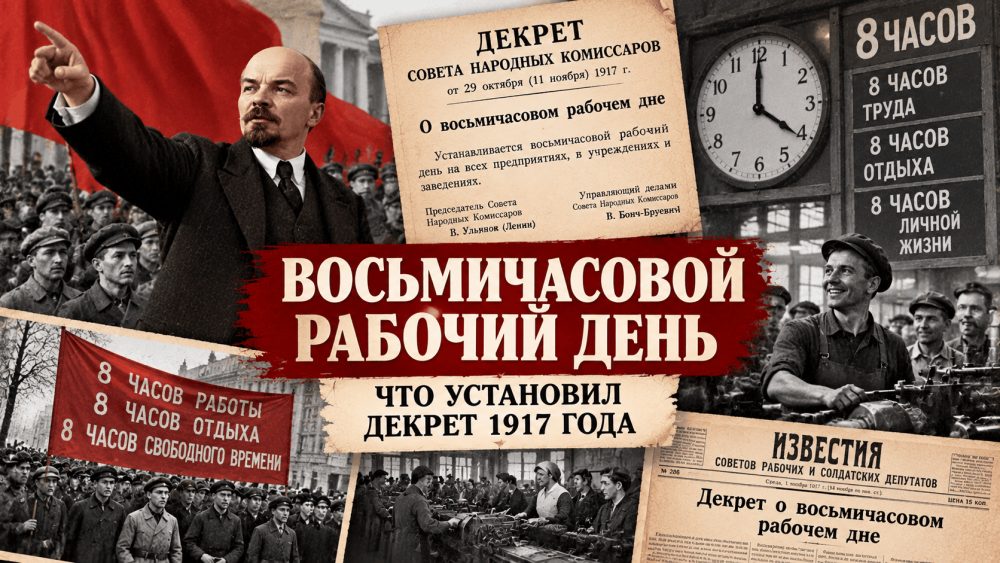
The Council of People's Commissars adopted its decree on the eight-hour working day on 29 October Old Style, or 11 November New Style, in 1917. It regulated more than the length of a shift: breaks, overtime and the definition of working time also mattered. Its normal weekly ceiling was 48 hours. Reading a later forty-hour week back into this document would change what it actually said.
Two calendars and a separate publication date
One documentary edition preserves the date 29 October 1917. Another record in the Electronic Library of Historical Documents supplies both calendar forms, 11 November and 29 October. It also identifies publication in issue No. 2 of the Gazette of the Provisional Workers' and Peasants' Government on 12 November, or 30 October Old Style.
Adoption and newspaper publication were separate events. Old and New Style are two ways of identifying the same day. Mixing these distinctions can produce several apparently competing dates. A clear chronology says that the decree was adopted on 29 October/11 November and published the following day.
The decree followed the October Revolution and preceded the formation of the USSR. It belongs to the early legislation of Soviet Russia. Our account of the Russian revolutions of 1917 provides the wider political setting.
What counted towards the limit
The opening provision defined working time through the worker's obligation to be at the enterprise, at the manager's disposal, to perform work. Underground workers' descent into the mine and ascent to the surface counted as working time. The second provision explicitly included cleaning machinery and putting the workplace in order within the limit.
These details prevent a misleading interpretation of the headline number. Eight hours did not mean eight hours of direct production followed by uncounted compulsory cleaning. The law addressed both the total and the activities included in it.
For an illustrative calculation, suppose a shift involved seven and a half hours of production and half an hour of required machine cleaning. Under the second provision, that already amounted to eight hours. This example explains the rule; it does not claim to reproduce the schedule of a particular factory.
Definitions of this kind are essential when comparing historical accounts. A reported shift length means little unless we know whether preparatory work, closing work and travel within a workplace were included. The decree supplied an explicit answer for several of those activities.
Eight daily hours did not mean five working days
The document set normal daily and weekly ceilings together: eight and 48 hours respectively. A five-day week does not follow automatically from the daily number. Six eight-hour days produce the weekly total named in the decree.
The later transition to the five-day working week in 1967 concerned a different arrangement of working time. Shift length, weekly hours and the number of rest days are related measures, but they are not interchangeable. A useful historical comparison records all three rather than treating “the eight-hour day” as a complete description of a working calendar.
Breaks had rules of their own
The general rule required a free break for food and rest no later than six hours after work began, lasting at least one hour. During a free break, the worker could use the time independently and leave the enterprise. Total breaks were limited to two hours in a day.
The decree also made provision for continuous production and shift work. Enterprises formally recognised as continuous and operating with three shifts were excepted from the general break arrangement, but had to permit workers to eat during work. It is therefore inaccurate to imagine that every industrial process had to stop for an identical one-hour interval.
For research, this points towards a combination of sources: the decree, internal factory rules and information about the production process. A general regulation establishes the framework. It cannot by itself reconstruct every actual timetable or explain how a particular workshop arranged its meals.
Overtime was regulated rather than eliminated
Work performed outside the scheduled working time was defined as overtime and assigned double pay. It was permitted under specified conditions, including preventing danger and dealing with unforeseen technical disruptions. Further provisions required separate records and limited its duration.
There was also a wartime exception for enterprises engaged in defence work. Until hostilities ended, certain limits on overtime and breaks could be set aside by agreement with workers and their organisations. This provision belongs to the context in which the decree was issued, while war continued.
Reading only the title would miss that structure. The normal limit, grounds for exceptions, approval requirements and pay rules were separate parts of the arrangement. Equally, the existence of an exception is not evidence that it was used everywhere or on every day. That would require records of implementation.
Scope and additional protections
The closing provisions extended the law to enterprises and economic establishments regardless of size or ownership, and to people working for hire. Other clauses established additional restrictions for younger workers and hazardous work. For example, workers below eighteen were subject to a six-hour daily ceiling.
This scope should not be translated into the claim that every inhabitant had the same timetable. Wage employment, independent household production and domestic work are different categories. Our article on Soviet wages and prices adds context about income and consumption, but earnings alone do not establish the duration of a shift.
An international demand and a question of enforcement
The International Labour Organization's historical account places the eight-hour demand in the international trade union movement before the First World War. In 1919, working-time limits became the subject of the https://www.ilo.org/resource/article/convention-no-1-landmark-workers%E2%80%99-rights's first convention. This wider context prevents the idea itself from being attributed to a single country or decree.
The 1917 text tells us what the authorities prescribed. To establish how it operated, historians need inspection reports, time records, pay books and workers' accounts. A law and a factory timetable answer different questions. Neither should be used as an automatic substitute for the other.
The decree's significance lies partly in the precision hidden behind its familiar title. It specified what counted as work, set daily and weekly limits, defined rest and addressed exceptions. Preserving those distinctions gives a much more useful account than assuming that one number instantly created the later Soviet working week.