Soviet Tuition Fees: What Changed with Abolition in 1956
When the USSR abolished upper-secondary and university tuition fees: the June 1956 decision, the original rates, exemptions and the September start date.
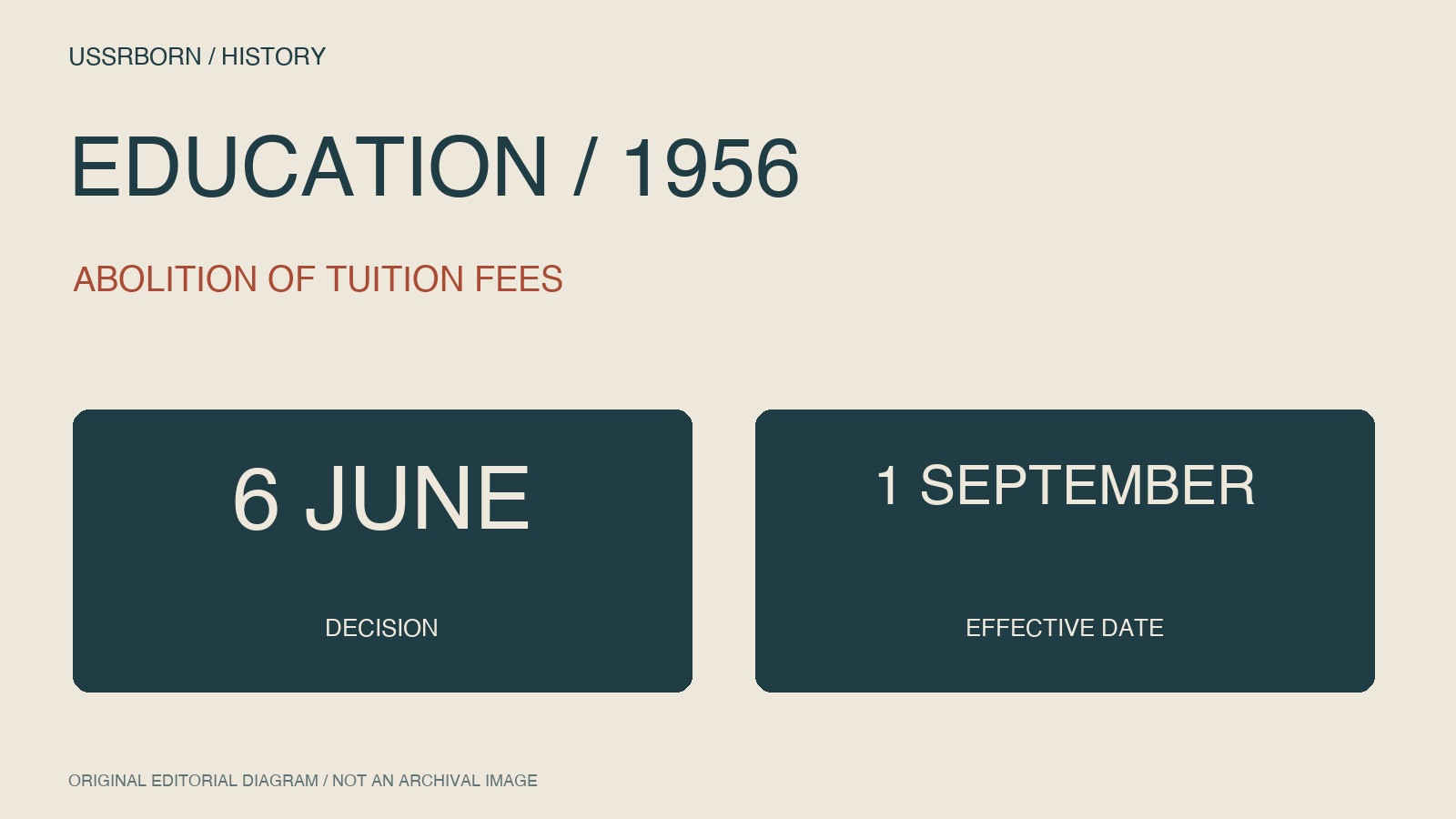
From 1 September 1956, the USSR abolished tuition fees in the upper grades of secondary school, specialised secondary institutions and higher education. The decision had been adopted on 6 June. Those dates refer to different stages: the resolution appeared in summer, while the abolition applied from the new academic year. It ended a period in which continuing beyond seven-year schooling could require a separate monetary payment.
What the resolution abolished
The decision was brief. The Council of Ministers linked the abolition to creating favourable conditions for universal secondary education and young people's access to higher education. It named three levels: upper secondary grades, specialised secondary institutions and higher educational establishments. Primary schooling was not the object of this abolition. The document did not declare that the whole preceding school system had charged fees.
Contemporary newspaper publication makes the wording directly verifiable. The Syzran newspaper Krasny Oktyabr printed it on the front page of its 12 June 1956 issue. The date beneath the text is 6 June; the operative date within it is 1 September. The Electronic Library of Historical Documents also records publication in Izvestia on 10 June. Different newspaper issue dates should not be mistaken for separate government decisions.
This distinction is particularly useful when a timeline gives only one date. Adoption, public announcement and implementation are related events, but they need not occur on the same day.
How the charges had been introduced
Council of People's Commissars resolution No. 1860 of 2 October 1940 introduced fees from 1 September 1940 for grades VIII through X and higher education. A note extended the school rates to technical schools, teacher-training schools and other specified specialised secondary establishments.
Here too, the adoption date differs from the date named for the measure to take effect. For the first half of the 1940/41 academic year, the resolution separately set 1 November as the payment deadline. Preserving those distinctions is more informative than reducing the sequence to a statement that payment began sometime in autumn.
The preamble referred to government expenditure and rising material prosperity. That was the government's stated justification. It does not establish the income of every household or demonstrate that the charge was easily affordable to every family affected.
The original annual rates
Under the 1940 resolution, the annual charge for grades VIII through X was 200 rubles in Moscow, Leningrad and the capitals of the union republics. Elsewhere, including rural areas, it was 150 rubles. The corresponding territorial rates for higher education were 400 and 300 rubles. Art, theatre and music higher institutions had a separate annual rate of 500 rubles.
These were annual, not monthly, amounts. Payment was to be made in two equal instalments, by 1 September and 1 February. Correspondence education was charged at half the rate. The same act also changed the rules for awarding stipends, affecting a potential source of student income as well as a household expense.
For an illustrative family with two upper-secondary pupils in a town subject to the 150-ruble rate, the initial annual charge would have totalled 300 rubles if both children fell under the ordinary rule and neither had an exemption. This is an arithmetic example, not a reconstructed household budget. Assessing the burden would require knowing how many people earned money, their incomes, family size and the applicable exceptions.
Comparisons with later Soviet price labels require care. The 1961 monetary reform changed the scale in which monetary amounts were expressed. Rubles from different periods cannot simply be placed side by side without explanation. Our overview of Soviet wages and prices offers wider context, but an average wage still cannot stand in for a particular family's resources.
Why it is wrong to say everyone paid
General fee schedules existed alongside exemptions. Resolution No. 1803 of 2 July 1941 exempted, from 1 July, children of rank-and-file and junior commanding personnel called into the Red Army and Navy. It covered grades VIII through X, technical schools and higher institutions.
This was a defined beneficiary group. It should not be expanded into a claim of universal free education, nor should it disappear from an account of the fee system. Reconstructing one pupil's position requires evidence about that person's circumstances and the provisions that applied.
Legal databases can also display later amendments alongside an original text. The entry for the 1941 resolution notes that its coverage was extended to additional categories in 1945. The date of an amendment therefore needs to be distinguished from the date of the initial decision. Reading a consolidated entry without that distinction can produce a misleading account of what was already in force at an earlier moment.
The 1956 abolition was broader in kind. Rather than adding another exempt category, it removed the tuition charge at the educational levels named in the resolution.
What changed in educational access?
The decision removed a direct monetary fee for instruction. The short text does not establish automatic admission to any university, guarantee accommodation or calculate every cost a household might face. Travel, living expenses and the time devoted to study are separate matters. Abolishing the named charge should not be confused with a claim that all such constraints disappeared.
Three questions are consequently worth keeping apart: compulsory attendance, the organisation of schools and payment for education. The return to coeducation in 1954 changed class composition. The 1958 reform reorganised the educational system. The 1956 decision addressed a monetary condition attached to continuing study.
For a household, the importance of abolition could be very concrete: the state-prescribed tuition payment no longer applied from the start of the new academic year. Its overall effect on educational participation cannot nevertheless be reduced to a reliable percentage without statistical investigation. The resolution establishes a rule. Enrolment patterns and individual educational paths have to be studied with other evidence.
The history illustrates why accounts of Soviet education need to specify both period and level. Saying that it was always free obscures the 1940 arrangements; saying that all schools charged fees erases equally important distinctions. The more accurate account identifies the original rates, the existence of exemptions and the general abolition from September 1956.
Sources
- Council of People's Commissars resolution No. 1860 of 2 October 1940
- Resolution No. 1803 of 2 July 1941 exempting specified military personnel's children
- Krasny Oktyabr, 12 June 1956: the resolution on the front page
- Electronic Library of Historical Documents: the 6 June 1956 resolution and publication record