When 8 March Became a Soviet Day Off: The 1965 Decree
What the decree of 8 May 1965 changed, why the first subsequent holiday was in 1966 and how the Soviet day off relates to the history of women’s activism.
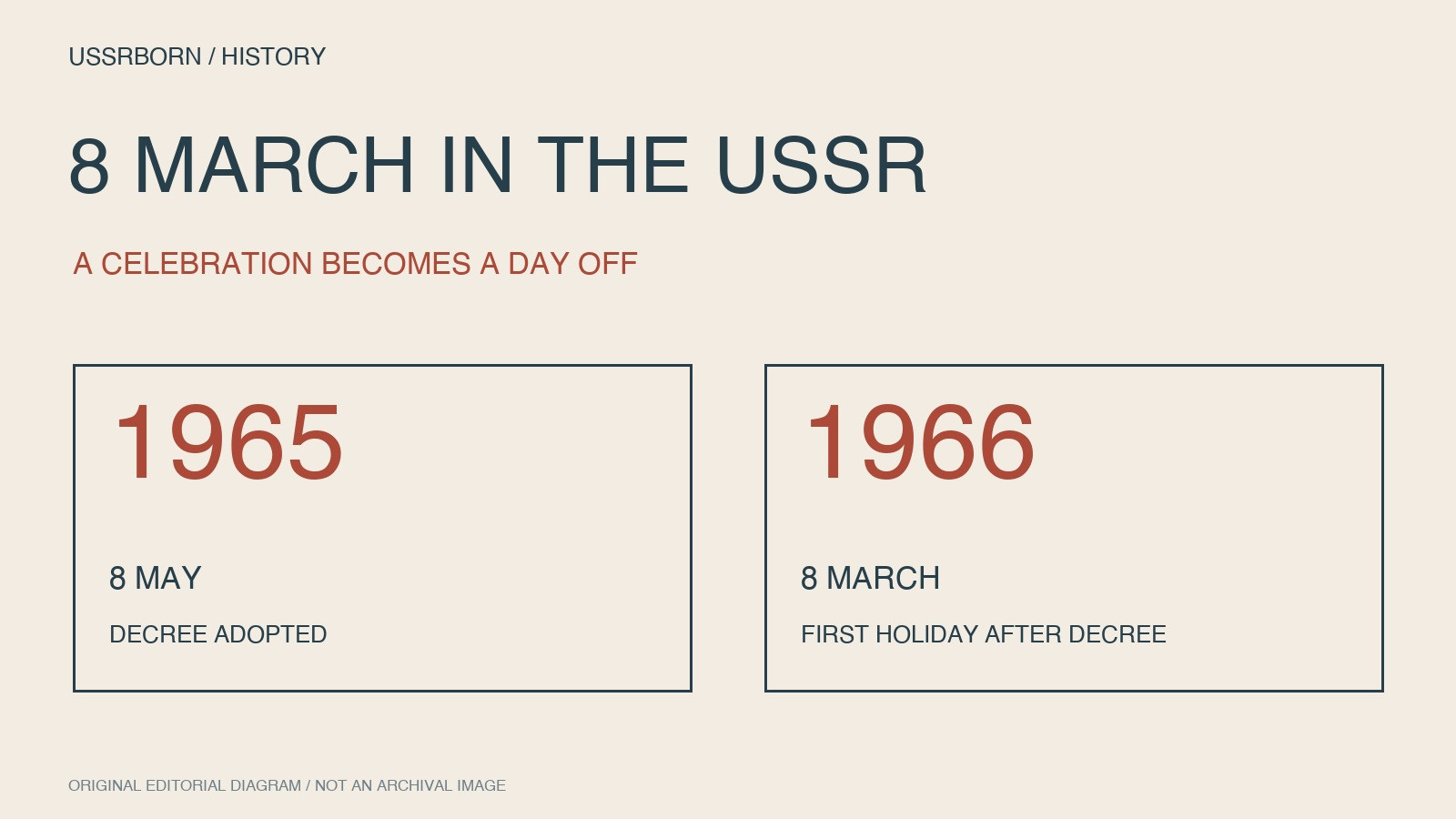
International Women’s Day became a non-working day in the USSR under a decree dated 8 May 1965. The celebration itself was much older. Its history therefore involves three separate developments: the emergence of an international women’s day, the establishment of 8 March as its date and the Soviet decision to make that date a day off work.
What the 1965 decree changed
Decree No. 3589-VI was adopted by the Presidium of the Supreme Soviet of the USSR. It bore the signatures of Presidium chairman Anastas Mikoyan and secretary Mikhail Georgadze. It appeared in the Supreme Soviet’s official bulletin on 13 May 1965, issue 19, article 249.
The document is brief. After stating its reasons, it gives a single instruction: declare International Women’s Day, 8 March, a non-working day in the USSR. It does not create a new celebration, rename the existing one or establish a special day off for women alone. Its subject is the status of a calendar date across the country.
The preamble recognises Soviet women’s contributions to communist construction, the defence of the country during the Second World War, service at the front and in the rear, international friendship and peace. These were the terms in which the Soviet state justified its decision. The text does not prescribe flowers, presents or family meals. Everyday customs and the wording of a decree provide different kinds of evidence about a society.
This distinction also changes how the source should be read. The preamble explains the official rationale; the final instruction makes the calendar change. Neither part is a survey of how every family understood or celebrated the occasion.
Why do accounts mention both 1965 and 1966?
The decree was signed in May, after 8 March 1965 had already passed. The first 8 March to occur under the new arrangement was therefore in 1966. The two years answer different questions: when the decision was made and when the next celebration took place.
There is no need to invent a one-year postponement. The decree contains no such provision. The explanation follows simply from the sequence of dates. Confusion arises when both adoption and the first subsequent observance are described as the holiday’s “introduction”.
Another change to working time was the introduction of the five-day working week in 1967. That concerned the recurring weekly pattern. The 1965 decree concerned one annual date. They should not be combined into a single reform.
Where did 8 March come from?
The United Nations’ historical account locates the day’s origins in labour activism and the movement for women’s political rights in North America and Europe. Its milestones include the American National Woman’s Day in 1909, an international initiative in Copenhagen in 1910 and European celebrations in March 1911.
Women’s protests in Russia in 1917 were particularly significant. A calendar distinction is essential: 23 February in the Julian calendar corresponded to 8 March in the Gregorian calendar. These are two labels for the same date, not two separate demonstrations. The relationship between women’s activism and the events of that year belongs within the broader history of the Russian Revolution of 1917.
The Soviet decree of 1965 thus addressed an existing international celebration. It would be misleading to credit the Soviet leadership of the mid-1960s with inventing it. The movement, the date and the Soviet day off have connected histories, but different starting points.
The Soviet decision and the United Nations
The UN’s WomenWatch archive records that the organisation began observing International Women’s Day on 8 March in 1975, during International Women’s Year. In December 1977, the General Assembly adopted a resolution concerning a day for women’s rights and international peace, with states choosing a date in accordance with their traditions.
Neither development was the source of the Soviet decision: that had already been taken in 1965. International recognition also does not mean every country introduced an identical public holiday. An international organisation’s observance and a national working calendar operate at different levels.
The USSR’s role in founding the United Nations helps explain why both histories feature in accounts of Soviet international celebrations. Sharing a name, however, does not turn separate institutional decisions into the same act.
A day off and the question of equality
A joint article by the UN and its human rights monitoring mission in Ukraine emphasises the day’s connections with employment and voting rights. That offers a useful corrective to descriptions concerned only with springtime or personal congratulations. A greeting can coexist with the historical meaning of the occasion, but cannot replace it.
A non-working day is not, by itself, a measure of women’s position in society. Assessing that would require evidence about education, employment, pay, political participation and unpaid domestic work. The decree answers a narrower question: what did the state change in the calendar? It is a source for everyday life in the USSR, not a complete account of it.
The basic sequence is clear: an international movement preceded the Soviet Union; events in Russia in 1917 connected the history of the celebration with 8 March; the 1965 decree made it a Soviet non-working day; and the first subsequent 8 March occurred in 1966. Keeping those stages distinct resolves the most common chronological confusion.